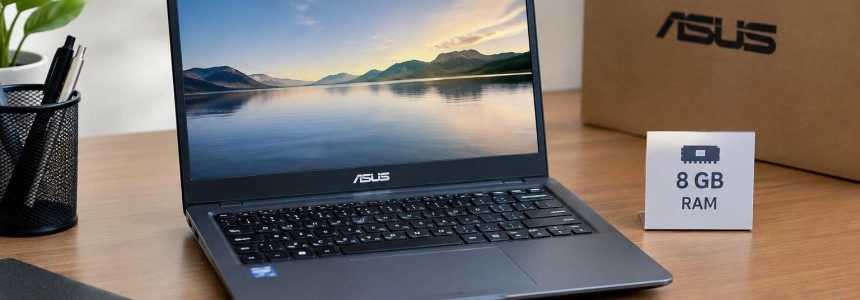
ASUS could reduce the installed memory in its midrange and entry-level computers from 16 to 8 GB of RAM. S.Y. Hsu, the company’s co-CEO, raised the possibility during its third-quarter 2026 investor call: component costs have risen so much that passing the full increase on to final prices threatens to slow purchases.
This proposal is not yet a product list or a launch schedule. It does, however, point to a concrete response to rising prices: cutting a specification that had become the usual threshold for a new PC for years, rather than continuing to make all entry-level models more expensive.
Costs can no longer be fully passed on to buyers
Hsu explained that ASUS had been raising its prices throughout 2026 as it ran through memory inventory purchased before the increases. But according to DDay.it, the company blames those higher prices for delayed purchases and an expected decline in PC demand in the fourth quarter. Some customers are waiting until they have the budget or genuinely need a computer before buying.
The pressure does not affect every segment equally. Hsu noted that buyers of higher-priced systems are more willing to accept increases: DDay.it cites RTX Spark systems as an example, which are also sold in configurations with 128 GB. In the midrange and budget segments, ASUS believes that passing on the entire additional cost would be unacceptable; reducing memory makes it possible to limit manufacturing costs without passing the full increase on to buyers.
ETNEWS provides a reference point for the jump in component prices. According to TrendForce, September contract prices for 16 GB and 8 GB DDR4 modules were $275 and $148, respectively. The arithmetic difference is $127, although ETNEWS cautions that these figures do not necessarily match what PC manufacturers pay their suppliers.
| Data cited by ETNEWS | Value |
|---|---|
| 16 GB DDR4 module, September contract price | $275 |
| 8 GB DDR4 module, September contract price | $148 |
| Difference between the two figures | $127 |
The calculation helps show why cutting capacity is attractive to manufacturers; it does not predict how much less a laptop will cost in a store. The actual savings depend on purchasing terms and the computer’s overall configuration. And if the memory cannot be upgraded, buyers are permanently stuck with the factory-installed capacity.
Windows 11 aims to do more with less
ASUS says it has worked with Microsoft to make 8 GB capable of delivering an acceptable experience on the new operating system. DDay.it details some of the measures associated with the Windows 11 26H2 update: more efficient memory compression, which can keep up to 2 GB more active data in RAM instead of moving it to the storage drive; Widgets that load only when opened, saving approximately 200 MB; and inactive Edge tabs that are suspended after 15 minutes instead of two hours.
The published performance figures do not describe exactly the same test. DDay.it reports on a laboratory test using an HP OmniBook 3 with Snapdragon X Plus, in which multitasking was up to 40% faster. ETNEWS reports improvements of up to 20% in system responsiveness and 40% in multitasking compared with the previous Windows 11 experience on PCs with 8 GB. Digital Trends also mentions an improvement of up to 40% for these computers, without specifying the test. These are results of system optimization, not a guarantee that every application will perform just as well with half the memory.
“We previously equipped budget and midrange products with 16GB of memory, but we may now adjust that to 8GB.”
— S.Y. Hsu, co-CEO of ASUS
Microsoft itself acknowledges, according to DDay.it, that 16 or 32 GB provides more headroom. That qualification matters because operating-system improvements do not eliminate application requirements: 3D modeling, advanced video editing, and processing large volumes of data benefit from at least 16 GB.
The cost shifts elsewhere
If ASUS goes ahead with the cut, buyers will face a trade-off between a lower starting price and less headroom for keeping multiple tasks open or running demanding software. Compression and Windows’ more selective management of components can help with everyday use, but they do not automatically make an 8 GB computer equivalent to a 16 GB one for intensive workloads.
For companies buying computers in bulk, the decision also shifts the issue to configuration and lifecycle planning. A laptop with 8 GB may suit light tasks, but organizations deploying analytics, editing, or modeling tools will need to assess capacity at the time of purchase. The ability to upgrade RAM is especially important: Digital Trends warns that some configurations may be limited if the memory is soldered and cannot be upgraded.
ETNEWS places this adjustment within broader industry pressure. The outlet reports that Lenovo is considering design changes and HP is working to optimize its component configurations; it also notes that manufacturers are considering lower-capacity memory or processors with fewer cores. Reducing specifications would therefore not be an ASUS-only measure, although the company has specifically raised the possibility of moving from 16 to 8 GB in its midrange and entry-level lines.
Demand may weaken before the high-end segment
ASUS’s forecast reflects the scale of the commercial problem. Hsu expects global PC shipments to fall by 10 to 15% over the coming year; Vandal places the steepest decline in the first half of 2027 and expects demand to recover in the second half. During the earnings call, ASUS also described the period from the fourth quarter of 2026 through, possibly, the second quarter of 2027 as a time of severe market difficulties and pressure on its profitability.
Reducing memory can help contain entry-level prices, but it carries a risk for brands: customers may feel they are paying the same—or almost the same—for a product with less capacity. ETNEWS specifically reports concerns that lower specifications could frustrate buyers, while manufacturers try to protect their margins from rising component costs.
For now, ASUS has not announced which computers would move to 8 GB or when. The practical question for buyers and companies planning their next purchases is whether the change will come with a lower price and upgradeable memory, or whether 8 GB will become a fixed configuration.
Sources: Digital Trends, DDay.it, Vandal, ETNEWS :: Korea IT News, Stock Analysis