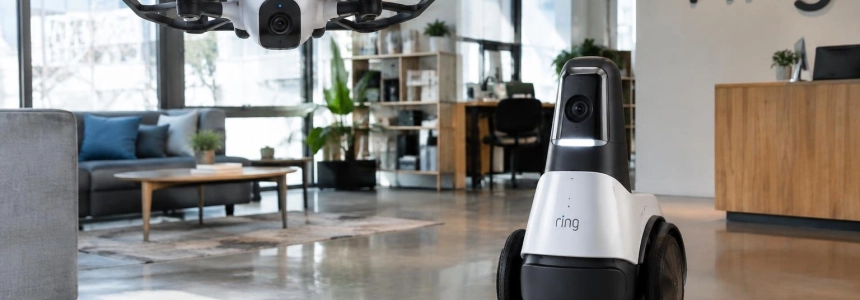
Ring will bring a flying camera into homes and a patrol robot into businesses with the launch of Ring Robotics, its new autonomous security division. The Drone Cam records in 2K and can fly for up to eight minutes per charge; the Rover Cam navigates commercial spaces and streams video at up to 4K.
The ground robot will arrive first: Ring says it will be available in the United States on December 16, 2026. The announced date for the drone is January 27, 2027. The published prices do not quite match: Ring and some media outlets put the Rover at $999.99 and the Drone at $249.99, while TechCrunch gives rounded or different figures. No dates or prices have been announced for Spain.
AI Pilot puts the cameras in motion
Both products use AI Pilot, Ring’s navigation system. It combines cameras and sensors with cloud processing to build a map of the space, suggest monitoring points, and navigate programmed routes. The devices can patrol at set times and respond to alerts from Ring cameras, sensors, or alarms.
Amazon describes AI Pilot as a platform that also recognizes rooms and suggests places worth monitoring, such as windows, doors, and hallways. In a business, the route can include the cash register. According to Hackster.io, processing takes place on Amazon’s remote servers, not directly on the devices.
The Drone Cam is designed for indoor use. It takes off from a charging dock and flies along routes set by the user; it can also go to patrol points when another Ring device detects an incident. The integration includes the brand’s cameras, doorbells, sensors, and alarms. Amazon says it can be controlled from Alexa Home Map.
The camera offers 2K video and a 148° field of view, and the device can rotate 360 degrees. Two LED lights turn on automatically in low-light conditions. Ring presents the system as a way to check a specific area without installing a fixed camera in every room, or to check alerts without going to the location.
A short flight constrained by the space
The drone’s battery life limits it to brief checks. Ring puts the maximum flight time at eight minutes with a new, fully charged battery, measured under controlled conditions; the Los Angeles Times reports a range of five to eight minutes. That outlet adds that each minute of flight requires about eight minutes of charging. The product is therefore intended for brief checks and patrols, not continuous aerial surveillance.
Navigation also does not work the same way in every home. Xataka reports Ring’s warnings about reflective surfaces—such as polished marble or wet floors—smooth, matte walls, frameless glass, and mirrors. RedesZone describes routes that can pass through doorways and even staircases, while Amazon limits the product to indoor flights. Ring also says that if the drone loses power or its connection, it will land in a place it has identified as safe.
The Los Angeles Times reports that the device weighs about 165 grams and that Ring has built in software measures to prevent it from operating outdoors. At a media demonstration, preproduction units flew along predefined routes; journalists could not operate them directly. The publication also notes that the drone is noisy. Jamie Siminoff, Ring’s founder and now an Amazon vice president, said some animals pay no attention to it, although others “don’t love it”.
Rover Cam: patrols for offices and warehouses
The Rover Cam is aimed at businesses, offices, warehouses, and retail stores. It follows programmed routes, can investigate alerts, and streams video at up to 4K as it moves. Its adjustable mast raises the camera to look over counters and shelves; when it reaches a point, it can rotate 360 degrees.
The device includes a siren, a light tower, and two-way audio so someone can speak remotely with anyone near the robot. Amazon says video is streamed and recorded while the Rover is moving or patrolling, and that continuous person detection can trigger an alert and a recording even when it is docked at its base.
According to Xataka, the device can cover up to 465 square meters. The Los Angeles Times gives a different figure: areas of up to 5,000 square feet. That outlet also says it can patrol for up to 30 minutes. Its use is limited to single-story indoor spaces: it cannot climb stairs and, according to Xataka, may have trouble with curved edges, recessed areas, level changes greater than 3.5 centimeters, and glossy black floors.
Ring says the Rover will arrive in the United States on December 16, 2026. Amazon does not list a price in its announcement, but Hackster.io gives a price of $999.99; Xataka and RedesZone say $999, and TechCrunch rounds it to $1,000. RedesZone says it is available for preorder. For the Drone Cam, the listed prices are $249.99 at Hackster.io and Xataka, $249 at RedesZone, and $270 at TechCrunch.
A project following several attempts
The drone revives an idea Ring announced in 2020, with the initial goal of shipping it the following year. According to the Los Angeles Times, the company abandoned that version and also scrapped a second design it was still working on last year. Siminoff explained that adding sensors and processing power required a larger battery; the increased weight called for more powerful rotors and affected flight stability.
“You basically keep fixing things that then break things and make them worse”
— Jamie Siminoff, Ring founder and Amazon vice president
The same publication attributes the change in direction to the intensive use of artificial intelligence and moving much of the computing to the cloud. A drone without a connection can take off and land, but it needs AI and an active Wi-Fi connection for functions such as setting routes and responding to alerts from other Ring devices.
The Rover also has a predecessor within Amazon: Astro, the company’s wheeled robot. The Los Angeles Times notes that many of its components remain the same and that the Rover adds, among other changes, a light tower that projects a ring onto the ceiling to make it easier to locate. TechCrunch recalls that Astro went from being presented as a home assistant to being aimed at small-business security, before Amazon discontinued it after it failed to gain commercial traction.
Privacy, encryption, and mobile surveillance
Ring says both products include privacy measures. The drone turns off its camera when docked; the Rover can enter sleep mode, retract its mast, and disable its microphone. Both display indicators when recording, and the Rover also shows an on-screen notice. Videos are protected with TAKE, short for Throw Away the Key Encryption, which Ring describes as its strongest default encryption to date.
TechCrunch notes that it is unclear whether local storage will be available and points out that Ring cameras typically store video in the cloud. Xataka adds that the Electronic Frontier Foundation considers TAKE an improvement over the previous configuration, but not equivalent to end-to-end encryption. Dependence on Amazon’s infrastructure therefore remains at the center of concerns about control over recordings.
The concerns come against a backdrop of past controversies. Xataka recalls that in 2023 the U.S. Federal Trade Commission accused Ring of allowing employees and contractors to access recordings of customers’ private spaces and cited security issues involving about 55,000 accounts in the United States. TechCrunch also points to criticism of Ring cameras being used in surveillance networks that law enforcement agencies can access.
The new devices do not appear to include facial recognition, according to Xataka. The publication notes, however, that Ring offers the “Familiar Faces” feature for some video doorbells and that it is the subject of a class-action lawsuit. The Drone Cam and Rover Cam will now open a new trial for the brand: automating surveillance with mobile devices connected to its ecosystem. Ring will launch them first in the United States, with the Rover arriving on December 16 and the drone on January 27, 2027.
Sources: Xataka, Hackster.io, RedesZone, Amazon News, TechCrunch, Los Angeles Times