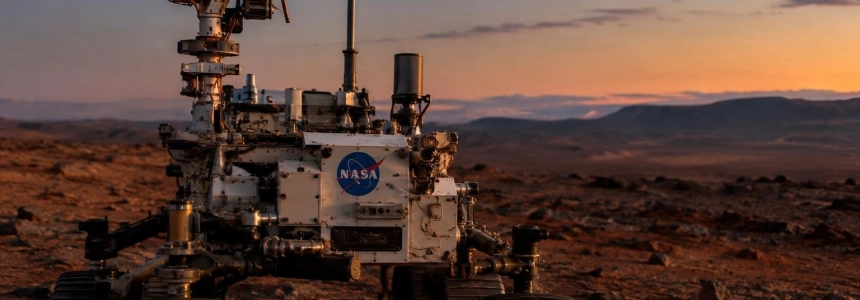
Perseverance has stopped conducting science while NASA investigates failures in both of its UHF radios: the primary radio did not respond during startup on October 30, and the backup is transmitting at approximately half its expected power. The rover is stable and remains in contact with Earth, but the available connection is too slow to sustain the usual flow of images and scientific data.
NASA has disabled both UHF radios while engineers investigate the causes. The rover communicates directly with Earth through its high-gain antenna and the Deep Space Network (DSN), but the lower speed of that connection has forced the team to reserve bandwidth for diagnostics. The agency expects Perseverance to be able to resume scientific activity before the end of November.
Twenty-five missed signals triggered safe mode
The incident began on October 30, when Perseverance powered up its systems for the day's tasks. The primary downlink radio did not send its periodic signals—the so-called electronic “heartbeats”—on time. The rover's central computer uses these signals to check that the radio is working. When it detected their absence, the rover's protection system shut down the radio, activated the redundant unit, and put the vehicle into safe mode.
In this case, there were 25 consecutive unanswered heartbeats, equivalent to about 100 seconds of silence. Steven Lee, Perseverance project manager at NASA's Jet Propulsion Laboratory (JPL), explained how the mechanism works: “The rover's main computer is continuously listening for that ping.” If it stops receiving it for a certain number of signals, Lee said, the computer switches to the redundant radio.
“In this case, there were 25 missed heartbeats, or about 100 seconds of silence.”
— Steven Lee, Perseverance project manager
After taking the rover out of safe mode, the team examined the diagnostic data and found a second problem: the backup radio was transmitting at about half its expected power. As a precaution, engineers stopped using both radios until they can determine what happened and whether one or both can safely return to operation.
The automatic response to the primary failure worked as intended, but it did not solve the communications problem: the unit meant to replace it was not operating normally either. NASA said the team will first investigate the backup radio's performance and options for returning it to service; afterward, it will focus on recovering the primary radio.
The connection to Earth is not enough to maintain the usual pace
UHF radios allow Perseverance to communicate with orbiters around Mars, which relay data to Earth. According to figures reported by Microsiervos, this link can reach up to 2 megabits per second. Without either UHF radio, the rover depends on X-band and a direct connection to the DSN, NASA's network of deep-space antennas.
With the network's 34-meter-diameter antennas, X-band transmission offers between 160 and 500 bits per second. With the 70-meter antennas, the range is 800 to 3,000 bits per second. These speeds are far lower than those of the UHF link through orbiters; that is why NASA has prioritized sending diagnostic information and halted science operations to preserve the available bandwidth.
| Link | Reported speed | Use in the current situation |
|---|---|---|
| UHF via orbiters | Up to 2 megabits per second | Both radios are disabled during the investigation. |
| X-band with 34-meter DSN antennas | Between 160 and 500 bits per second | Direct communication with Earth. |
| X-band with 70-meter DSN antennas | Between 800 and 3,000 bits per second | Direct communication with Earth. |
The pause also affects new images from the cameras: Perseverance is not taking photographs during this period. The lack of recent images on the mission website caught the attention of people following the rover's activity; NASA explained that the interruption is related to the suspension of science operations and the need to reserve the connection for diagnostics.
The rover, however, has not lost all contact. NASA says it remains stable and communicates with the team from Mars via X-band. The difference is that the link now allows direct communication to be maintained, but cannot carry the large volumes of data associated with scientific operations and images at the usual pace.
The team is prioritizing the backup radio
NASA JPL has assigned a team to investigate why the secondary unit is transmitting at lower power and what options are available to restore it. Once that issue has been addressed, engineers will turn to the primary radio, which stopped sending its activity signals on October 30. The recovery of one or both radios will determine when science operations can resume.
The agency expects Perseverance to be able to return to science before the end of November. It has not announced a definitive cause for the failures or confirmed which of the two radios can be restored. While testing continues, the rover is still using its high-gain antenna and X-band to communicate with Earth.
Odyssey faces a different problem
The Perseverance investigation coincides with another malfunction on Mars: the 2001 Mars Odyssey orbiter has also suspended its science operations, in its case because of a problem with a reaction wheel. NASA considers the two incidents separate technical issues, although both affect the scientific activity of its Mars missions.
Odyssey entered safe mode between November 4 and 6, after one of its reaction wheels stopped spinning. The spacecraft has four; another failed in 2013, and at least three are needed to help orient the spacecraft. During a test, the affected wheel moved when commanded to do so, but the team is still checking whether it can be recovered.
If Odyssey had to rely solely on its hydrazine thrusters, current estimates suggest it would have enough fuel for one or two months of attitude control. The spacecraft is no longer in safe mode, but its science instruments and relay operations remain out of service while NASA JPL and Lockheed Martin analyze the data and conduct tests. The goal is to complete this work and, if possible, restore science operations and relay service during the last week of November.
Odyssey arrived in orbit around Mars in October 2001, after launching in April of that year, for a mission designed to last a little over two and a half years. During its 25 years at the planet, it has produced global maps of the surface's composition and served as a communications relay for surface missions, including Phoenix, Spirit, Opportunity, and Curiosity. For now, both investigations remain ongoing: Perseverance is waiting to restore its UHF communications, while Odyssey is checking whether its wheel can work again.
Sources: Microsiervos, theregister, NASA Science, USNOW