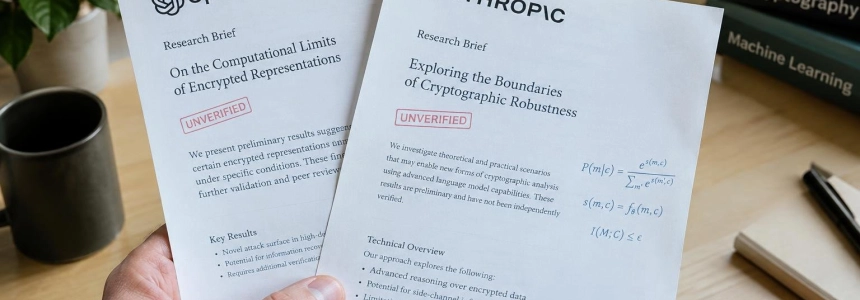
Scott Aaronson says he has reason to believe that OpenAI and Anthropic are holding significant cryptography results, but he has not confirmed what they have achieved. The mathematician and computer scientist says the details may have become distorted as they passed from person to person; there is no public demonstration that the labs have broken RSA, Bitcoin signatures, or post-quantum cryptography.
Caution matters because the rumor has surfaced alongside a series of mathematical results that Aaronson considers extraordinary. In a post published on Shtetl-Optimized on November 25, he described proofs and advances attributed to OpenAI and Anthropic on problems in complexity theory, as well as new results on matrix multiplication and Fourier transforms. His interpretation is that AI is advancing toward problems that seemed out of reach for decades.
In that context, Aaronson wrote that he was “virtually certain” that the labs had one or more important results in cryptography, based on several sources he described as reliable. But he added a crucial caveat: without details or direct confirmation from someone at those labs, he was much less confident about the specific nature of the findings.
“I feel much, much less confident about the specific nature of those bombshells.”
— Scott Aaronson, theoretical computer scientist
A rumor with several versions
Hacked.com reports that one version involves “factoring in P”: an algorithm that would factor integers in polynomial time. Factoring is relevant to certain uses of RSA, but that label alone is not enough to conclude that a deployed system could be attacked in practice. The algorithm’s actual speed, key sizes, and required resources also matter.
Aaronson says he has repeatedly heard the rumor, but does not know how much credence to give it. He also declines to confirm another rumor, according to which ECDSA is broken. This distinction separates the existence of claims about a possible result from a published mathematical proof or a demonstrated attack against a real service.
Charles Guillemet, Ledger’s chief technology officer, commented on X about rumors involving factoring, elliptic-curve cryptography, and the quantum resistance of Ring-LWE. According to Hacked.com, he was skeptical that a complete break had occurred. The outlet could not independently verify the underlying claims or establish whether Guillemet’s and Aaronson’s sources were independent.
For now, it is best not to treat “cryptography” as a single target. The three families mentioned in the versions of the rumor protect different functions; an improvement in one mathematical problem does not automatically mean the others have also fallen.
| Area | What is claimed or used | What the rumor does not prove |
|---|---|---|
| RSA | Some uses depend on the difficulty of factoring large integers. | A polynomial-time algorithm does not, by itself, prove that deployed keys are vulnerable in practice. |
| Bitcoin signatures | Bitcoin uses secp256k1; it supports ECDSA and Schnorr signatures with Taproot. | A result about factoring does not demonstrate an attack against those signatures. |
| Ring-LWE | A problem related to some lattice-based cryptography proposals. | The rumor about quantum resistance is not public proof of a classical break. |
Bitcoin is not RSA, and a public key is not a private key
Bitcoin uses the secp256k1 curve for signatures that authorize spending. Hacked.com notes that the network supports ECDSA and, with Taproot, Schnorr. If an effective attack against the curve or signature construction were to emerge, funds associated with affected keys could be exposed; the scope would depend on the method and the information available to the attacker. No such attack related to the current rumors has been publicly demonstrated.
Exposure also depends on the type of Bitcoin output. Hacked.com explains that Taproot outputs include a public key, while some other types initially hide it behind a hash and reveal it when spent. Address reuse and a pending transaction can affect what is exposed. None of this means that a method currently exists for deriving private keys from public ones.
The same distinction applies to other parts of the system: Bitcoin uses hash functions such as SHA-256, among other things for mining. A weakness attributed to RSA or an elliptic-curve signature would not demonstrate that SHA-256 is compromised. The name of one cryptographic family does not justify extrapolating a break to all the others.
That is why a viral alert recommending that people move their coins is not the same as validated technical guidance. Hacked.com advises against transferring funds or revealing recovery information in response to a warning on social media. Recovery phrases and private keys must remain secret, even from someone who claims to be offering an urgent migration.
Published results are not the same as an attack
There is concrete research that helps explain why the subject deserves attention, but it does not confirm the rumor about OpenAI or Anthropic. Hacked.com describes work by Google DeepMind, published as a working paper on November 5, on factoring batches of integers of similar size. Its authors explicitly say that the result does not currently threaten deployed RSA systems with keys of 2,048 bits or more.
On November 25, a series of papers attributed to Cogentic, an AI research system, also appeared in a Google Research repository. One claims a mathematical bound for factoring whose growth is subexponential, not polynomial; the description says a formal proof will be published later. Hacked.com stresses that this is not public proof of a practical attack against RSA keys in use and that the mathematics requires independent examination.
The difference between a theoretical improvement and an operational threat is central for companies and security professionals. Assessing a real risk would require a precise claim, an examinable method or proof, and a defensible estimate of its cost and the systems affected. An important mathematical result does not automatically amount to a viable intrusion.
What companies can do without panicking
The reasonable response is not to disable algorithms or disrupt services because of rumors. Hacked.com suggests that organizations identify which critical systems depend on RSA, elliptic curves, or post-quantum cryptography, which vendors control their updates, and how certificates and keys could be replaced if a reliable recommendation emerged.
That inventory has a practical benefit: it makes it possible to know which teams, vendors, and processes would need to be coordinated in response to a verified change. It does not determine in advance which algorithm to replace or when to do so; that would depend on the nature of the finding and the technical recommendations available. Useful preparation starts with understanding dependencies, not migrating blindly.
The Ethereum Foundation announced on November 23 that it is prioritizing a transition aimed at addressing potential risks from quantum computing and AI. According to Hacked.com, the proposal considers hash-based signatures to replace elliptic-curve signatures in parts of the ecosystem. The foundation acknowledges that the change would affect wallets, validators, and other infrastructure, and that the signatures would be larger; the work is at the initial specifications and development networks stage, not a completed upgrade.
That plan concerns Ethereum, a network distinct from Bitcoin, and does not prove that Bitcoin has been compromised or provide an upgrade for its wallets. It does show the cost of organizing a transition: replacements must be agreed upon, and software and infrastructure must be modified before a theoretical threat becomes an operational emergency.
The unanswered question is what result exists
Aaronson argues that recent AI advances in mathematics justify taking seriously the possibility of new cryptographic results. At the same time, he warns that he does not want to amplify rumors about the exact nature of those results. That combination—high expectations and incomplete public evidence—is precisely what prevents the discussion from becoming a compromise alert.
For developers and companies, the immediate task is not to guess which algorithm might fall. It is to distinguish between a reviewable proof, a technical announcement, and a chain of rumors; follow communications from their vendors; and keep track of where their keys and dependencies are. The missing piece is verifiable proof: without it, we do not know which system would be affected, at what cost, or what response would be appropriate.
Sources: Shtetl-Optimized, Hacked.com