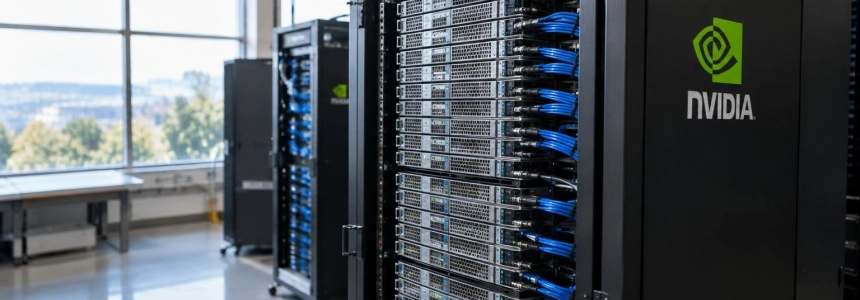
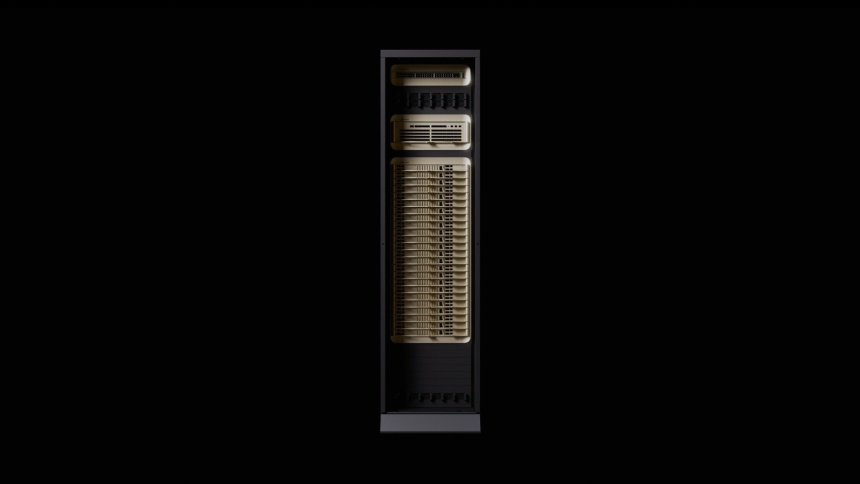
Nvidia introduced Vera, a high-performance computing platform that brings together 192 custom CPUs in a liquid-cooled rack, with more than 200 TB/s of maximum aggregate memory bandwidth. The company targets it at climate simulations, molecular dynamics, and other scientific workloads that do not use accelerators.
The platform combines Nvidia's first fully custom data center CPU with its Quantum-X800 InfiniBand network. According to the company, the goal is to keep large datasets moving and reduce the time processors spend coordinating during complex simulations.
“Scientific simulations need CPUs that can keep large datasets moving and sustain performance as applications scale.”
— Ian Buck, vice president of hyperscale and high-performance computing at Nvidia
192 processors and more than 200 TB/s
Each Vera features 88 Nvidia Olympus cores, 176 threads, and compact, replaceable SOCAMM2 LPDDR5X memory with bandwidth of up to 1.2 TB/s. Nvidia presents it as a CPU designed for data-intensive scientific applications.
The complete rack contains approximately 300 TB of memory and 1 PB of storage, in addition to the 192 processors. It is built on the Nvidia MGX design and is liquid-cooled; each 1U tray integrates eight CPUs, NVMe storage, and management components. The figure of more than 200 TB/s refers to the system's maximum aggregate memory bandwidth.
The architecture makes use of elements from NVL72 racks, including the chassis, power distribution, and cooling infrastructure. Nvidia says reusing these components can simplify deployment and maintenance. Quantum-X800 InfiniBand handles the connection between nodes, while Nvidia SHARP In-Network Computing reduces, according to the company, the coordination work processors must perform.
A different configuration from other Vera racks
The system described is designed for simulations involving close communication between processors. StorageReview distinguishes this rack from other 256-CPU Vera systems announced by Dell and Supermicro for agent environments: the 192-CPU HPC configuration adds InfiniBand and SHARP for tightly coupled simulation workloads.
The distinction matters because Nvidia is not presenting a single Vera configuration for every task. In this case, the emphasis is on combining memory, storage, high-speed networking, and CPUs for scientific work, rather than describing a general-purpose agent system.
Announced results compared with x86
In the OpenFOAM motorBike Large airflow simulation, Nvidia says Vera achieved 1.9 times the performance and 2.4 times the performance per watt of x86 systems. These are results from the company's own tests; StorageReview notes that Nvidia did not identify the x86 processors used for the comparison.
The second benchmark is the open-source Weather Research and Forecasting (WRF) weather model. Nvidia reports a projected improvement of 1.6 times in performance and 2 times in energy efficiency compared with x86. The company presents both cases as indications of Vera's potential for scientific simulation, but the figures come from Nvidia tests or projections, not from an independent comparison described in these sources.
StorageReview also reports results from its own review of a two-socket Vera system: on a large OpenFOAM mesh, it finished 1.44 times faster than a 384-core EPYC 9965 system and 1.20 times faster than a 240-core Xeon 6978P. Those measurements apply to a different configuration and should not be confused with the figures for the 192-CPU rack presented by Nvidia.
DKRZ adds Vera to HLRE-5
The German Climate Computing Center, known as DKRZ, has selected Vera CPUs for its HLRE-5 supercomputer. The system will also include Nvidia GB200 Grace Blackwell systems and Quantum-2 InfiniBand networking. Bull will build it, and it is expected to be available in early 2028.
DKRZ will use HLRE-5 for climate and artificial intelligence research. Nvidia says it will enable global climate simulations at kilometer scale with lower energy consumption than the current system. The availability date and the benefits described are forecasts, not results already measured on that supercomputer.
DKRZ's selection of Vera provides a concrete destination for the platform beyond performance tests. It also puts the timeline in context: partner racks are expected starting in early 2027, while Bull's system for the German center is scheduled for early 2028.
Compilers and commercial availability
Nvidia HPC SDK 26.11 is now available with compilers and libraries optimized for Vera. The company also announced a public beta of its next-generation Fortran compiler, developed in collaboration with high-performance computing centers and national laboratories.
The compiler is intended to run existing Fortran programs faster on Nvidia platforms without rewriting the code. Nvidia presents Fortran as a core language for scientific computing, and the software aims to make it easier for researchers to adapt their applications to Vera. The public beta is the announced status of the compiler; the sources provide no additional dates or access conditions.
Vera racks are expected from Dell Technologies, HPE, Lenovo, and Supermicro starting in early 2027. Nvidia also cautions in its announcement that the capabilities, software, and availability described may change, and that several features will be offered when available.
For now, the next milestone indicated is the arrival of racks from the four partners in early 2027; HLRE-5, the featured scientific deployment, is targeted for early 2028.
Sources: electronicsweekly.com, NVIDIA Newsroom, Engineering.com, StorageReview.com