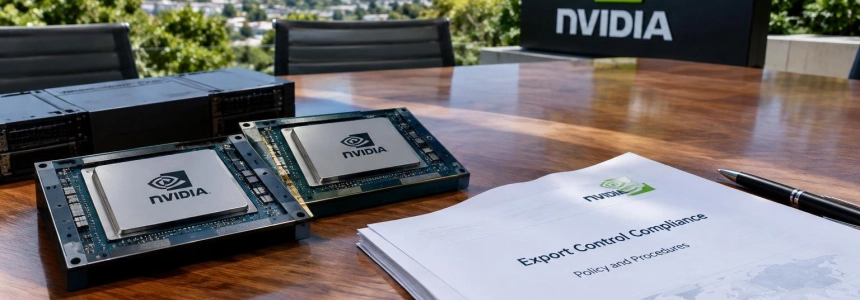
Nvidia created a standing board committee to oversee its national security policies and compliance with export controls, amid a U.S. investigation into Singaporean company Megaspeed. The change places oversight of these matters at board level, while Colette Kress serves as interim chief executive following Jensen Huang's departure.
The new body, called the National Security and Export Control Oversight Committee, will be chaired by director Suzanne Nora Johnson. Stephen C. Neal and John O. Dabiri will also serve on it; meetings will be held at least quarterly and may include executive sessions.
The existing National Security and Global Trade Compliance teams will report directly to the committee and Kress on their day-to-day operations. The committee will oversee plans to strengthen both teams and work with independent external experts in law, national security, and trade compliance.
“We are committed to working constructively with government and industry partners to help establish and advance a robust framework that uses every tool at our disposal to safeguard national security while supporting continued technological innovation”
— Harvey Jones, chairman of Nvidia's board
The investigation into Megaspeed
The U.S. Department of Commerce opened an investigation into Megaspeed in 2024 over possible export control violations. According to a joint statement from the Department of Commerce and the Department of Justice, the investigation began after its monitoring systems detected suspicious activity related to the possible diversion of sensitive semiconductors.
In May 2025, Commerce investigators asked Nvidia for documentation on direct or indirect sales to Megaspeed. A month later, Nvidia added the company to its “no sell” list, meaning customers it would not sell to, according to the same official statement.
Also in June 2025, agents from the Bureau of Industry and Security (BIS), the U.S. Commerce agency that enforces export controls, conducted an in-person inspection at Megaspeed alongside Singaporean law enforcement authorities. During the visit, they interviewed Alice Huang, then the company's chief executive. Following that action, the Justice Department took the lead in the criminal investigation.
The two departments said they would apply the full force of the law if criminal conduct is discovered. The statement does not reach a conclusion about Megaspeed's guilt: it refers to possible violations and any crimes the investigation may establish.
The allegations and Jensen Huang's departure
Attention on Megaspeed has become intertwined with Jensen Huang's departure from Nvidia and allegations about his ties to Alice Huang. The Register linked the co-founder's and then-CEO's resignation to his admission of infidelity and reports of a possible relationship with a Nvidia employee. ABC News clarified that Huang did not acknowledge an affair with Alice Huang—who is not related to him—but said he had been unfaithful to his wife.
The suspicion that Alice Huang worked for Chinese intelligence has also not been proven. ABC News reported that Chinese Foreign Ministry spokesperson Guo Jiakun rejected the claim, calling it “completely unfounded and pure slander.” Megaspeed, for its part, told ABC that Alice Huang ceased to be its CEO on August 30, 2025, no longer holds any position at the company, and that it is conducting an internal investigation led by outside lawyers.
The corporate context has also changed: Kress, Nvidia's chief financial officer, took over as interim CEO after Huang's departure. ABC News reported that board chairman Harvey C. Jones said during the earnings call that the board does not intend to reinstate Huang. That same Tuesday, Huang said he would be willing to return if the board believed it was in the best interests of the company, its shareholders, its employees, and the United States.
Huang acknowledged in a statement that he had made personal mistakes and had fallen short of the standards expected at Nvidia. According to ABC News, he shared it on social media, and a representative also sent it to the outlet. The board's position and Huang's stated willingness leave a gap between what he would be prepared to do and what the company intends.
Congress seeks answers
Huang is scheduled to take part in a closed-door transcribed interview on December 1 before the House Foreign Affairs Committee, the House Select Committee on the Chinese Communist Party, and the House Intelligence Committee. Nvidia general counsel Tim Teter is scheduled for a similar interview before the same three committees on December 2, according to ABC News.
The committee chairs said they want to learn about Huang's and Nvidia's roles in possible access by actors from the People's Republic of China to the company's most advanced chips, as well as the possible role of an alleged Chinese intelligence agent in the case. These are questions raised by lawmakers, not established conclusions about what happened.
Political oversight adds to the board's internal review. TechCrunch reported that the change comes amid increased scrutiny by U.S. lawmakers of both Huang's alleged ties and his advocacy for easing restrictions on exports of advanced AI chips to China.
Controls on remote access
The case comes as Washington is also examining how other countries access AI infrastructure. TechCrunch reported that Commerce planned to introduce new export controls for AI chips and data centers outside the United States, with the aim of preventing companies in China and elsewhere from bypassing existing rules through remote access to infrastructure located in third countries.
The Register also noted that BIS had issued new rules to tighten restrictions on exports of AI technology and on cloud service operators that allow remote access to it. The outlet linked the tightening to concerns about the use of remote infrastructure to circumvent controls, although the sources do not specify the final scope of the measures here.
Meanwhile, the United States expanded the Pax Silica initiative, according to The Register. Allied countries signed an agreement that frames protecting AI supply chains as a shared responsibility.
Nvidia said it recognizes the national security challenges associated with advanced semiconductors and AI technologies, and that it has a responsibility to address them. The company described the committee as part of the board's commitment to strengthen its relationship with relevant authorities and raise its oversight standards.
The Justice Department added that, under the Trump Administration, 17 defendants had been charged in six separate investigations into the alleged smuggling of semiconductors valued at billions of dollars. It also said monetary penalties imposed by Commerce in export control cases had reached new highs and were 18 times higher than under the Biden Administration. These figures were included by the department in its statement about Megaspeed; they are not findings from that specific investigation.
For now, the confirmed milestones are the committee's quarterly oversight, monitoring of the federal investigation, and Huang's and Teter's interviews in December. U.S. authorities said they would pursue any criminal conduct uncovered; the investigation into Megaspeed remains open.
Sources: theregister, TechCrunch, Wccftech, NVIDIA Newsroom, U.S. Department of Justice, ABC News