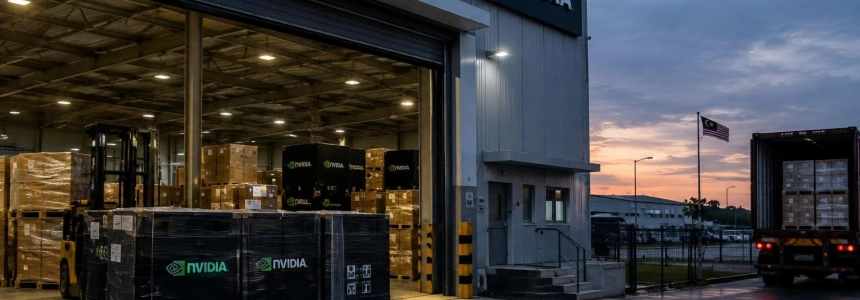
Megaspeed reportedly handled nearly $12 billion in Nvidia chip orders for Chinese companies between March 2024 and June 2025, according to records reviewed by The Wall Street Journal. The company is owned by Alice Huang, the former partner of Jensen Huang, Nvidia’s now-ousted chief executive. The orders would total several hundred thousand chips subject to U.S. export controls.
The figure refers to orders handled, not confirmed deliveries. The Wall Street Journal notes that the documents do not indicate what portion of the hardware actually reached its intended recipients or where it originated. The Decoder also reports on the deal and attributes the review of the records to the U.S. newspaper.
A route to accessing restricted chips
According to people familiar with the matter cited by the Journal, Megaspeed gained preferential access to scarce artificial intelligence chips as an Nvidia cloud partner. The company reportedly had Alibaba as a major customer: the partner program prioritized firms able to show they had a large customer waiting to use computing capacity.
The records indicate that the orders were for Chinese buyers with long-standing business relationships with major local technology companies. The Journal does not claim that all the chips ended up in China: it specifies that the documents do not make it possible to determine how many were delivered or where the hardware originated. This distinction separates the volume of orders attributed to Megaspeed from a verified figure for smuggling or deliveries.
Nvidia says it works to prevent smuggling. Megaspeed, for its part, said it takes regulatory compliance seriously and is committed to following U.S. law. It also said it had hired a U.S. law firm to oversee an inventory of its graphics processing units.
The case comes amid a broader ecosystem of Chinese access to advanced chips. The Journal describes two routes: physically bringing the processors into China or renting computing capacity at data centers located in other countries. The second option allows Chinese companies to use chips installed outside their borders, although controls proposed by Washington could limit that remote access.
China business and Nvidia’s figures
Nvidia reported $12.4 billion in revenue from China during the six months through July 26, 2026, equivalent to 7% of its global revenue for that period, according to the Journal. Culper Research, a short-selling research firm, estimates that more than 20% of Nvidia’s revenue in the last fiscal year came from Chinese customers. The second figure is Culper’s estimate, not the official revenue figure for China.
| Figure | Period or reference | Source |
|---|---|---|
| Nearly $12 billion in chip orders | March 2024 to June 2025 | Records reviewed by The Wall Street Journal |
| $12.4 billion in revenue from China; 7% of total | Six months through July 26, 2026 | Nvidia, according to The Wall Street Journal |
| More than 20% of revenue attributable to China | Last fiscal year | Culper Research estimate |
Jensen Huang defended chip sales to Chinese customers even as U.S. companies competed with rivals from that country, according to the Journal. His argument was that keeping customers within the U.S. technology ecosystem would protect high-value jobs in the United States, rather than making room for Chinese manufacturers such as Huawei Technologies. Nvidia also argued that giving market share to foreign competitors would harm other U.S. companies working in artificial intelligence.
“Chinese demand is responsible for the enormous scale of data centers.”
— James Chai, researcher at the Iseas-Yusof Ishak Institute, according to The Wall Street Journal
The Journal traces the origins of this shift to two events in late 2022: the United States began blocking exports to China of advanced chips such as Nvidia’s, and OpenAI launched ChatGPT. The release of that system accelerated Chinese companies’ race to develop their own models and increased their demand for computing capacity.
In December 2023, Gina Raimondo, then U.S. secretary of commerce, summed up her government’s policy in blunt terms: Washington would not allow China to obtain the most advanced chips. Chinese companies, according to the Journal, subsequently sought to circumvent the restrictions through physical shipments and remote access to data centers abroad.
Data centers outside China
The Journal describes the expansion of facilities in Southeast Asia as part of that demand. In May 2025, Donald Trump’s administration revoked a Biden administration plan that limited how many chips countries in Southeast Asia and other regions could import. The administration said it would establish alternative restrictions, but the newspaper reported that they had not yet been implemented when its report was published.
Malaysia has attracted more than $34 billion in data center investments, mostly from U.S. and Chinese companies, according to a recent report cited by the Journal. James Chai attributes the country’s appeal to its relative proximity to China, its relations with Beijing, and the conditions it offers for building and operating these facilities.
Among the projects mentioned is Aolani Cloud, a Singapore-based cloud computing provider and Nvidia partner. The company presented investors with an opportunity to connect Chinese customers with advanced chips they could not buy directly. Its investors helped finance about $2.5 billion in hardware in Malaysia in early 2026. Its main customer is ByteDance, TikTok’s parent company, which aims to bring its AI models on par with those of OpenAI and Anthropic within several years.
Aolani said it has systems in place to comply strictly with U.S. regulations and has sought a global customer base from the outset. The Journal also cites DayOne, a Singapore-based company spun off from a Chinese data center operator, which is building facilities capable of hosting Nvidia chips in Malaysia and Indonesia. A recent DayOne document attributes nearly 70% of its business to a single customer; people familiar with the company told the newspaper that the customer is ByteDance.
In Senawang, near Kuala Lumpur, Vena Group is building another data center. The company, backed by BlackRock, plans to construct the facilities and lease space to technology companies that will install their own hardware. People familiar with the project told the Journal that Alibaba is one of the companies planning to use servers equipped with Nvidia chips there.
Investigation in Malaysia and possible limits
The Megaspeed case has already prompted an official response in Malaysia. The country said it would not allow itself to be used to circumvent export controls and was investigating both the company and its Malaysian subsidiary over the possible re-export of AI chips to other countries. The Journal does not report any conclusion from that investigation.
In the United States, the Department of Commerce is working on rules that would add Malaysia, Indonesia, and Singapore to a group of countries subject to export restrictions. The proposals would require licenses to export powerful chips, including Nvidia’s Blackwell series, to those destinations; the licenses would prevent Chinese customers from remotely accessing computing capacity.
The Journal also reported that Nvidia began limiting the share of Chinese customers at some of its cloud partners outside China. The threshold reportedly ranged from 30% to 49%, but was not included in contracts. The company also reportedly asked some partners to remove Chinese citizens from management positions and exclude Chinese investors.
Political pressure on mechanisms for accessing chips intensified after Jensen Huang’s departure, according to the Journal. Commerce Secretary Howard Lutnick faced criticism for his closeness to the executive and for advocating a less restrictive approach to exports. The White House said Donald Trump had full confidence in Lutnick; a Commerce Department official maintained that there was no special relationship between the two beyond the secretary’s interest in maintaining a good relationship with one of the leading U.S. companies.
Ryan Fedasiuk, of the Foundation for American Innovation, told the Journal that he considers tighter regulation of sales to data centers that rent capacity to Chinese companies inevitable. As Washington considers new rules and Malaysia investigates Megaspeed, the available records still do not clarify how many of the chips included in those orders actually reached China.
Sources: The Decoder, The Wall Street Journal (republished by To Vima), NVIDIA