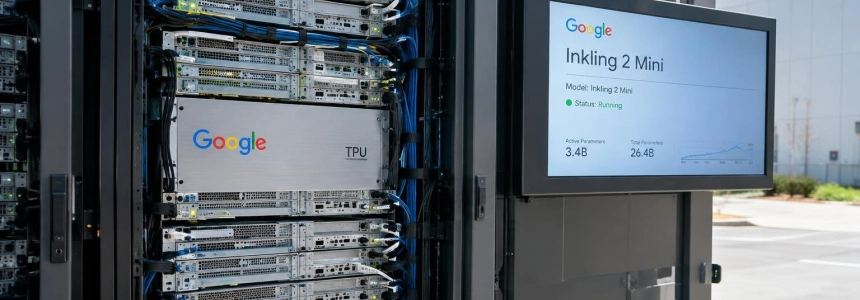
Inkling 2 Mini has 26.4 billion total parameters and 3.4 billion active parameters, but runs its central layers three times per token. The open-weight model, released by Thinking Machines Lab, aims to bring the performance of larger systems to local machines.
The name may be misleading, but identifying the model matters when assessing the release: the provider is Thinking Machines Lab. The model card says it appeared on November 20, 2026, under the Apache 2.0 license, and that its weights are available for research, fine-tuning, and integration into third-party products. The technical proposal is not just about reducing size; it changes how computation is distributed during generation.
More internal work with the same layers
Inkling 2 Mini is a 24-layer multimodal transformer with a Mixture-of-Experts architecture. The first six and last six layers run once; the 12 central layers are run three times, reusing the same weights. Thus, each token passes through 48 layer applications, even though the model stores only 24 distinct layers.
The passes are not independent copies. According to Thinking Machines Lab's technical description, each one starts from the output of the first block and receives learned messages from the previous pass. This mechanism allows the central layers to refine their computation without writing each step out as reasoning text. The company says this repetition particularly improves tasks that require chaining steps, such as agentic programming.
The model activates eight experts out of 128 per layer. The active parameter count depends on how the additional cost of repetition is counted: Thinking Machines Lab reports 3.4B active parameters and 5.4B with loop activations, while Hugging Face summarizes the model as having about 3B active parameters and the vLLM model card puts the figure at 3.5B. Total parameter counts are also rounded on those pages.
The practical distinction is that “few active parameters” does not mean “little computation per token.” In vLLM's published serving tests, each additional pass increases decoding time and reduces available cache capacity. In its test with a GB200 and a 4K context, the batch-1 decoding step rose from 1.51 milliseconds with one pass to 3.85 milliseconds with three.
What the results show—and what they don't
Thinking Machines Lab places Inkling 2 Mini ahead of comparable open models on several programming benchmarks. On DeepSWE v1.1, it scored 48.2%, compared with 42.2% for Qwen3.8-27B; on SWE-bench Pro v2 Hard, the company's table records 77.9% versus 73.8%. These are results reported by the provider itself and depend on the methods and tools used in each evaluation.
The comparison is not a clean sweep. Qwen3.8-27B outperforms Inkling 2 Mini on Terminal Bench v2.1 and AutomationBench-AA; it also scores higher on AA-Omniscience, a factual knowledge evaluation. The loop favors reasoning; it does not add facts to the weights: Thinking Machines Lab says factual recall remains close to that of other models of similar size.
| Evaluation | Inkling 2 Mini | Qwen3.8-27B | Takeaway |
|---|---|---|---|
| DeepSWE v1.1 | 48.2% | 42.2% | Inkling leads |
| SWE-bench Pro v2 Hard | 77.9% | 73.8% | Inkling leads |
| Terminal Bench v2.1 | 71.6% | 73.0% | Qwen leads |
| AutomationBench-AA v1.0.6 | 41.8% | 48.2% | Qwen leads |
| AA-Omniscience, score | -8.6 | -6.4 | Qwen leads |
It also excels at tasks involving search and tool use: Thinking Machines Lab reports 79.0% on BrowseComp and 85.3% on DeepSearchQA. That combination can offset some limitations in closed-book knowledge, provided the application has reliable tools. It does not mean the model remembers information better; it means it can perform better when it has ways to search for it.
The model card also lists text and image input and a context window of up to one million tokens. The mixed NVFP4 and MXFP8 file is around 20 GB; the company notes compatibility with Mac systems with at least 32 GB of memory and with DGX Spark. Its size makes local testing easier, but does not eliminate speed differences across hardware and runtimes.
The cost of repetition
The architecture aims to reduce the number of stored weights, not make additional reasoning free. In vLLM's measurements on a GB200, the batch-1 decoding step took 1.51 ms with one pass, 2.67 ms with two, and 3.85 ms with three. KV cache capacity went from 352,000 tokens to 233,000 and 175,000, respectively.
In vLLM's tests, more passes increased decoding time and reduced KV cache capacity. For workloads with many simultaneous requests, these figures help size a service on the tested hardware; cache capacity can limit how many sessions fit on one GPU. vLLM allows the KV cache to be shared across passes in its research variant, although in its tests capacity rose from 175,000 to 194,000 tokens, not to the level of a single pass.
The main model uses a fixed number of passes. Thinking Machines Lab also releases TML-d24-varloop-research, which allows that number to vary; Hugging Face and vLLM describe how to configure one, two, or more passes. Fewer passes speed up generation, potentially at the cost of quality, while more passes increase the cost. Variable-loop mode turns that trade-off into a configuration choice, rather than a property that can be ignored.
Local access and integration work
Open weights let teams evaluate the model without relying exclusively on a hosted service. Thinking Machines Lab lists options such as Ollama, llama.cpp, vLLM, and SGLang; Hugging Face adds support in Transformers and MLX. vLLM announced day-one support for Blackwell, Hopper, and DGX Spark. Availability across multiple runtimes lowers the cost of getting started, but integration still requires testing compatibility and performance in the specific environment.
For an assisted programming product, DeepSWE or SWE-bench scores may justify a comparative trial using the team's real tasks. For a knowledge application, however, factual performance and the ability to follow complex instructions deserve more weight: Inkling 2 Mini lagged behind Qwen3.8-27B on MultiChallenge and ComplexConstraints. Thinking Machines Lab also acknowledges limitations in multi-turn conversations and tasks with many constraints.
Hugging Face warns that the model can get stuck in reasoning loops, especially when debugging code, and recommends limiting output tokens and agent turns. It also notes that an agent may delete or overwrite files without asking for confirmation. In systems with tools, the cost of an error goes beyond that of an imprecise answer; the model card recommends using a sandbox, confirming irreversible actions, and conducting your own evaluation before deployment.
Less visible reasoning, oversight under debate
Repetition raises a question distinct from performance: some computation happens inside the model and does not appear in the chain of thought that a monitor can read. In the research variant, the task horizon the model could solve without a chain of thought rose from 16 seconds with one pass to 37 seconds with three, according to Thinking Machines Lab's measurement. On a search-chain task, performance continued to improve up to ten passes.
The company found no clear reduction in chain-of-thought legibility in its experiments. With five passes, average reasoning on a subset of questions was 1,661 tokens, compared with 3,703 with one pass; the reported legibility indicators remained similar. However, this does not demonstrate that internal reasoning is observable: the explanation itself acknowledges that processes that are not verbalized cannot be detected by a chain-of-thought monitor.
In tests of agentic tasks, Thinking Machines Lab observed no clear trend toward more covert sabotage when adding passes. Its model card also says the model was unable to carry out covert side tasks in realistic agent environments. The company calls for more research into oversight of recurrent models; for now, the results are preliminary and specific to these tests, not a safety guarantee for every workflow.
Inkling 2 Mini offers an open alternative whose appeal combines local execution, moderate storage requirements, and strong results on certain programming and search tasks. The trade-offs are more computation per token, variation across platforms, and limitations in factuality and complex instructions. For those evaluating it, the specific question is not whether it replaces a larger model in the abstract, but whether the gains on their task justify the additional passes and required safeguards.
Sources: Thinking Machines Lab, Hugging Face, Hugging Face, vLLM