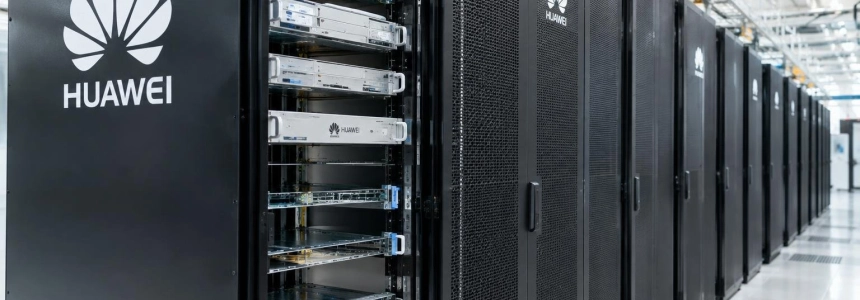
Huawei has an AI data center in Horinger, Inner Mongolia, with around 81,000 H100 equivalents, but its computing capacity is estimated at just 7% of Colossus 2, SpaceX’s data center in Tennessee. Epoch AI estimates that the Chinese facility currently has 170 MW of IT power: the limit is not just how much power the grid can supply, but how many accelerators are available and how much work they can do with that energy.
The figure of 286 MW corresponds to the estimated capacity of four buildings with dense cooling systems, not to the computing power Epoch AI attributes to the center in operation. Its directory, updated after the initial analysis, puts current IT power at 170 MW and revises its previous estimate of 184 MW downward. The difference matters: having buildings, cooling, and power supply does not mean all the racks are filled with AI accelerators.
A large campus that is not yet fully occupied
The campus is part of Horinger New Area in Inner Mongolia and the state-run East Data West Computing initiative, launched in 2022. Huawei divided the facilities into three zones—west, south, and north—that function as availability zones for its cloud. Satellite images show that the west and south zones have denser cooling, consistent with AI workloads; the north has fewer cooling units and appears to have lower power density.
Epoch AI combined satellite imagery, public information, and a model based on visible cooling equipment to calculate how much heat the buildings could dissipate. It cross-checked that estimate against two other indicators: substation data, which point to 304 MW, and the capacity of backup generators, estimated at 230 MW. The organization cannot see from satellite imagery which chips are inside each server, so that part of the calculation depends on estimates of sales and deployment.
Occupancy is also a factor. Epoch AI uses a rack occupancy rate of around 76% in the Horinger area as a benchmark and assumes Huawei’s campus has a similar rate. Its latest estimate attributes around 104,700 Ascend 910C chips and 7,700 Ascend 910B chips to the center. This is not an inventory confirmed by Huawei: it is a calculation combining available capacity with estimated sales and an assumed four-month lag between chip sales and installation.
The comparison of key figures makes clear why physical size alone is not enough to measure AI capacity:
| Measure | Epoch AI estimate | What it represents |
|---|---|---|
| Current computing power | 170 MW | Estimated IT power for current operations |
| Cooling capacity analyzed | 286 MW | Estimated capacity of four buildings |
| Current compute | 81,000 H100e | Equivalence calculated from theoretical performance |
| Projection for the first quarter of 2028 | 141,000 H100e and 351 MW | Estimate that includes a new phase of the campus |
The bottleneck is accelerators and their efficiency
Epoch AI calculates that an Ascend 910C is equivalent to approximately 0.76 H100 units based on its theoretical performance in 8-bit operations. Huawei itself has not published definitive performance specifications, the organization notes, and the equivalence does not capture every aspect of training and inference. It is a comparative metric, not a guarantee that two systems will perform equally on a specific workload.
The gap widens when comparing the 910C with Nvidia’s B200 and B300. Epoch AI estimates that the latter deliver 2.5 times the performance of an H100, as well as around 2.5 times the energy efficiency of Huawei’s chips. So, even with the same available electrical power, its calculation puts the computing capacity of a Chinese facility at around 40% of that of a U.S. facility equipped with Nvidia’s leading chips.
U.S. restrictions on exports of advanced chips limit the alternatives available to China. In 2025, Huawei deployed the Ascend 910C in several of its own data centers, while Epoch AI also identified reported deployments of the chip at facilities operated by China Telecom, China Mobile, China Unicom, and the Shenzhen government. The organization identified eight locations with reported deployments of these chips and detected at least one CloudMatrix384 system at each; each system combines 384 Ascend 910C chips in 16 racks.
The strategy has a practical trade-off: available power does not eliminate the chip shortage. Epoch AI estimates that not all of Horinger’s electrical capacity is devoted to AI accelerators and that some racks may remain unoccupied while more components arrive. Huawei, for its part, has an incentive to deploy its own chips in a public cloud, where the use of accelerators subject to export controls would be more visible. Epoch AI considers it possible, though unlikely, that the center uses Nvidia chips subject to those controls.
Scale does not automatically translate into a single large training run
With 81,000 H100e, Horinger is one of China’s largest AI centers, but Epoch AI’s comparison with Colossus 2 puts it at around 14 times smaller. The figure compares estimated total capacity, not the speed of a specific model. In addition, a campus’s compute is usually distributed across several densely connected clusters; it is not always possible to combine all the capacity to train a single model.
This distinction affects the planning of large training runs: a campus’s aggregate capacity cannot always be combined to train a model. Epoch AI calculates that 10% of Horinger’s current compute would be enough to train a model the size of DeepSeek-V4-Pro in one month. In a highly optimistic scenario, where all the compute could be combined in a single run, training a model the size of GPT-6 Astra would take a year.
For developers and enterprise customers, therefore, the figures describe both an expanding offering and its limitations. The center can host large training and inference workloads, but actual capacity depends on which servers are installed, occupancy, and how compute is divided among clusters. H100e values help compare theoretical computing power; on their own, they do not indicate how long a specific application will take or what performance each customer will get.
The planned expansion adds power but does not close the gap
Epoch AI projects that Horinger will reach 141,000 H100e in the first quarter of 2028, with 351 MW of IT power and an estimated cost of $13.3 billion. The latest revision raises the projected power figure but reduces projected compute: it now estimates around 75,600 Ascend 950DT chips for the expansion, compared with an earlier estimate focused on 910C chips. These are projections, not capacity already installed.
The new building under construction in the south zone could house up to 100,000 accelerator cards, according to a public announcement cited by Epoch AI. The organization estimates it will be operational in early 2028 and applies the 76% occupancy rate to its capacity. It also estimates that the Ascend 950 could be less energy-efficient than the 910C, so the increase would depend mainly on adding power and servers, rather than getting more compute from each unit of electricity.
The power grid appears capable of supporting the expansion: plans include adding transformers to the substations in all three zones. But more electricity does not guarantee a stronger relative position. Epoch AI expects Colossus 2 to reach at least 1.8 million H100e in 2028, so Horinger could maintain a similar or even smaller share relative to that center, even after growing by more than 70%.
Horinger illustrates both the reach and the limits of China’s strategy: Huawei can build campuses with hundreds of megawatts of power and produce its own accelerators, but usable capacity depends on how many chips it can deploy and their performance per watt. The next concrete test will be whether the south building comes online on schedule and with the Ascend 950DT chips projected by Epoch AI.