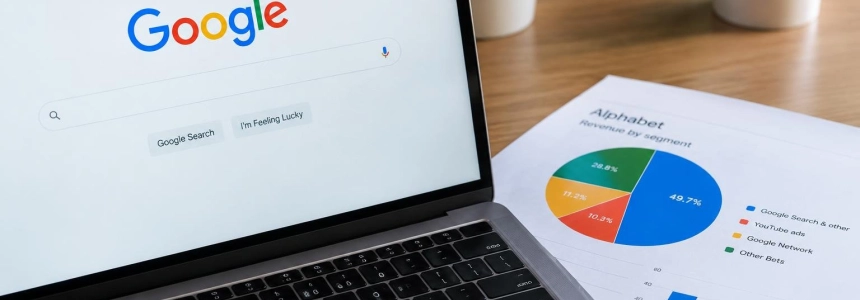
Google Search generated 49.7% of Alphabet’s revenue in the quarter ended in September 2026: $63.4 billion out of a total of $128.0 billion. It is the first time the business has fallen below half since Alphabet began reporting Search revenue separately, according to data compiled by Company Atlas.
The figure may suggest that the search business is contracting. That is not what the revenue shows: Search grew 12% year over year, to $63.4 billion. Its relative share fell because other parts of Alphabet advanced more quickly, especially Google Cloud, which nearly doubled its revenue in a year. The change is therefore less a story of Search’s decline than a sign of the group’s revenue mix shifting rapidly.
The share is falling; Search revenue is not
The contrast becomes clear when comparing the quarter with the same period in 2025. Search rose from $56.6 billion to $63.4 billion, while Alphabet’s total revenue increased from $102.0 billion to $128.0 billion, according to Company Atlas. The denominator grew faster than the main line item: the arithmetic result is a Search share below 50%, even though its sales increased.
The historical series underscores the scale of the change. In the previous 31 quarters, Search’s share had remained between 52.8% and 62.0%. In December 2018 it was 59.4%; it reached 62.0% in March 2019 and still accounted for 55.3% in September 2025. September 2026’s 49.7% breaks that pattern, but does not by itself show that search has lost volume or customers.
What the category includes also matters. Company Atlas describes “Google Search & other” as advertising on Google Search and other Google properties, including Gmail, Maps, and Google Play. YouTube, the advertising network, subscriptions, devices, Cloud, and Other Bets are reported as separate line items. Thus, the figure does not measure the search engine alone as a product: it groups advertising revenue from several properties.
Cloud changes the balance
The main driver of the shift is Google Cloud. Its revenue reached $30.7 billion, compared with $15.2 billion a year earlier: year-over-year growth of 103%, according to Company Atlas. Cloud’s share of Alphabet’s revenue rose from 14.8% in September 2025 to 24.1% in September 2026. In December 2018, it accounted for just 4.4%.
The two lines tell different stories. Search remains much larger in scale and increased its revenue; Cloud, by contrast, is growing at a rate that is quickly changing the balance among the group’s businesses. In the latest quarter, the gap between them was about $32.7 billion. That is why the 49.7% milestone matters for understanding Alphabet’s composition—not because Search has ceased to be its largest source of revenue.
The rest of the picture also shows that Alphabet does not depend on a single business, although none of the other individual line items matches Search or Cloud. In September, YouTube ads contributed $11.2 billion; subscriptions, platforms, and devices contributed $14.3 billion; Google Network brought in $7.5 billion, and Other Bets contributed $372 million. These categories, together with Cloud, explain why Search’s share can fall even as the line itself continues to grow.
The financial results presented in Alphabet’s quarterly report and reproduced by Stock Titan put consolidated revenue for the quarter at $127.577 billion, compared with $102.346 billion a year earlier. The difference from Company Atlas’s $128.0 billion reflects the rounded presentation of that figure. The report also records $30.709 billion for Google Cloud, in line with the rounded $30.7 billion in the Company Atlas series.
Growth requires investment and commitments
Cloud’s expansion comes alongside a significant increase in investment in the group’s infrastructure. The quarterly report notes purchases of property and equipment totaling $131.953 billion during the first nine months of 2026. It also records $802.1 billion in contractual commitments, calculated using the maximum expected prices and volumes; some agreements allow volumes to be reduced in part. Most of the associated payments are expected through 2031, and the commitments extend through 2032.
These figures describe scale and obligations; they do not prove that all spending or commitments relate exclusively to Cloud. They do, however, provide context for understanding the growth: sustaining a business that more than doubled its revenue in a year goes hand in hand with high capital investment and long-term commitments. The report also records $130.5 billion in future payments for leases that had not yet commenced, with start dates expected between 2026 and 2031.
Alphabet’s remaining performance obligations totaled $567.7 billion, of which $560.8 billion was attributable to Google Cloud, according to Stock Titan. The company expects to recognize just over 55% of that total as revenue within 24 months. This is a measure of contracted or committed business that provides visibility, but it is not equivalent to revenue already collected and does not eliminate the need to maintain capacity to meet that demand.
The expansion is also reflected in acquisitions completed during the period. Alphabet closed its acquisition of Wiz for $29.5 billion and Intersect for $5.9 billion, according to the summary of the report published by Stock Titan. That summary links Wiz to AI-driven security and Google Cloud’s multicloud business, and Intersect to data center capacity and energy development. These are large transactions in the same context of infrastructure growth, although Cloud’s revenue figures alone do not allow the quarterly advance to be attributed to them.
There is a financial nuance in the quarter: Alphabet recorded revenue of $127.577 billion and operating income of $40.576 billion, up from $31.228 billion the previous year, but net income fell from $34.979 billion to $26.468 billion. The report attributes the accounting difference to other net income and expenses: these shifted from income of $12.759 billion in the comparable quarter of 2025 to an expense of $8.221 billion in 2026. Therefore, the decline in net income should not be confused with a decline in the business’s operating revenue.
Search revenue still grew: the share fell because the rest of Alphabet grew faster.
— Company Atlas
For developers and companies working with Google Cloud, the concrete signal is that the platform now accounts for nearly a quarter of Alphabet’s revenue and has a remaining performance obligation balance far larger than its quarterly revenue. This provides context for the commercial and investment priority suggested by the growth, but it does not allow specific changes in prices, availability, products, or customer terms to be inferred: the published figures do not detail those decisions.
For those who depend on Search or advertising across its properties, the figure also does not signal an immediate product change. The line continued to grow and remains the largest individual source of revenue reported by Company Atlas. What is changing is its weight within a group whose Cloud business is rapidly gaining ground. The next key measure will be whether Cloud maintains that pace and whether Search can continue to grow as its share of the total keeps shrinking.
Sources: Company Atlas, Stock Titan