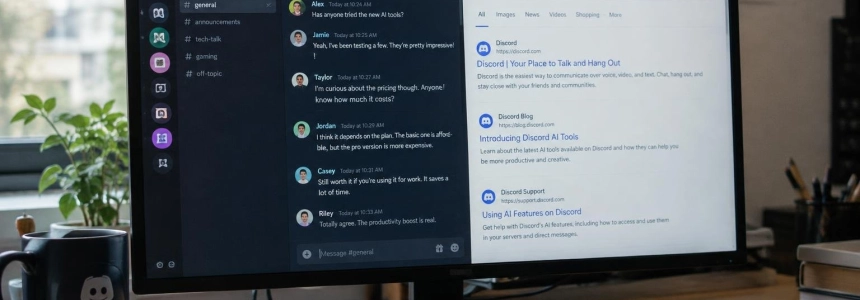
More than 63,000 public Discord servers will have a web page starting November 16, and some messages from their channels may appear on Google and other search engines starting in mid-December. The company presents the change as a way to make answers that currently remain within the platform’s conversations easier to find; controls for administrators and members are already beginning to roll out.
The measure is limited to so-called Discoverable Servers: communities that anyone can find and join without an invitation. To qualify, a server must have at least 1,000 members, have been active for eight weeks, and meet Discord’s activity and safety requirements. Private servers, direct messages, and group chats are excluded.
Pages in November, messages in December
The rollout has two stages. On November 16, each discoverable server will have a Server Web Page. Those who have already created a page won’t need to do anything; for everyone else, Discord will publish a default version based on the server’s profile. These pages may include summaries automatically generated from recent conversations in public channels.
Summaries and messages are separate features. Discord says summaries will cover conversations starting November 16 and will not show usernames or avatars. The company warns in its documentation that these summaries may not always be accurate. Administrators will be able to choose which channels contribute content, review summaries, or disable them.
In mid-December, the gradual rollout of individual messages will begin: some posts in public channels may be displayed, word for word, both on the server page and in search results. Discord estimates that it could take several weeks for the first messages to appear. Posts published before mid-December will not be included, and posts will appear without usernames or avatars.
Thread replies and forum posts may also be included in the system if they belong to an enabled public channel. Private threads and forums are excluded, even if the channel containing them is public. For now, messages will be displayed as text only.
“This has led to valuable information being locked away in Discord conversations, inaccessible to the rest of the internet. We want to fix that.”
— Discord
What administrators and members can disable
Administrators can choose which channels participate or exclude them all from Server Settings > Web Presence. If they don’t change the settings, public channels will remain enabled. They can also disable the server’s discoverable status; in that case, the community will revert to being a Community Server. As long as it remains discoverable, its web page will still be available.
Members have their own toggle under User Settings > Data & Privacy. Turning it off will prevent their new messages from appearing on the web in all discoverable servers they belong to. The message setting does not affect summaries: these will remain visible unless administrators disable them.
In the European Union, the United Kingdom, Canada, Brazil, Australia, and South Korea, the option to display members’ messages will be off by default. In other regions, it will be on unless each user turns it off. Teen accounts are excluded and cannot enable the feature. Discord also says that channels whose messages may appear on the web will display a visible label before posting.
Turning off the option does not remove older posts that have already been displayed. Discord notes that they may remain visible until deleted. When a message is deleted, it will no longer be available in the app or on the server page, although the company does not guarantee that search engines won’t retain an indexed or cached copy.
The scope of the change and the initial test
Discord had already tested messages on pages for gaming communities such as NBA 2K, Rust, and Dead by Daylight. During that test, according to the company, all visible posts were from administrators and moderators, not members. The rollout starting in December expands the possibility to include user messages, provided they are in enabled channels and subject to users’ personal settings.
Discord presents the initiative as a way to help people find guides, strategies, and answers shared in their communities. The company also argues that the pages can help people looking for information learn about a server before joining. At the same time, this exposure changes the context in which these messages are read: a conversation written for a community may be found from outside Discord.
Asked about companies using messages for artificial intelligence, Discord responds in its frequently asked questions: “No. Nothing has changed. We’re making Discord content easier to find if administrators and users choose to make it available on the web.” The company does not explain in that answer how AI crawlers are handled. Before November 16, administrators can review which channels are enabled; members, for their part, can change their message preference starting now.
Sources: Search Engine Journal, Xataka, Discord, PC Gamer, Engadget