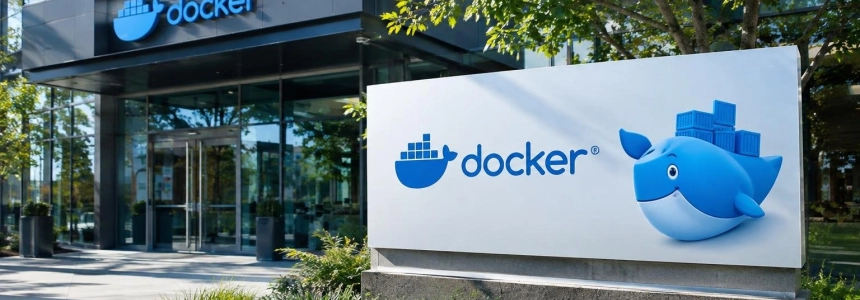
Docker unveiled a new visual identity and redesigned Moby, its well-known whale-shaped mascot, to accompany a strategic shift: the company wants to offer tools for running and governing artificial intelligence agents, in addition to continuing to develop its container technologies.
The announcement appeared on November 19 on Docker’s blog, in a post by Terri Avnaim, the company’s chief marketing officer. Linuxiac reported the following day on the identity change and Docker’s expanded focus, having previously been associated primarily with containers.
Docker describes the refresh as an evolution of its brand for an era in which agents can take actions, not just respond to instructions. The company argues that this autonomy raises a different question: how to let agents work without giving them unlimited access to systems, files, or tools.
“The new Docker is all about trust.”
— Terri Avnaim, Docker’s chief marketing officer
A brand change for a broader strategy
The redesign covers the Moby logo, the website, and the corporate image. Docker says it sought an identity that could represent a company that no longer wants to define itself solely by containers. Moby retains its recognizable role but adopts a new look that, according to the company, reflects the evolution of its products and messaging.
Docker worked with Motto, a strategic brand transformation company, on the change. In her announcement, Avnaim presents Moby as a small-scale representation of the company itself: a familiar figure that changes to meet a new phase rather than disappearing.
The company links the rebranding to the expansion of its products into AI agents. The distinction it makes is functional: a container isolates a workload, while an agent can decide which commands to run, which resources to access, and what changes to make. For Docker, this capability requires controls covering both where the agent runs and the actions it can take.
Docker is not abandoning containers, a point made explicitly in the corporate announcement and in Linuxiac’s coverage. The company says they continue to play a central role in the software development lifecycle and that it will keep working on them. Its new positioning adds agent management to that foundation; it does not replace it.
What controls Docker proposes for agents
Docker AI Governance organizes its proposal into three areas: policies for isolated environments, control of tools connected through MCP, and audit logs and visibility. MCP, or Model Context Protocol, is the mechanism Docker refers to for connecting agents to external tools and services.
The first area, Sandbox Policies, limits where the agent can operate. Docker Sandboxes provides each agent with an isolated microVM environment, with its own Docker Engine, file system, and network. AI Governance adds centralized policies that can allow or block domains, IP ranges, and ports, as well as control which host-machine paths are mounted and whether access is read-only or read-write.
The second, MCP Tool Governance, covers the tools an agent can use through Docker MCP Gateway. Administrators can decide which MCP servers are registered and which operations are permitted, including tool calls, resources, prompts, and approval requirements. Docker says these rules are expressed in Cedar, a policy language; if MCP policy enforcement is enabled, governed requests are denied unless a rule authorizes them.
Docker also defines the scope of this control: MCP policies apply to activity that passes through its MCP Gateway. If an agent connects directly to a remote MCP server from a sandbox, the connection is subject to the sandbox’s network policy, not the gateway’s rules.
The third area, Audit + Visibility, records policy decisions and sandbox session events. Structured logs can include who initiated an activity, what action was evaluated, its target, whether it was allowed or denied, and when it occurred. Docker says these logs contain governance metadata, not the content of prompts or agent responses.
Logs can be stored locally or sent to the cloud, according to Docker. With cloud delivery enabled, teams can search logs across the organization, export them, or send them to SIEM workflows—systems used to manage security information and events. The current coverage described by the company includes policy decisions for Docker Sandboxes and sandbox session events.
From agent security to the supply chain
Docker separates controls over agent behavior from trust in the artifacts the agent uses or produces. For the latter, it points to Docker Hardened Images, its offering of container images, Helm charts, and system packages that it describes as minimal, secure, and production-ready.
The company says these images include signed SBOMs—software component inventories—VEX information, cryptographic signatures, and SLSA Build Level 3 build provenance. It also offers FIPS-enabled and STIG-ready variants within the relevant Docker Hardened Images offerings.
In Docker’s explanation, AI Governance controls the agent’s authority while it works; Hardened Images provides verifiable information about the components and creation of artifacts. These are distinct parts of a single trust proposal, not one unified security mechanism.
A bet on standards and collaboration
The shift toward agents had become apparent before the brand announcement. On November 2, Docker described its participation in collaborative initiatives to define shared architectures and security controls for AI. The company said it does not consider it sufficient for each provider to solve the problem independently.
One of these initiatives is Blueprint Alliance, whose founding members are Okta, AWS, CrowdStrike, Databricks, Docker, Google Cloud, Lovable, Proofpoint, Salesforce, ServiceNow, Wiz, and Zscaler. GE Appliances and World Central Kitchen are listed as strategic advisors. The alliance proposes an open, multivendor reference architecture that aims to answer where agents are, what they can do, what they are doing, and how to respond.
Members have committed to testing interoperability through MCP, OCSF, SSF, and CAEP, and to publishing reference integrations. The other initiative cited by Docker, Agent Baseline, defines six outcomes—Discover, Constrain, Authorize, Observe, Validate, and Respond—and 35 open, versioned controls, each with a permanent identifier. Docker, Snyk, and Keycard drafted the document, whose current version at the time of the announcement was v1.0-draft.
Docker distinguishes the purpose of the two projects: Blueprint Alliance describes how the pieces fit together, while Agent Baseline establishes which capabilities should be present and how to verify them. The company places its contribution primarily in the agent runtime, where policies are enforced and logs are generated.
Autonomy, with limits defined by policies
Docker introduced these tools in response to a specific difference between agents and traditional workloads. An agent can change course, run code, access files, or call services; therefore, the company argues that it is not enough to ask the model to behave in a certain way. Limits must be enforced in the environment and permissions, and the results must be logged.
Docker’s post about AI Governance, dated November 18, sums up the approach with three questions: where can the agent act, which tools can it use, and what happened during its activity? The company proposes defining these limits before work begins, enforcing them while the agent operates, and reviewing the recorded decisions afterward.
In its brand announcement, Docker invites users to visit the new website and try Docker Sandboxes and Docker AI Governance. The company does not present the change as a break with its history: it seeks to extend to agents the promise of portable, controlled development environments that it associates with its containers.