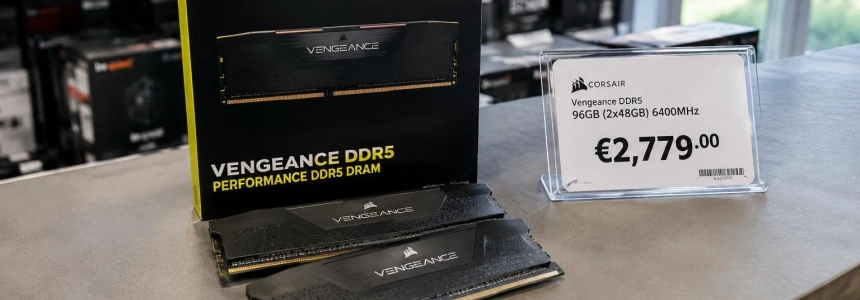
A 96 GB DDR5-6400 kit that cost 304 euros in July 2025 is now being offered for 2,779 euros in Germany: 9.1 times its initial price. The figure is part of 3DCenter’s November index, which puts the average cost of the 20 DDR5 products analyzed at 607% of the July 2025 level.
The 607% figure is an index relative to the reference price, not the percentage increase: it represents 6.07 times the initial cost, or an increase of 507%. Compared with October, the average rose 8.6%, after increasing 2.8% the previous month, according to the calculation published by 3DCenter.
Higher-capacity kits lead the increases
The jump is not evenly distributed across all products. The 2 × 48 GB DDR5-6400 kit reached 2,779 euros in November, after costing 2,279 euros in October. Its monthly change was 22%; compared with July 2025, the cumulative increase is 814%.
Two categories that rose sharply in a single month also stood out: the 32 GB DDR5-5600 module increased 28%, to 495 euros, and the 2 × 24 GB DDR5-6400 kit rose 29%, to 830 euros. At the other end of the scale, several products barely changed or fell slightly.
| DDR5 product | July 2025 | November 2026 | Cumulative change |
|---|---|---|---|
| 32 GB DDR5-6000+ (2 × 16 GB) | 75 € | 468 € | +524% |
| 64 GB DDR5-6000+ (2 × 32 GB) | 158 € | 1.080 € | +584% |
| 96 GB DDR5-6400+ (2 × 48 GB) | 304 € | 2.779 € | +814% |
The table brings together prices for the categories selected by 3DCenter. Its tracking records the lowest price available for each product in German retail, as checked on Geizhals during the middle-of-the-month weekend. The index therefore describes that market and those recorded minimum prices; it is not an average of what all buyers paid.
An October pause that did not last
The index had shown signs of moderation. After rising to 544% in September, it reached 559% in October before jumping to 607% in November. The October monthly increase was 2.8%, according to Deal N Tech’s calculation based on the published levels; 3DCenter rounded its own rate. November’s movement puts the curve back on an upward trajectory.
The July 2025 reference is equivalent to 100% on the index. In September of that year, the figure was 103%; in December, 346%; and in March 2026, 408%. It reached 419% in June, 544% in September, and 559% in October. November marks a new high in the series tracking the performance of the 20 DDR5 products.
The behavior of higher-capacity products also changed during the crisis. 3DCenter notes that larger modules are now rising more sharply, whereas smaller kits had been a more prominent driver at the start of the price surge. The report attributes this difference to current demand for large modules, which are more sought after in the server market.
Demand for AI memory is driving the pressure
3DCenter dates the start of the crisis to autumn 2025 and identifies OpenAI’s agreements with Samsung and SK Hynix as a significant trigger, saying they would have secured the company access to around 40% of global memory chip production. The report argues that this increase in demand added to the expansion of AI data centers and manufacturing capacity that could not grow quickly.
The German site also describes a race among computer and electronics manufacturers to secure the remaining supply. That pressure first spread to the spot market and then to contract prices and long-term agreements, which 3DCenter considers a factor keeping prices elevated. The article also notes that demand for AI memory no longer comes solely from OpenAI.
The strain is affecting other technologies too. In November, 3DCenter’s index put DDR3/DDR4 249% above its reference level, equivalent to 3.5 times the initial level; DDR4 alone was 3.9 times more expensive. SODIMM modules for laptops rose to 4.3 times their initial price. Internal SSDs, hard drives, and graphics cards also recorded increases relative to their respective reference points, though to varying degrees.
TechRadar reported that Counterpoint Research calculated a 369% year-over-year increase in global DRAM revenue during the third quarter of 2026, to nearly 200 billion dollars. Bit shipments grew by around 4% during the quarter, according to Counterpoint analyst Jeongku Choi, quoted by The Register. Choi summed up the change as follows:
“AI has turned memory from a commodity into a valuable scarce resource,”
— Jeongku Choi, Counterpoint analyst
Shortage forecasts and a legal dispute
The supply outlook does not point to an immediate solution either. 3DCenter says that increasing the capacity of a memory factory takes between 2.5 and 3 years from planning to mass production, and considers the industry to have started its major expansions relatively late. Its analysis forecasts that high prices could continue for several years, although it does not set a specific date for a change in trend.
Business forecasts reported by TechRadar point to different time frames. Micron said supply and demand will be much tighter in 2027 and 2028 than in 2026, and that it has no visibility into when they will return to balance. SK Hynix said in a section of its results that the memory shortage will persist until 2030. TeamGroup, meanwhile, predicted there would be no downward price trend in 2027.
There is also a legal case related to conventional DRAM prices, although it has not yet established liability. HardZone reported that Judge Noël Wise of the U.S. District Court for the Northern District of California rejected Samsung, SK hynix, and Micron’s request to dismiss a lawsuit against the companies on November 14. The decision allows the proceedings to continue, but does not prove that the manufacturers coordinated.
The plaintiffs allege that the companies coordinated decisions to restrict the supply of conventional DRAM and prioritize products linked to AI. The judge allowed the case to proceed at this stage, in part because of allegations concerning production cuts, the shifting of resources toward HBM memory, and announcements made close together about phasing out DDR4. The companies maintain that they acted in their own commercial interests and in response to the same market conditions.
According to HardZone, the manufacturers must respond to the lawsuit by December 7. The outlet says a case management conference is scheduled for January 2027 and clarifies that these dates are procedural steps, not an announced date for a ruling or for changes to store prices. The court decision also does not order prices to be lowered or production to be increased.
The next update will arrive in December
The next 3DCenter update should be based on prices collected in mid-December, following the index’s monthly method. It is unclear whether October’s slowdown or November’s rebound will prove a better indication of that result. For now, the 96 GB DDR5 kit that started at 304 euros is listed in the sample at 2,779 euros.
Sources: Wccftech, HardZone, 3DCenter.org, Deal N Tech, HTR#GAMING, PC Games Hardware, TechRadar