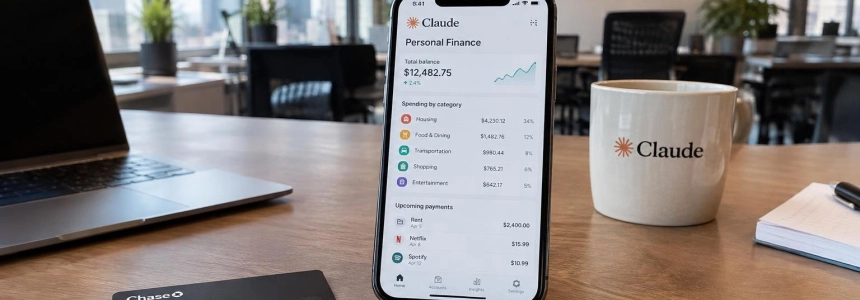
Claude can view balances and transactions for accounts connected by the user, but it cannot pay bills or transfer money. Anthropic has begun rolling out Personal Finance in beta, a feature that lets users ask the assistant where their money went, review upcoming payments, or compare spending with previous months. For now, it is available only in the United States for Pro, Max, and Ultra plans.
The tool connects to banks, credit cards, loans, and investment accounts through Plaid. The permission Claude receives is read-only: the company says the model cannot move, manage, or invest funds. It also does not offer its own financial products, such as cards, loans, or savings accounts, or show ads or sponsored recommendations.
Anthropic announced the feature on November 5. Its rollout began that week and is gradual, so it may not yet appear in all eligible accounts. In Claude, it can be accessed from the sidebar menu, although the Help Center says Personal Finance is also available in Claude Desktop and the iOS and Android apps.
Questions about spending, bills, and money until the next payday
Once accounts are linked, users can type questions in natural language. Claude adds up transactions from connected accounts and organizes them by category to answer questions such as “Where did my money go this month?” or “Am I spending more than I earn?” It can also check whether an expense is higher than usual and calculate how much would be left before the next payday.
Anthropic’s launch example places the query ten days before the next paycheck. Claude calculates spending of $4,309.37: more than half goes to rent and utilities, and $1,024.51 to food and drink. It then identifies a membership renewal and four scheduled payments before payday; the calculated balance after those charges is $1,393.22. These are figures from the company’s demonstration, not data from a real user.
The feature can also look for duplicate charges, unexpected fees, and bills that have been rising. To do these checks, it compares transactions from previous months. Users can ask it to explain financial terms: Anthropic gives the example of asking about APR and how much interest was paid over the past year.
In addition to text responses, Claude can generate weekly spending charts, payment calendars, and dashboards with figures users want to track. The Help Center describes a page with widgets for spending, cash flow, accounts, subscriptions, and upcoming bills. These elements can be added, edited, removed, and rearranged.
“Claude gives you answers in everyday language, from your balances and transactions, and explains any term that's new to you.”
— Anthropic
What information goes through Plaid
The connection does not give Claude the bank password. Users sign in through Plaid and authorize access there to the accounts they choose to share. Anthropic explains that the assistant can read the bank’s name, the name and type of each account, its last four digits, balances, credit limits, and up to 24 months of transactions. For each transaction, it may receive the amount, date, merchant, category, and description added by the bank.
The documentation distinguishes between the data Plaid may request during the process and the data Claude uses. For investment accounts, loans, and credit cards, Claude reads balances and credit limits, but not holdings, transactions, interest rates, or terms. If a bank includes a full number in an account name or transaction description, that text could be visible; Plaid, for its part, gives Claude only the last digits of the account number.
Anthropic says conversations within the Personal Finance space are not used to train its models. If users discuss their finances outside that space, their usual privacy settings apply. The company also acknowledges that the providers hosting Claude process banking data, while Plaid handles it under its own terms and privacy policy.
Data Claude has already used appears in the chat history and remains there until the conversation is deleted, in accordance with the company’s data retention practices. Unlinking a bank cuts off future access, but does not by itself remove previous responses or figures included in chats, artifacts, or shared links. Those items must be deleted separately.
There is another practical difference between removing an account and stopping payment. If a subscription ends, users lose access to Personal Finance and Claude can no longer read accounts in chats, but the banks remain linked until they are manually disconnected. Deleting a Claude account does cause Anthropic to unlink the banks once the deletion has been processed.
Limits on access and availability
The feature is not intended to provide investment advice. Anthropic presents it as a way to understand data and answer questions about money. It also warns that Claude can make mistakes and recommends checking important figures with the bank. The Help Center adds that balances may be one or two days old and that an account linked through two sign-ins could be counted twice if the bank presents it differently in each one.
If Claude temporarily cannot read a bank, the page’s spending totals exclude that institution; as a result, the budget may show more money available than there really is. The company recommends asking which transactions support a figure and verifying it in the banking app or statements.
For now, Personal Finance supports only U.S. banks and is not included in the Free, Team, or Enterprise plans. Because the rollout is gradual, some Pro, Max, or Ultra subscribers may not see it yet. Anthropic has not announced a date for bringing it to other countries. SoftZone notes that it has also not been confirmed which institutions will be available outside the United States; the Help Center currently limits linking to U.S. banks.
The Help Center also sets a maximum of 16 linked banks. If that limit is reached, one must be removed before another can be added. The service does not work in scheduled tasks, Cowork, or Claude Code, and is not available in Claude Duet. Data saved in the financial dashboard is also not yet included in data exports.
Chats and artifacts retain financial information
The content of a response does not disappear when an account is disconnected: it remains in the history, and artifacts created from banking data may continue to exist even if the chat is deleted. Claude asks permission before publishing an artifact generated in a conversation that used connected accounts. Shared links to chats may show both messages and figures and charts; artifacts can also expose information to anyone who opens them.
The system has an additional feature: an artifact can read the linked accounts of the person who opens it if that person uses Personal Finance and authorizes Plaid. Figures included in the artifact, including saved ones, are shown to anyone who accesses it.
The feature also does not deliberately save what was discussed in a financial chat to Claude’s memory or include it in the monthly summary. The Help Center says Claude is designed not to retrieve that chat later through searches. Even so, these measures do not replace manually deleting history, artifacts, or links containing financial responses.
Anthropic explores partnerships with regulated institutions
The launch comes after OpenAI added a personal finance tool to ChatGPT in May, which also lets users connect accounts and review spending. The Decoder and TechCrunch describe Personal Finance as a similar offering. Anthropic, for its part, says it wants Claude to be able to work alongside licensed financial professionals and regulated companies on broader decisions, and that it is exploring how to do so. It is also inviting banks, wealth managers, and financial services companies to take part in this work.
At this first stage, the offering is limited to reading information from selected accounts and turning it into answers, calculations, and dashboards. If users stop using it, they can unlink their banks from Claude or disconnect Claude from my.plaid.com; if they keep an active subscription, the accounts will remain connected until they take that step.
Sources: The Decoder, SoftZone, Xataka, Claude, Claude Help Center, TechCrunch, MacRumors