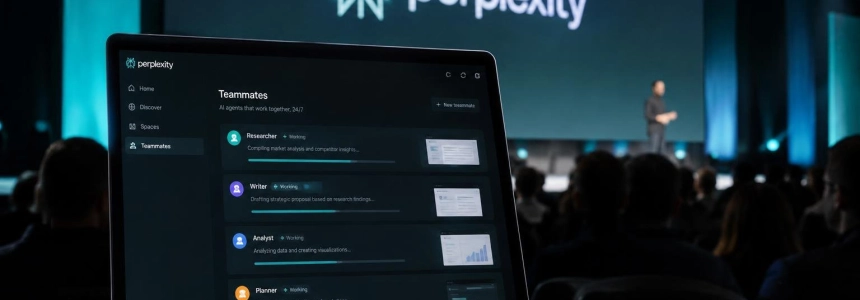
Perplexity wants its AI agents to stick around after a task is finished: Teammates work around the clock and can take on ongoing responsibilities within a workspace. The company introduced them on November 5 as persistent assistants capable of taking on high-level goals, rather than simply responding to one-off instructions.
The product is built on Perplexity Computer, the company's system that deploys agents to perform tasks on a user's device. According to Perplexity, Teammates adds capabilities for sustaining work on a larger scale and over longer periods. The offering also puts the company in direct competition with tools from OpenAI and Anthropic; access requires the Max plan, which costs $200 per month.
The product is built on Perplexity Computer, the company's system that deploys agents to perform tasks on a user's device. According to Perplexity, Teammates adds capabilities for sustaining work on a larger scale and over longer periods.
Agents with projects, memory, and parallel tasks
A user can assign each Teammate a different role or job; agents can carry them out simultaneously. Perplexity presents them as collaborators that retain project context, skills, and memory already available in its tools, rather than starting from scratch in every session. Digital Trends adds that they can also access connectors, files, and previous sessions.
The main difference from Computer is persistence. Digital Trends describes Computer sessions as temporary environments that disappear when each task is complete, while Teammates remain available to continue handling ongoing responsibilities. Perplexity presents this change as a shift from single-session instructions to broader goals.
The agents have individual threads in the Perplexity app. From there, users can review progress, request a status update, assign more work, or change the direction of a task. Free Press Journal reports that each agent has a persistent thread in the sidebar and that Teammates can also collaborate with one another.
Slack integration extends this interaction into the team's workspace. According to The Verge, users can communicate with agents from Slack; Free Press Journal notes that they can also keep track of colleagues. Digital Trends explains that if an agent is added to a channel, it can monitor it and respond to changes according to its instructions.
Yahoo Tech describes background operation and notifications when an agent needs a person to make a decision. It also says each Teammate can manage other agents and bring in collaborators to distribute new tasks. This autonomy is paired with oversight: users can check what each agent is doing and what it has completed.
From advertising campaigns to engineering alerts
Examples published by Perplexity cover marketing, sales, support, and operations. Digital Trends mentions tasks such as classifying bugs, running quality assurance cycles, monitoring security, analyzing data, and managing A/B tests. Free Press Journal cites advertising campaigns, legal research, and the role of an on-call engineer who investigates alerts and opens requests to fix problems.
Digital Trends also recounts a demonstration in which an agent dedicated to advertising detects that creator ads are exceeding the customer acquisition cost target, prepares a larger campaign, and sends a contract extension to the legal team. The brand director then asks it to repeat the process in similar cases without consulting her next time. The example points to a working dynamic in which user corrections and preferences begin to guide subsequent tasks.
According to the same outlet, each agent operates in its own environment, with a desktop and browser, and users can review its work, take control of its desktop, or redirect it. Free Press Journal adds that it uses the same extensions and permissions the user already has installed. These details make Teammates more like collaborators that operate tools and workflows than a simple conversation thread.
Aravind Srinivas, CEO of Perplexity, described the company's ambition on X with a vision of hundreds of agents for every person in an organization:
“Over time, we envision every org having hundreds of teammates working for each person.”
— Aravind Srinivas, CEO of Perplexity
In another post cited by Digital Trends, Srinivas argued that agents need to remember the user and the organization, work with colleagues, and improve when they receive corrections. He presented Teammates as the first step toward that idea, not the end of the product's development.
Max costs $200 a month
Access requires Perplexity's Max plan, priced at $200 per month. Punto Informatico and The Verge describe the subscription as necessary to use Teammates. Free Press Journal says agent usage is included at no extra cost for a promotional period for Max subscribers; afterward, it will use credits already included in the plan.
Digital Trends and Free Press Journal place the initial availability on the web. Yahoo Tech, by contrast, says the feature is available to Max subscribers on both the web and iOS. The other two outlets describe mobile versions as coming soon: Digital Trends quotes Srinivas as saying that native mobile and desktop apps will arrive later, and Free Press Journal also says both versions are still pending. Mobile availability is therefore not described consistently.
The company has not specified a separate price for the agents in the cited reports: the known cost is Max, and after the promotion mentioned by Free Press Journal, usage would be deducted from its credits.
The race for agents that retain context
Teammates enters a category where OpenAI and Anthropic are already competing. The Verge compares the simultaneous assignment of jobs with OpenAI's Dots and Anthropic's Claude Duet. Free Press Journal provides more context: it says OpenAI introduced Dots on September 29 during its DevDay conference, and that each agent has a computer and browser in the cloud, with access to more than 4,000 apps through extensions. According to the outlet, Dots is available to Pro and Business Premium users in eligible markets.
Anthropic opened a research preview of Duet on October 21, according to Free Press Journal, although the outlet itself notes that some publications date it to October 22. Duet is offered as a standalone app for professionals and small businesses, with a daily briefing and tasks ranging from scheduling to creating forecasts and web apps. According to that report, access is limited to Claude Pro and Max subscribers in the United States through a waitlist.
The comparison also highlights differences in how they work. Free Press Journal says Anthropic has explained that Duet checks connected accounts every few hours, not continuously, and can misjudge how urgent a task is. The company has also said the system is less suited to personal errands such as booking tickets. Perplexity, for its part, presents Teammates as always-on agents; the sources do not specify how often they check each integration or what operational limits apply.
Digital Trends also places OpenAI's workspace agents, Microsoft's Copilot Cowork, Grok Bot, and Anthropic's Claude Cowork in the same race, noting that the first two are aimed at organizations rather than individual subscribers. Teammates' launch thus expands Perplexity's push from its Computer agent to teams of persistent agents, but initial use is limited by Max and the credits included in that plan.
For now, the specific timing Perplexity has announced for the next step is that native mobile and desktop apps are coming soon; no more precise timeline has been given.
Sources: Punto Informatico, The Verge, Yahoo Tech, Digital Trends, Free Press Journal