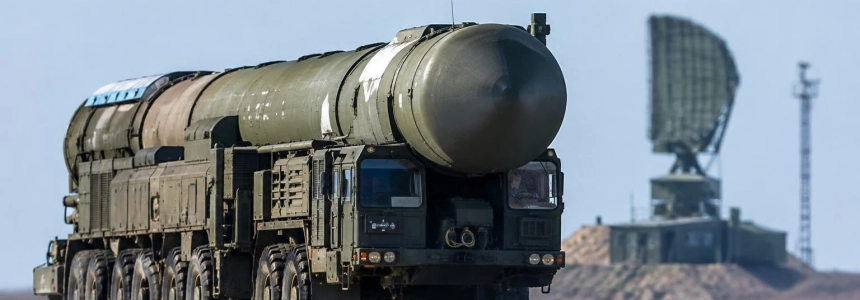
Researchers at the Beijing Academy of Military Sciences warn that artificial intelligence could reduce the U.S. nuclear decision-making process from the traditional 15–30 minutes to 90 seconds or less. The concern is not just speed: if AI helps locate and track Chinese missiles, it could also put Beijing’s ability to respond to a first strike at risk.
Two researchers at the Beijing Academy of Military Sciences wrote that AI could shorten the process to 90 seconds or less, according to The Next Web. Separately, The New York Times reviewed more than 100 recent papers by Chinese researchers and consulted experts and former U.S. officials. The fear described points to a paradox: Beijing believes AI could weaken its nuclear deterrence, while at the same time seeking to incorporate it into its own weapons.
Missile survivability at the heart of the problem
China’s nuclear strategy depends on enough missiles surviving a first strike so the country can retaliate. If U.S. forces could detect and track missiles earlier and act more quickly, that assumption would become harder to sustain. The concern is not limited to a machine making the decision to launch: it also affects the information reaching decision-makers.
Philip Reiner, director of the Institute for Security and Technology, described that distinction to The New York Times:
“Nobody’s turning launch decisions over to A.I., but everything that tells you whether you should launch is now going to be shaped by A.I.”
— Philip Reiner, director of the Institute for Security and Technology
The distinction matters to companies developing AI systems or components intended for military use. Reiner raises precisely that point: the risk does not depend solely on delegating the launch, but also on how AI changes the factors informing the decision.
The size of the arsenals adds pressure to the question of survivability. China has about 620 nuclear warheads, according to figures from the Federation of American Scientists cited by the Times; it is expected to reach around 1,000 by 2030. The United States and Russia each have close to 1,800 deployed warheads. These are figures for different arsenals—the figure cited for China does not specify that the warheads are deployed—but they help explain why losing part of a smaller force could weigh heavily in Beijing’s calculations.
China has dispersed its forces to protect them. According to the Times, it has built about 320 launch silos in northern deserts and tested a long-range missile from a submarine in July. These measures do not eliminate the concern raised by the researchers: the value of a dispersed force also depends on it remaining difficult to locate and retaining the ability to respond.
Beijing is developing AI for its own missiles
The warning has not halted the search for military applications. The Rocket Force, which controls most of China’s nuclear missiles, is studying how to use AI to help ballistic and hypersonic missiles evade defenses. In July, Xi Jinping convened senior officials to discuss the military uses of the technology, according to the Times.
That is where the main strategic trade-off emerges: a tool that can facilitate detection and tracking can also help a weapon evade them. The cited studies show that this tension also exists within the People’s Liberation Army.
Two Chinese military institutes warned this year that AI-amplified false data can create serious risks for command and control. The observation points to a specific weakness: processing speed does not guarantee that information is accurate. If erroneous data affects the picture received by decision-makers, the system could speed up a mistaken assessment rather than improve it.
For developers and companies, the issue does not support a universal recommendation for AI design. It does, however, point to a specific requirement for the military uses described: distinguish between automating analytical tasks and allowing information generated or prioritized by a system to influence launch decisions. The studies cited by the Times locate the problem both in model capabilities and in the quality of the data informing command.
The political agreement has not led to talks
In 2024, Xi Jinping and then-U.S. President Joe Biden agreed that humans would retain control over any decision to use nuclear weapons. However, no official talks have followed on the issue, according to the Times. The commitment addresses who makes the decision, but the concerns of Chinese researchers also extend to the information that could shape it.
The issue also did not come up at the summit held in Shenzhen last week, where Xi, Donald Trump, and Vladimir Putin met. Although the leaders discussed reducing nuclear risks, AI in nuclear weapons was not on the agenda, according to The Outpost, which summarizes coverage by the Times and The Next Web.
Beijing’s concern, therefore, is not just that Washington could make decisions faster. It is that the development of AI to find, track, and attack targets could call into question the survivability of the missiles on which China’s ability to retaliate depends, even as China incorporates similar technology into its own systems. The figure that sums up the researchers’ fear remains 90 seconds or less.
Sources: TNW | Defence, The Outpost