Tristan Buckmaster and Levent Alpöge claim to have closed the gap that drew criticism in OpenAI’s Navier-Stokes proof: their new result establishes a singularity in the equations without an external force designed to trigger the phenomenon. The proof, developed with intensive use of artificial intelligence, has also been formalized in Lean, though the work still needs polishing.
The difference from OpenAI’s result is significant. In September, the company presented a proof that the equations could “blow up”: under certain conditions, the fluid’s velocity would tend to infinity. The problem, according to Scientific American’s coverage, was that this construction relied on a carefully tuned force, capable of stirring the fluid in exactly the way needed. Although it technically met the conditions for the Clay Mathematics Institute’s one-million-dollar prize, that choice left many experts unsatisfied.
The shift: a singularity without forcing the fluid
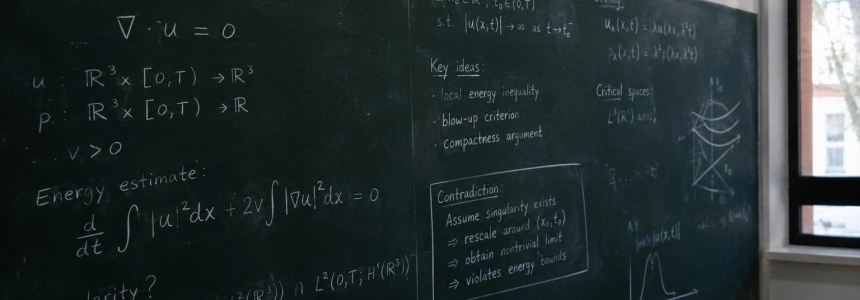
Buckmaster and Alpöge’s new claim concerns the incompressible Navier-Stokes equations in three dimensions and a finite-time singularity without an applied force. Terence Tao, who ranked the recent results by how “digested” they are, describes the mathematical approach: numerically construct an approximately self-similar solution on discrete scales, then turn it into an exact solution using rigorous perturbation theory.
This approach matters because it directly addresses the objection raised against the earlier result. Rather than choosing an external force that induces blow-up, the argument seeks to show that the equations’ own unforced dynamics reach a singularity. It does not eliminate the need to review the mathematical details: it changes which central difficulty must withstand that review.
Tao considers the overall strategy broadly clear, but also notes that the text, though technically readable by humans, is not yet professionally written. His assessment distinguishes two issues that are often conflated in announcements of results: whether there is an understandable path and whether the exposition is complete enough for others to examine rigorously.
Lean provides formal verification, not an automatic explanation
The proof has also been formalized in Lean, a proof assistant. Tao says that both the Navier-Stokes result and another result concerning the three-dimensional Euler equations have formalizations in that system. Scientific American’s report, however, says that the authors did not publish the result’s certificate with the announcement and stated that they would release it soon. The distinction between a claimed formalization and available materials means separating the work’s stated status from what third parties can inspect at that moment.
For developers working with Lean, the case is of particular interest: Tristan Buckmaster’s public GitHub repository shows projects called navier-stokes and fluid_lean, both tagged as Lean. The existence of those repositories does not, by itself, establish what each contains or whether the announced formalization is complete; it does place the result within the tools and software artifacts that may form part of its evaluation.
According to Tao, AI played a substantial role in this result as well as in the Euler proof attributed to Alpöge, Buckmaster, and Matei Coiculescu. But the description does not present the system as a substitute for validation: the mathematical strategy must be understood, the formalization must be verifiable, and the exposition must allow specialists to examine the argument. For a company developing AI or verification tools, the episode offers a specific use case: assistance in producing mathematical proofs accompanied by formal coding. It does not, by itself, demonstrate that the process is reproducible at scale or that human review is no longer necessary.
“couldn’t risk waiting”
— Tristan Buckmaster
A race that had already tainted the announcement
The urgency did not arise in a vacuum. Buckmaster had publicly accused OpenAI of deliberately getting ahead of the work he and Alpöge were carrying out. He also voiced suspicions that the company had stolen his user data; Scientific American notes that OpenAI denied the allegations of misconduct. The publication adds that early reports suggested the company’s proof may have followed a different approach.
In that context, Buckmaster published the new argument on Mastodon and explained that the text was rough because, after the previous experience, he and Alpöge could not risk waiting. The decision favors rapid disclosure, but has a visible cost: the presentation still needs work, and the certificate did not accompany the announcement. The episode illustrates a particular tension in this story: getting a claim out first may prevent another team from getting the headline, but it does not automatically speed up the scrutiny that determines what has been proved.
Tao’s comparison with the other results announced that day also counsels against lumping them all into the same category. He places the Euler proof first, considering it human-readable and formalized in Lean; next, the Navier-Stokes proof, whose strategy he judges broadly clear but whose writing needs polishing; and further behind, a proof of the generalized Riemann hypothesis generated with an internal AI model and presented only in Lean. Tao says the latter requires a longer process of understanding.
What remains to be evaluated
According to Tao’s description, Buckmaster and Alpöge’s work offers a recognizable strategy for the unforced case, a text that can be read with reservations about its finish, and a formalization in Lean. The next steps are to improve the exposition and make it possible for others to examine both the reasoning and its coding.
For teams building proof tools or AI models, the practical implication is not a sweeping promise about automated mathematics: it is that an AI-assisted proof can be presented alongside a mathematical strategy and a formalization that facilitates verification. The value of this combination will depend on the argument being understandable and the formal artifact being available for review. The certificate announced for the Navier-Stokes proof had not yet been published.
Sources: Scientific American, What's new, GitHub