Prometheus has raised $12 billion to develop artificial intelligence that can help design and manufacture everything from jet engines to smartphones. The startup, led by Jeff Bezos alongside Vik Bajaj, is emerging from stealth with a valuation of $41 billion.
The company aims to bring to engineering what language models did for text: process large amounts of information to accelerate complex tasks. Rather than learning primarily from words, Prometheus works with data from the physical world, including manufacturing test results and principles of physics, its founders told Semafor.
A $12 billion round and a $41 billion valuation
The announced funding totals $12 billion. Investors include Bezos, JPMorgan Chase, Goldman Sachs, and BlackRock, as well as venture capital firms DST Global and Arch Venture Partners, according to Semafor and TechCrunch. Following the deal, Prometheus is valued at $41 billion.
TechCrunch describes the deal as the startup’s second funding round. According to the outlet, which attributes the information to CNBC, Prometheus launched late last year with an initial raise of $6.2 billion. The reports therefore describe a company that had already raised a considerable sum before making its ambitions public and announcing this new round.
The valuation puts Prometheus among the most highly valued AI startups to have received funding, according to TechCrunch. The outlet also describes it as one of the largest individual bets focused on the physical AI sector. In Semafor’s coverage, the announcement coincides with the company emerging from stealth; its founders, however, did not detail what products or systems it has built so far.
| Figure | Details |
|---|---|
| Announced funding | $12 billion |
| Valuation | $41 billion |
| First round, according to TechCrunch and CNBC | $6.2 billion |
| Staff | Approximately 150 people |
From text to physical systems
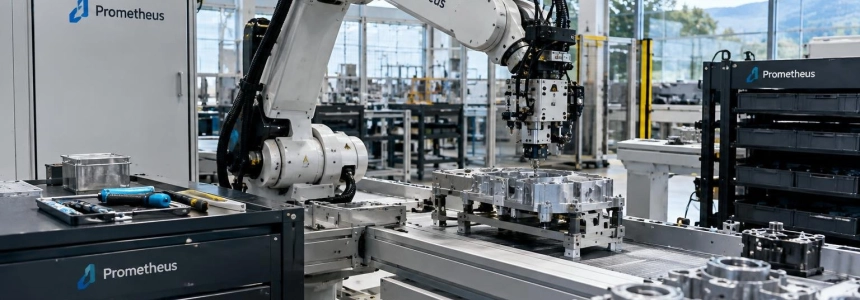
Prometheus calls its goal an “artificial general engineer”: software that automates parts of the design and manufacturing of complex physical systems. Semafor cites jet engines, skyscrapers, and smartphones as examples of what the company wants to help produce. TechCrunch adds pharmaceutical compounds to its list of potential fields.
Bezos’s idea is to reduce the time and personnel needed to develop engineering projects. In an interview with Semafor, he offered a hypothetical example: a job that today would require 100 engineers for ten years could instead take ten engineers one year. In his view, the result would be that more things get built, not just that some processes become cheaper.
“Something that today was going to take 100 engineers 10 years to build, if you can change that to taking 10 engineers one year to build, you’re just going to get way more things built,”
— Jeff Bezos, interview with Semafor
Data is central to the plan. Bezos and Bajaj told Semafor that they have assembled information based both on established physical laws and on test results from manufacturing companies, whose names they did not disclose. Bajaj explained that Prometheus generates much of this data itself, though it also obtains data from other sources.
Some of the information comes from partnerships with companies seeking to improve their processes, Bezos said. When Semafor asked whether the data was exclusive, he replied that he was more concerned about the difficulty of the work than the possibility of building a competitive advantage based on it. The company did not explain exactly what data it uses or what agreements it has signed.
Bezos returns to running a company
Prometheus marks Bezos’s first CEO role since he stepped down as head of Amazon in 2021. Semafor identifies Vik Bajaj as a former Google X executive, while TechCrunch describes him as a former co-founder of Verily, Google’s life sciences unit.
The company has about 150 employees and offices in San Francisco, London, and Zurich, according to TechCrunch. Semafor adds that it operates a large GPU cluster for internal use and also buys computing capacity from other providers. Bezos said that computing capacity is scarce and will probably remain insufficient for some time.
TechCrunch notes that a significant portion of the capital will go toward meeting those computing needs. The company has not specified how much will be allocated to that expense or how the rest of the funds will be distributed. The founders also did not describe the capabilities the company has already built.
The promise of productivity and the debate over jobs
Automating engineering tasks raises questions about employment. Bezos argues that increased productivity could lead to a labor shortage, because building would become easier and cheaper, and demand for workers would therefore grow. TechCrunch presents this view as a counterpoint to those who predict widespread job losses due to AI.
Semafor says manufacturing accounts for about 8% of nonfarm workers in the United States. Bezos does not believe automation will necessarily lead to fewer jobs: he argues that greater production capacity could expand activity and create a need for workers. In an interview with CNBC the previous month, according to Semafor, he also predicted that productivity gains could bring deflation in major sectors.
This position exists alongside Amazon’s recent track record, which TechCrunch mentions for context. Bezos is its executive chairman and largest individual shareholder; under Andy Jassy’s leadership, the company has laid off tens of thousands of people over the past year while accelerating its own automation. That fact does not describe Prometheus’s impact, but it is part of the contrast surrounding Bezos’s predictions about employment.
TechCrunch also reports another part of his argument: productivity improvements, Bezos told CNBC, would raise living standards and could allow some two-income households to rely on one income, or people working overtime to stop doing so. These are Bezos’s predictions, not outcomes that Prometheus has demonstrated with its system.
An industrial bet whose details remain under wraps
Semafor reports a plan to build a portfolio of industrial companies, in the style of Berkshire Hathaway, that would use Prometheus’s models to manufacture products faster and more cheaply. Bezos and Bajaj declined to discuss this second part of the strategy, although they have been raising funds to buy existing industrial companies or create competitors from scratch.
The founders have not detailed which companies they intend to acquire or how the portfolio would work. TechCrunch notes that the company is keeping the details of what it has already built under wraps.
Prometheus is not the only initiative focused on applying AI to the physical world. Semafor notes that researchers from leading AI companies founded Periodic Labs last year to accelerate discoveries in fields such as physics and chemistry. TechCrunch also describes growing interest among investors and founders in physical AI, which some consider more defensible than pure software because the material world can create barriers to entry that code alone cannot.
The bet has also drawn criticism. Semafor recalls that Elon Musk called Bezos a “copycat” in a post on X last year, after the initiative’s existence was leaked. The outlet also reports the concern that the deal carries a risk of institutional investors following the AI hype without yet knowing enough about the project.
Prometheus has announced $12 billion in funding, has about 150 employees, and operates a large GPU cluster for internal use, according to Semafor and TechCrunch. The company is keeping the details of what it has built so far under wraps.
.Sources: Semafor, TechCrunch