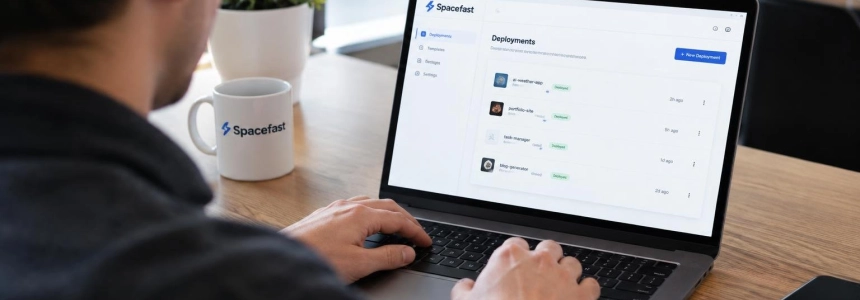
Automattic launched Spacefast on November 9: a platform for bringing applications and websites created with artificial intelligence tools to the web, without requiring users to leave the agent they work with. ChatGPT, Claude, Cursor, Muse, Grok Bot, OpenClaw, and Hermes are among the supported options. The promise is to shorten the leap from an AI-generated prototype to something a team can share and continue developing.
Spacefast provides hosting, a database, and deployment tools. It also lets other people comment on a page and lets the agent use those comments to make changes. Automattic presents it as a way to put projects built through “vibe coding” into production, a practice in which people describe in natural language what they want to build and delegate much of the code to an agent.
The platform is available at spacefast.com. Automattic offers a personal plan with one dollar of included monthly usage, a custom domain, and a database; the Go plan costs $5 per month and adds unlimited spaces and more usage. The Pro plan costs $15 per member per month and includes team features and early access to new features. Enterprise plans with custom pricing are also available.
A shared home for projects across multiple agents
Spacefast does not aim to replace ChatGPT, Claude, or other assistants. The idea is for users to keep working in their usual tool and ask it to publish the project to Spacefast. According to Automattic, the agent receives instructions to get started with a database and prepared configurations; when asked to put the work online, it returns a private link in the conversation.
The platform supports both connecting agents and starting from a Git repository. Automattic lists ChatGPT, Claude, Muse, Grok Bot, OpenClaw, and Hermes, as well as coding tools such as Claude Code, Codex, and Cursor. TechCrunch’s list also includes Pi, OpenCode, and Amp. The company says other assistants can be connected through an API, a command-line interface (CLI), and MCP, and that Spacefast is available as an official add-on in Claude, ChatGPT, Grok Bot, and more.
The company wants the workspace not to be tied to a single person or assistant. One team member can use Claude while another uses ChatGPT or Cursor; their projects live in a shared space where others can find them, comment on them, and pick them up. Each Space is private by default, and the owner decides whether to invite specific people or share a link.
Comments can be left directly on the page. The team describes what it wants to change, and the agent can turn that feedback into modifications. The platform also lets users adjust the agent’s permissions and require approval for sensitive actions. Automattic says files from any saved version can be downloaded and application data can be exported.
MariaDB database and version control
Spacefast’s launch announcement details a MariaDB database for each space, access control, and sharing options. It includes version control, builds, and GitHub support; its Spacefast CI system generates builds and pull request previews. Changes remain available for review or rollback. It also offers domains at cost, with no DNS lock-in, as well as a CDN, DDoS protection, bot detection, and spam controls.
Automattic presents the tool as suitable for projects ranging from a simple page to a real-time application. The announcement lists support for Vite, TanStack Start, Next.js, and Astro, among other stacks. It also mentions starting points such as portfolios, menus, and landing pages; in those cases, it says it accounts for details such as spam protection and adapting to phone screens.
There is a difference between what is available now and what the company has announced for the coming weeks. The database is included from the start, but Automattic lists built-in application authentication, transactional email, and shared team knowledge—including its playbooks and brand context—among upcoming features. Spacefast’s list of future additions also includes object storage, video streaming, design systems, custom skills, e-commerce, payments, and ad monetization.
The announcement also says the platform runs on WordPress.com infrastructure, which handles more than 15 billion page views per month. For WordPress VIP and Pressable customers, it adds, connecting existing sites does not require approval of a new provider.
From an internal project to an Automattic company
Spacefast is led by Batuhan İçöz, founder and CEO of the new company, according to the launch announcement. İçöz joined Automattic through its acquisition of Texts and built the first version of Spacefast during Radical Speed Month, an internal initiative that gave employees time to focus on a single project. Automattic eventually turned it into its own company as colleagues joined and the project grew.
Spacefast’s published account traces the initiative’s origins to April, when Matt proposed that teams temporarily set aside their previous roadmaps to work on projects of their own choosing. The proposal included pairing up within the same time zone, setting a metric, and sharing regular progress updates. İçöz was looking for a way to host static pages and share what he called “AI artifacts”; that work evolved into a platform for complete applications.
TechCrunch reports that, during an earlier period, İçöz was working at Beeper and receiving Vercel links from non-technical friends experimenting with these tools. That experience led him to consider how to make it easier to publish their projects and take advantage of the infrastructure Automattic already had. “I thought there had to be a better way for everyone to set up and deploy their projects,” he told TechCrunch.
“AI is turning everyone into a maker, and the web is about to feel like its early days again, full of small, personal things people build for themselves, their teams, and their friends,”
— Batuhan İçöz, founder and CEO of Spacefast
Before the public launch, Automattic held a limited launch in September to gather feedback, according to TechCrunch. The platform had already been used for internal mockups, presentations, and offer-related websites. İçöz also expects some users to stop using it after trying it: he acknowledged to TechCrunch that some may not be interested in building applications on an ongoing basis.
Published plans and questions about the product’s status
The launch comes as tools such as Lovable and Emergent offer both interfaces and infrastructure for AI-created projects. İçöz argues that Spacefast stands apart by letting each person choose their agent and way of working. TechCrunch points to a possible downside of that flexibility: some users might prefer a solution that makes the decisions for them. Figma, Canva, and Notion have also introduced products that sit between AI coding, mockups, and presentations.
Automattic sees an opportunity among enterprise teams that have landing pages scattered across different services. İçöz described the problem to TechCrunch as a sprawl of IT tools and argued that the company already has experience serving enterprise customers. The company also expects to easily add WordPress integration, web analytics, and e-commerce features through WooCommerce.
The product’s status and commercial information are not described identically across all launch publications. Automattic’s announcement distributed by PR Newswire says Spacefast is now available and lists its prices. Crypto Briefing, by contrast, describes it as a research preview and says pricing for paid tiers was not part of the launch details.
Spacefast’s proposition also responds to a change in web usage that İçöz acknowledges: some people are already creating websites with ChatGPT or Claude instead of deploying them on WordPress, and some projects may not need a content management system. For Automattic, the challenge will be ensuring those projects do not remain prototypes and that teams keep using the platform after the initial novelty wears off.
Sources: TechCrunch, Automattic, Spacefast, Cision PR Newswire, Crypto Briefing, ATLABYTE