
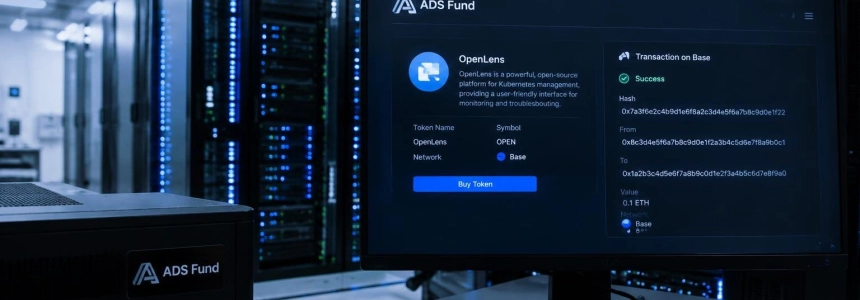
ADS Fund wants open source projects to be able to raise funds through their own tokens, without requiring their developers to manage the launch themselves. The platform offers to create these assets on the Base network and says it handles the technical details and promotional support at no charge. For an SME or a small team with a homegrown product, the proposal is to turn some of the community’s interest into economic activity; however, this is not the same as charging people to use the software, nor does it guarantee income.
The distinction matters. With donation models, someone contributes money directly. ADS Fund proposes that supporters buy or trade a token associated with the project, with a fraction of those transactions going to its developers. Funding is therefore tied to the asset’s activity: if there are no transactions, the mechanism described generates no return.
One token per project, with ADS handling the infrastructure
The ADS Fund website presents the service as a launch platform for open source projects on Base. Its promise is to lower the barrier to entry: the creator team would not have to handle the technical aspects of the launch itself and would receive marketing support. It also invites projects to persuade AI agents to buy the token, indicating that the project aims to attract market activity rather than simply collect donations.
An article published by Bitcoin Insider describes a more specific mechanism: after a project is submitted, the ADS team would manage the token’s creation and deployment on Base, then add it to the platform and promote it on social media. According to the article, the project would receive 0.15% by default of transactions involving its token, increasing to 0.3% if the developer completed a basic verification. This process would involve adding a text file and a badge to the GitHub repository.
Bitcoin Insider also says that ADS does not lock tokens or impose requirements on investors, and that some selected projects may receive airdrops from 1% of the total supply of certain tokens. These details were published in that article; the ADS Fund page, meanwhile, highlights the free service and technical and promotional support, but does not show these terms in the content provided.
“Open source gave us crypto,”
— ADS Fund
The phrase appears in the Bitcoin Insider article, attributed to the platform. It sums up the argument for reciprocity: open software is part of the infrastructure on which the crypto industry is built, and according to ADS, that industry could return some of the value to those who maintain public projects.
What a small team can gain—and what it depends on
For a team with a homegrown project that already has users, the potential benefit is not just fundraising. The token could raise the repository’s visibility and give the community a way to participate in the project. The ADS website displays names of open source projects alongside market capitalizations, 24-hour changes, and donations. It also publishes recent transactions denominated in ADS tokens and other assets. This is a showcase of activity, although these figures alone do not indicate how much money each team has received or how much it has managed to keep.
The list includes projects such as Lldap, Spotube, Etcher, and Ant Design. For example, the website shows a $21 donation next to Lldap and another of $10 next to Chokidar. These amounts are visible in the listing, but they do not necessarily represent the total raised or make it possible to measure those projects’ sustained income. The difference between market capitalization and funds allocated to development is crucial when evaluating an opportunity: a market figure is not money available to pay for work.
There is a more direct sign of use in the Midori for Android repository: its description says that the project is supported by ADS.FUND. This shows a public link between the platform and a software product, although the repository page does not specify how much money it has received or how the support is calculated. It does not allow us to conclude that the model already covers costs or provides stable income.
For an SME, then, the practical question is not just whether it can launch a token, but whether it has a community willing to use it and what that community expects in return. Bitcoin Insider raises the risk that buyers may behave like speculators and seek to resell the asset rather than support development. The mechanism described makes returns dependent on transaction volume; initial interest may not translate into recurring funding.
The tension between support and speculation
ADS Fund proposes an alternative to relying exclusively on donations or corporate sponsorships. Bitcoin Insider compares it with donation platforms such as GitHub Sponsors, OpenCollective, and Liberapay, and notes that these channels can depend on each project’s visibility and promotional capacity. The token changes the incentive: participants might expect the asset to increase in value, in addition to wanting to support the software.
This change may attract people who would not donate through traditional channels, but it also alters the relationship between the community and the project. If the conversation shifts toward price, market fluctuations may carry more weight than development priorities. The Bitcoin Insider article identifies precisely this balance—between meaningful participation and speculative trading—as one of the model’s challenges.
The platform proposes lightweight verification to link the asset to the repository: adding an adsfund.txt file with the registration details and a “Supported by ADS” badge to the README.md. According to Bitcoin Insider, this method makes the relationship between the project and token visible, but does not certify the quality of the software. For a company evaluating the service, the badge can serve as a sign of participation, not as a guarantee of legitimacy or financial performance.
The regulatory and tax unknowns
Bitcoin Insider warns that token-based funding models could be subject to securities regulation in some jurisdictions, especially if the assets are traded with an expectation of profit. The article does not identify any countries or offer a legal conclusion applicable to a specific case. Nor does it detail tax obligations, accounting treatment, or how to report the income received.
This gap is especially important for an SME: launching a token and receiving a share of transactions can raise issues that differ from those associated with a conventional donation. The available sources do not make it possible to determine what obligations would apply to a specific company or whether a particular token would be considered a security. Therefore, the promise of a technically simple launch should not be confused with an assessment of its legal or tax consequences.
ADS Fund puts forward a funding channel based on tradable assets, with a technical barrier that the platform says it lowers and a reward tied to transactions. For small teams, the appeal lies in trying an additional channel without taking on the work of building the infrastructure. The decision depends on accepting its conditions as well: variable income, exposure to speculation, and regulatory questions that the published material does not resolve.
Sources: ads.fund, GitHub, upd.dev (GitHub issue archive), Bitcoin Insider


