Linux 7.4-rc3 adds a mitigation for TSA on AMD Zen 5 and enables three graphics clock management features for GC 11.0.2, the Navi 33 generation. Linus Torvalds announced this third release candidate on November 15; the changelog also includes fixes for drivers, networking, and filesystems.
A TSA mitigation, with no further details in the changelog entry
Among the release fixes is the change “Mitigate TSA on AMD Zen5”, attributed to Borislav Petkov. The entry confirms that the kernel includes a mitigation for TSA on those processors, but does not specify what it involves or its usage conditions or effects. It also does not identify specific affected models.
The reference appears in the Linux 7.4-rc3 announcement alongside many other fixes. It is not presented as a formal vulnerability notice or as a bulletin with a CVE identifier: the changelog places it among the patches in this release candidate.
Navi 33 gains three clock management features
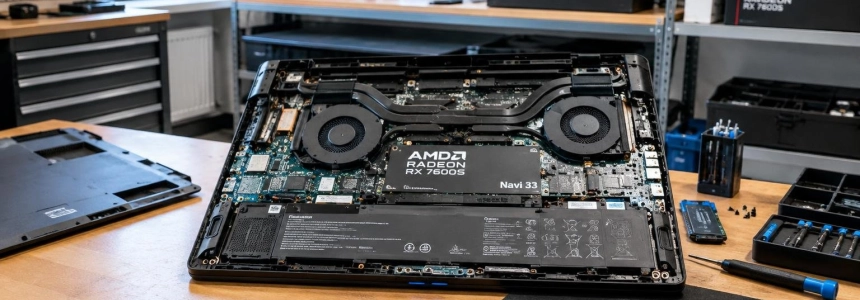
Another notable change affects GC 11.0.2, based on Navi 33, in the amdgpu graphics driver. Andrei Krautsou’s proposal enables MGCG, FGCG, and PERF_CLK, three flags that allow the shared GC 11 code to adjust clock management. According to the patch explanation, GC 11.0.2 did not have these features enabled, although GC 11.0.0, 11.0.1, and 11.0.4 had all three; GC 11.0.3 already had MGCG.
Krautsou explains that without these flags, the driver does not clear the override bits in RLC_CGTT_MGCG_OVERRIDE under load, leaving clock management disabled. On the RX 7600S tested, the GFX current limit was 68 A on both Linux and Windows. With clock management disabled, each MHz consumed more graphics current, and the power management firmware stopped the clock earlier than it did on Windows.
The following figures come from a 300-second vkpeak test, using the median after the first 60 seconds. In all cases, GFX current was around the 68 A limit. The Windows measurement is compared only by GFLOPS, because the system reports different clock sensors.
| Configuration | GFX clock | VDDGFX | Result |
|---|---|---|---|
| Without the flags | 2,030 MHz | 800 mV | 8,915 GFLOPS |
| MGCG | 2,261 MHz | 873 mV | 9,921 GFLOPS |
| MGCG, FGCG, and PERF_CLK | 2,314 MHz | 894 mV | 10,104 GFLOPS |
| Windows 11 with AMD driver | Not comparable | 910 mV | 10,157–10,186 GFLOPS |
With all three flags enabled, the measured result was less than 1% below Windows, according to the patch author. MGCG delivered most of the improvement; FGCG and PERF_CLK added around 2% more. The difference between the configuration without flags and the one with all three enabled was 1,189 GFLOPS in this test.
An initial test on a single laptop
The measurements were taken on an ASUS TUF A16 FA617NS with a Radeon RX 7600S and PMFW 82.97.0. The system ran Fedora with kernel 7.2.11 and Mesa 26.2.5; Krautsou enabled the flags using a local debugging patch. He ran a 300-second test for each setting and some gaming tests, and observed no amdgpu errors in dmesg.
The author himself qualifies the scope: he has only this one laptop with Navi 33. He had not tested suspend and resume or long runs, and said he had not found out why GC 11.0.2 lacked these flags. He suggested that if FGCG or PERF_CLK proved problematic, MGCG alone would still provide most of the gain: in his test, it improved GFLOPS by around 11% compared with the initial configuration.
The proposal is linked to an issue filed in AMD’s tracking system. The rc3 changelog includes Krautsou’s patch, so all three features appear among the changes in this release candidate; the figures, however, come from the local tests described in the submission, not from a general evaluation of Navi 33 hardware.
iomap and networking account for much of the rest
Torvalds described rc3 as “the usual noise all over” and noted that small changes predominate, although the overall set is broad and network and graphics drivers lead the activity. He also highlighted a change to the iomap calling convention, the kernel’s shared layer that lets filesystems query storage in byte ranges.
and the usual noise all over.
— Linus Torvalds
Joanne Koong of Meta submitted five patches to change the iomap model: instead of start and end calls, users advance through iomap_iter_next(). The work requires adapting XFS, btrfs, ext4, f2fs, gfs2, ntfs3, ntfs, erofs, zonefs, ext2, and ext_map in FUSE. Torvalds called it a “fairly trivial but large” change: the logic does not change, but many files do.
In networking, the changelog lists 19 patches from Paulo Alcantara for the SMB client and another 19 from Avi Weiss for NFS and SUNRPC, as well as four from Jeff Layton. Security fixes include one from Jérémy Jean that closes an authentication bypass in TCP authentication options. The list also includes changes to help the SMB client handle writes with O_DIRECT identifiers and retries when reconnecting.
The Intel drm/xe, AMD amdgpu and amkfd, and Intel i915 graphics drivers receive changes. The list includes, among other things, a fix to prevent the reuse of still-referenced VRAM pages, changes to TLB invalidation fence management, and a fix to Type-C port locking order. Other subsystems include fixes for ksmbd, NTFS, KEYS, and caam.
The release candidate follows a record integration window
The 7.4 cycle began with an integration window that closed on November 1 and added 19,671 changes, according to Linux Compatible. That figure exceeds the 16,267 in version 7.3 and the 14,395 in 7.2; a typical window is around 15,000. The tree is approaching 42 million lines of code, although a large contribution of AMD DCN6 GPU register header files accounts for a considerable portion of the total.
Linux Compatible also reports that Torvalds considers it preferable for AI-assisted patches to arrive during the integration window as part of normal development, rather than being concentrated in the stabilization phase. Many of those changes, the publication notes, are rewritten before being incorporated. Alexei Starovoitov, BPF maintainer, reported that developers in that subsystem were fixing bugs detected with AI assistance faster than new reports were coming in; Torvalds warned that most other subsystems had not yet reached that point.
Linux 7.4-rc3 is a development release candidate, not the final version. Torvalds’s announcement lists fixes and automated tests, but does not set a stable release date in the message. For now, the most concrete data on graphics power savings remains the vkpeak result obtained on an RX 7600S with the local patch.
Sources: Linux Compatible, AMD GPU mailing-list archive, Openwall Linux Kernel Archive