OpenAI is now showing some businesses how often they appear in ChatGPT and how many clicks their websites receive from the platform. The new portal, Business Hub is in beta, lets businesses claim a profile, keep business details up to date, and view engagement metrics. For eligible U.S. ecommerce and online service businesses, it also includes conversational agents that can answer questions about their products.
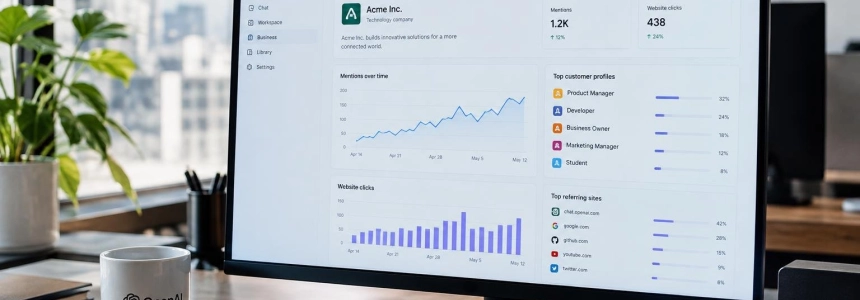
OpenAI’s November 10 announcement presents Businesses in ChatGPT as a way to connect with the 1.2 billion people who use ChatGPT each week. The tool brings together business profiles and information with aggregated statistics: mentions, profile views, and website clicks. It also offers discovery topics—that is, common subjects in conversations where a business’s website is mentioned.
The clicks metric has an explicit limitation. A help notice states: “Number of recorded clicks on links to your website in ChatGPT. Clicks don't confirm website visits or conversions.” It counts clicks recorded on links; it does not measure actual visits or purchases.
“We’re introducing Businesses in ChatGPT in beta, giving businesses a new way to connect with the 1.2 billion people who use ChatGPT each week.”
— OpenAI
Claimed profiles and engagement data
Businesses can search for their business in Business Hub and claim its profile to correct or complete the information ChatGPT provides about their products and services. Verification, as described by Search Engine Roundtable, can be done by text message or a call to the business’s main phone number, or through DNS verification. The author of that publication said they used DNS.
OpenAI says a verified business can provide information so people can explore its products and services using accurate, up-to-date details. PPC Land adds that the portal allows businesses to add product catalogs with prices and availability. Shopify merchants can connect their store from Business Hub or the Shopify admin panel; catalog data can be transferred automatically so they can review products, prices, and inventory.
The dashboard separates brand statistics from agent metrics. According to PPC Land, the brand section includes counts of mentions, profile views, and clicks, as well as a chart of mention trends and the top five discovery topics. Seven- and 28-day views are available. The tool does not reveal what questions people asked or who asked them: OpenAI says users’ conversations and chats with agents are not shared with businesses. Metrics are shown in aggregate and only when a sufficient interaction threshold is reached, though that threshold is not quantified.
The published examples show why it is useful to distinguish a demonstration from the first data shared by businesses. The fictional dashboard for toy store Colorful Clatter shows 15,356 mentions, 1,234 profile views, and 5,432 clicks over seven days. Its topics include “Affordable kids activities,” with 5,375 mentions and a 35% share; “Gift for kids,” with 3,993 and 26%; “San Francisco toy shops,” with 2,610 and 17%; and “Fun toy brands,” with 1,996 and 13%.
By contrast, the real screenshots that circulated on November 10 were much more modest. Conrad O'Connell posted data from BuildUp Bookings on X: 690 mentions and 24 clicks over 28 days. The Second account shared a Spanish-language dashboard for Zianvo showing 28 mentions and one click. Both showed data through November 9, according to PPC Land, and neither is enough to establish a general average. Search Engine Roundtable noted that some users still saw an empty dashboard, while others were already sharing figures.
Verification, review, and data still hidden
The process starts by searching for a business name. The screen lets users select an existing listing or create a new one, then prove that the person claiming it is authorized to represent the business. After submitting the request, the interface may show the statuses “Claim received” and “Review in progress”; the decision is sent by email, and users can withdraw the request while it is under review. PPC Land also observed a subsequent request to verify identity with an official document before changing information or publishing an agent.
OpenAI has not detailed all its verification criteria in the announcement. According to PPC Land, eligibility depends on factors such as industry, location, and verification and integrity checks. OpenAI business customers and advertisers can process a claim through their OpenAI representative. Shopify merchants have the store connection as an additional option.
Data visibility has limitations beyond privacy. The dashboard does not show the questions that led to a mention, user data, or rankings against competitors. It has also not been explained when the profile views metric appears: it is included in OpenAI’s example and the product description, but not in the two real screenshots mentioned by PPC Land.
The ability to claim profiles also raises the risk that someone might try to impersonate a business. Search Engine Roundtable raised this concern in its coverage of the launch. Authority checks are part of the process, but OpenAI has not explained in its announcement how it resolves a dispute over an improperly claimed listing. Not everyone was able to complete the process on the first day, either: Fabio Ricotta said on X that his request was placed on a waitlist and that he would receive updates by email.
Agents for product questions
Eligible businesses can create, test, and publish a Business Agent, an assistant that answers questions using information provided by the business. OpenAI gives the example of someone comparing two products and asking about their differences and which features suit their needs. The business can provide product and policy information and set guidelines for responses.
According to OpenAI, the agent remains separate from a regular ChatGPT conversation and from the assistant’s independent responses. In the published example, a business profile includes delivery and returns policies, a description, product cards with prices, and the options “Start chat” and “View website”. The first opens a conversation with the agent; the second takes users to the website.
For now, these agents are available to eligible ecommerce and online service businesses in the United States. OpenAI also says businesses can sponsor their agent and use it as a destination for ChatGPT ads. Sponsored placements must be labeled and kept separate from ChatGPT responses.
The connection between the free profile and advertising makes the agent a feature that can both answer questions from a profile and receive users from a paid campaign. Digiday had reported before the launch that the dashboard would not show queries or rankings against competitors, and that organic metrics could complement external tools for visibility in generative search. Business Hub, however, provides OpenAI’s own counts of mentions and clicks.
A new attempt to bring ChatGPT closer to commerce
The launch comes after a different attempt to turn ChatGPT into a place to shop directly. TechCrunch notes that OpenAI had tested an ecommerce experience with a cart and a commission system, but abandoned that project in March. Business Hub does not offer the same model: it focuses on profiles, business information, product discovery, and conversations with agents.
PPC Land links the new agents to OpenAI’s advertising business: a company can sponsor its agent and direct ChatGPT ads there. Digiday also places the dashboard on the organic side of brand visibility, while suggesting that counting mentions could increase advertisers’ interest in promotion.
For now, the most tangible change for businesses is the ability to claim a listing and view some activity counts, without access to the conversations that generate them. For eligible U.S. businesses, the next available step is to configure an agent that answers questions and, if the business chooses to promote it, can also receive traffic from ads.
Sources: Search Engine Roundtable, TechCrunch, Digiday, PPC Land