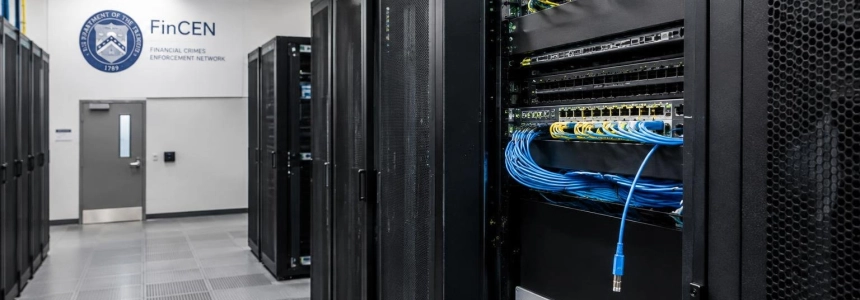
The U.S. Treasury Department’s Financial Crimes Enforcement Network (FinCEN) disconnected some systems after unauthorized access to a limited portion of its infrastructure. The agency is investigating the incident; its filing portal remains operational, although some services may be temporarily unavailable.
The alert appeared on the BSA E-Filing system website, which financial institutions use to submit reports required under the Bank Secrecy Act. FinCEN said it took the measure as a precaution while investigating; it has not detailed how the intrusion occurred, how long it lasted, or which specific systems were disconnected.
The notice describes the incident as unauthorized access to a limited subset of systems. The agency has not confirmed that data was viewed, altered, or taken. Nor has it attributed the operation to a group or country.
“FinCEN is investigating a cybersecurity incident that resulted in unauthorized access to a limited subset of its systems.”
— FinCEN
The portal remains available, but not all services
The BSA E-Filing page remains online, although some services may be temporarily unavailable. FinCEN said it is working to restore normal operations as soon as possible. It has not indicated how long the affected systems may remain offline.
The portal allows users to submit suspicious activity reports, currency transaction reports, and other filings related to the Bank Secrecy Act (BSA). This 1970 federal law is a central component of U.S. policy against money laundering. Banks, credit unions, brokerage firms, casinos, and other financial institutions use the platform.
Suspicious activity reports feed the database FinCEN uses to support criminal, tax, and national security investigations. CyberScoop notes that filing delays can slow the flow of information to federal authorities.
The agency clarified that its financial institution hotline is not affected. Institutions that need to transmit urgent information about suspicious activity to law enforcement can call 1-866-556-3974.
Which filers can use the extended deadline
A temporary relief order issued on November 24 gives certain filers affected by the disruption more time. The Hacker News identifies the order as FIN-2026-R002: covered reports originally due between November 18 and December 29 may be filed through December 30.
The measure does not suspend all BSA obligations. According to The Hacker News, it applies to three specific groups, while the duty to monitor suspicious transactions remains in effect.
| Covered group | Condition specified |
|---|---|
| Entities filing through SDTM | Were using Secure Direct Transfer Mode to send batches from their own servers as of November 18. |
| Companies with beneficial ownership reports | Were required to file a beneficial ownership information report during the covered period. |
| Individuals with a FinCEN identifier | Were required to update their FinCEN Identifier during that same period. |
The order describes the reason as a service disruption that makes it difficult to meet filing obligations. The Hacker News notes that the text does not expressly attribute the disruption to the cyber incident. FinCEN has also not confirmed whether earlier automated filing problems resulted from the intrusion.
Filing problems began before the announcement
The Hacker News dates the start of filing difficulties to November 18, when filing service providers reported failures in automated batch transmissions. FinCEN posted a notice late last week about disruptions to SDTM, the channel that lets entities send batches of BSA reports directly from their servers.
That background does not by itself establish a connection to the intrusion. The relief order refers to a service disruption but does not mention the cybersecurity incident; FinCEN has not said whether the two events are connected.
CyberScoop reported that the FBI, the Cybersecurity and Infrastructure Security Agency (CISA), and external forensic examiners are involved in determining the scope and impact. The Record, meanwhile, attributed to a FinCEN spokesperson confirmation that the FBI and CISA are involved in the investigation.
Regarding the beneficial ownership databases, CyberScoop said a source told it there was no indication of a breach. The Record also reported that investigators had no evidence that those databases or the BSA databases had been compromised. FinCEN has not published a conclusion on whether data was accessed or modified.
A day of incidents at federal agencies
FinCEN’s disclosure coincided with reports of a breach in an open-source intelligence analysis system used by the CIA and the Office of the Director of National Intelligence (ODNI). CyberScoop said it was unclear whether the two incidents were related.
SecurityWeek also placed the case in the context of a series of disruptions and incidents affecting U.S. agencies. Among the episodes it mentioned were the National Security Agency’s temporary disconnection of an internal network used for classified communications and an FBI investigation into an apparent intrusion into a national law enforcement database.
The Record also described an earlier Treasury breach in 2024, in which a China-linked group used a compromised BeyondTrust API key. That incident reached department systems and documents. The publication noted that no connection has been reported between that breach and the current FinCEN incident.
For now, the perpetrator and potential impact on data remain unclear. FinCEN is working to restore its systems to normal, while keeping the filing website and emergency hotline active.
Sources: SecurityWeek, CyberScoop, The Hacker News, ABC News, The Record