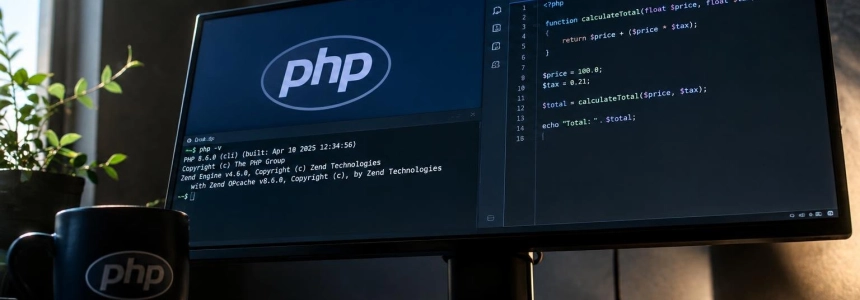
PHP 8.6 introduces partial function application, a polling API for streams, and the new Time\Duration type. The release also changes session security defaults and opens a broad round of deprecations: for teams, the news is not only what they can write, but also which existing code they need to review.
There is a discrepancy in availability status: PHP.net announces the release, while PHP.Watch still describes 8.6 as a development branch, shows 8.6.0RC7, and lists November 19, 2026, as the first GA release. The official page presents the features as part of a released version; this difference makes it advisable to check the download channel and status used by each environment before planning deployment.
Fewer wrappers for callbacks
Partial application lets you fix some of a function's arguments and leave others pending using the ? and ... placeholders. The result is a Closure that waits for the remaining arguments and executes the original function when it receives them. In code that passes callbacks—for example, to array_filter()—this can replace arrow functions created solely to fix a parameter.
The difference is not merely aesthetic: the argument is expressed alongside the function, rather than hidden inside an additional layer. Zend connects this syntax with the pipe operator introduced in PHP 8.5, because it allows transformations to be chained with fewer manually written closures. The WordPress blog also sees potential here, although it warns that its core will not adopt recent features soon while it maintains a much older minimum PHP version.
“The most talked-about new feature is partial function application (PFA), and rightfully so.”
— Milana Cap, WordPress Developer Blog
For libraries, the practical advantage will be the ability to offer callback APIs that can be composed with less helper code. The cost is that code using this syntax requires PHP 8.6; if a package is distributed to applications with lower minimum versions, its authors will have to maintain an alternative or restrict compatibility. The new syntax does not eliminate that support decision.
Typed durations and polling for streams
Time\Duration represents elapsed time, not a date or time zone. PHP.net states that it supports nanosecond precision and a range of more than 250 years. It can be used to express delays, timeouts, or performance measurements without mixing integer units in arguments whose meaning depends on comments and conventions.
The official example turns an exponential wait into a typed operation: it adds durations, limits the result with min(), and sleeps using seconds and nanoseconds. Units become part of the value, and the duration can also be combined with partial application to prepare a retry function. The WordPress blog points to potential uses in cache expirations, cron intervals, and HTTP timeouts, but presents them as future opportunities, not as changes already made in WordPress.
The Io\Poll API addresses another limitation: it allows multiple streams to be monitored using the mechanism available on each platform, such as epoll, kqueue, event ports, or WSAPoll. PHP.net presents it as a foundation for event-loop libraries such as ReactPHP and AMPHP, and compares it with stream_select(), which the example describes as normally unable to handle more than 1024 connections.
The consequence for those maintaining asynchronous infrastructure is a common, scalable polling foundation, but not an automatic migration of the libraries: ReactPHP and AMPHP can build on the API, according to the official page. Zend also notes that these improvements lay the groundwork for future advances in asynchronous processing. The new stream error API is optional as well: it allows exceptions or silent failures and exposes structured errors with the affected code, wrapper, and path or URL.
| Change | What it provides | Aspect to consider |
|---|---|---|
| Partial application | Fixes arguments and returns a Closure. | Code that uses it requires PHP 8.6. |
| Time\Duration | Represents elapsed time with nanosecond precision. | Consumers must decide whether to adopt this type in their APIs. |
| Io\Poll | Multiplexes streams using native system mechanisms. | Event libraries can use it as a foundation. |
| Stream errors | Provides structured errors and exception or silent-failure modes. | The change is configurable; it is not mandatory. |
Security and consistency in APIs
Sessions gain more restrictive defaults: PHP 8.6 enables session.use_strict_mode and session.cookie_httponly, and sets session.cookie_samesite to Lax. Zend links these settings to preventing session fixation, access to cookies from JavaScript, and cross-site requests. For businesses, the immediate effect is that an update may change the behavior of applications that relied on the previous configuration; it is worth reviewing both the configuration and custom session handlers.
These handlers also have a new requirement: those that do not implement create_sid() and validateId() are deprecated. In parallel, PHP adds SortDirection, with the cases Ascending and Descending, so libraries can share a type instead of mixing integers, strings, booleans, and custom enumerations. A typed signature can reject invalid values at the boundary that previously would have made it through to a failure inside the logic.
The new clamp() limits any comparable value to a minimum and maximum, and can also work with Time\Duration. However, it is not new to every ecosystem: the WordPress blog notes that its core has included an implementation since version 7.1. This is a concrete reminder that a function built into the language does not guarantee that every project will gain anything by replacing its own solutions.
The compatibility bill
The deprecation list affects patterns found across applications and dependencies. PHP 8.6 deprecates Oniguruma-based mbstring regular expressions, including functions such as mb_ereg() and mb_split(); the official page recommends using PCRE functions with the u modifier. Zend links the decision to the end of Oniguruma maintenance in April 2025.
Aliases such as is_double(), is_long(), and is_integer() are also deprecated, along with spl_object_hash(), for which spl_object_id() is proposed. WordPress offers an example of the work this cleanup can involve in ecosystems with extensions: it reports matches in thousands of plugins for several of these names. These are not just warnings in the core; included libraries and third-party code can produce them too.
Other changes affect less obvious cases: returning values from __construct() or __destruct() is deprecated; using return in a finally block is also deprecated, because it can discard exceptions or returned values. Passing objects where arrays are expected is deprecated in several functions, and trim(), ltrim(), and rtrim() now also remove the form-feed character by default.
There are also changes that can expose previously ignored failures: fclose(), file_put_contents(), and copy() return false if flushing or closing the stream fails, and several functions throw ValueError for out-of-range values, invalid flags, or strings containing NUL bytes. An update can change runtime results, not just add warnings; it is therefore worth reviewing error paths and automated tests.
WordPress shows the cost of maintaining compatibility
The WordPress team was already testing PHP 8.6 in the PHPUnit matrix for the 7.2 development cycle. The blog post, updated with project comments, says that since November 10, tests on 8.6 can no longer fail and that known compatibility issues in the core had been resolved. Even so, its stated minimum version was still PHP 7.4, which separates being compatible with a new version from being able to use its features in the core.
This gap affects plugin developers and businesses deploying WordPress: a feature available in the language may take time to become a viable dependency for a product that must support older installations. The blog notes that around 17% of WordPress sites were still on PHP 7.4 at the end of October, down from approximately 20.5% in April. It also raises selectively enabling new features based on the installed version as a possible path for extensions, not as a policy already adopted by the core.
To assess the migration, the practical order is to identify deprecations in your own code and dependencies, run tests on PHP 8.6, and check configuration and error-handling differences. The new APIs can simplify callbacks, timing, and network operations, but their value depends on whether deployment and application support allow them to be used. PHP.net refers readers to the migration guide for the complete inventory of backward-incompatible changes.
The immediate decision for each team is whether to test the version in its validation environments and which dependencies need updating. In the WordPress ecosystem, the gap between being able to run PHP 8.6 and raising the minimum version will continue to determine when new features reach shared code.
Sources: php.net, PHP.Watch, WordPress Developer Blog, Zend