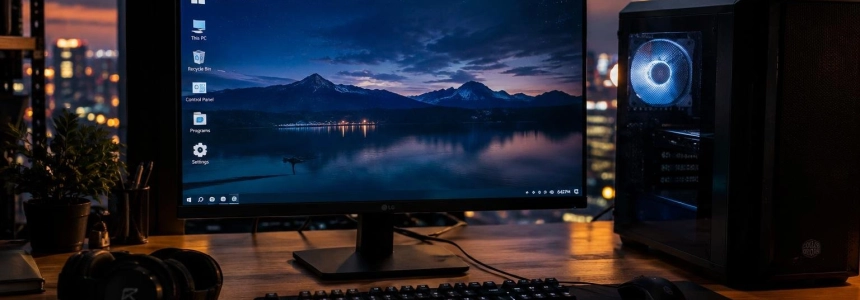
Impossible OS already boots on real hardware and displays a desktop, although its creator warns that it is not yet ready for everyday use. Derick Payne, an independent South African developer, is building this system from scratch for x86-64 machines, with the first public release planned for August 8, 2028.
The proposal is neither a Linux distribution nor a Windows adaptation. The project website describes Impossible OS as a modern, open-source 64-bit operating system with a desktop visually inspired by Windows 11 and an architecture intended to run Win32 applications natively. That is a considerable ambition for a project Payne is developing on his own.
A system built from the ground up
Profesional Review attributes a custom ring 0 kernel, a UEFI bootloader, and an original graphical environment to the project. The GitHub repository specifies that it is a 64-bit SMP kernel and a desktop with window compositing. The code is written primarily in C and x86-64 assembly; the project also incorporates mature open-source libraries when rewriting them is not practical.
The system uses UEFI-only boot and does not support legacy BIOS or VGA text mode. Its custom bootloader hands control to the kernel, and the project says direct boot already works. Secure Boot support is under development: GitHub notes that shim chaining is implemented, but no shim is pinned while the transition to Microsoft's UEFI certificates is being resolved.
For storage, Impossible OS combines IXFS, its own file system, with FAT32 for reading and writing USB drives. The official page lists journaling, copy-on-write, and 64-bit extensions in IXFS. It also reports AHCI drivers with DMA and NCQ, a native NVMe driver, and an ATA PIO driver as a fallback for older machines. GitHub adds support for VirtIO storage and GPT and MBR partitions.
The kernel starts the available processors and distributes threads using a round-robin scheduler. The site mentions mutexes, semaphores, read-write locks, seqlocks, and a basic RCU implementation. Per-CPU run queues and fair scheduling in the style of CFS are listed as future work; therefore, not every component described in the architecture is complete.
Win32 as the system interface
The distinctive feature of the approach is how it aims to run Windows programs. Rather than relying on a virtual machine or an emulation layer, the project presents Win32 as the kernel's native interface. According to the official website, calls such as CreateFile() and ReadFile() are translated directly into native NT system calls, and PE32+ executables can be loaded and run natively.
That goal does not yet amount to full compatibility. Impossible OS's own page says the complete Win32 subsystem is under construction. The available SDK is minimal and user-mode; it includes functions such as GetCurrentProcessId, GetTickCount, CreateFileA, ReadFile, and CloseHandle. The full SDK and packaged releases remain on the roadmap.
The project also aims to run Linux ELF binaries without modifying them. To do so, it plans an integrated layer that translates calls such as open(), read(), fork(), and exec() into operations handled by its own kernel. According to the official site, it would not rely on WSL or containers, but Linux compatibility has not yet been implemented.
The graphical interface already has a taskbar, Start menu, and compositing window manager. Rendering includes translucent Acrylic surfaces, dirty-rectangle repainting, TrueType text, gradients, and CPU-accelerated blur using SSE2. Mica title bars are listed as the next step on the project page; GPU acceleration remains an area of research.
Networking, registry, and project status
Networking covers Ethernet, ARP, IPv4, ICMP, UDP, and DHCP through an RTL8139 driver. TCP, DNS, and a VirtIO-net driver are planned. The system also has a Windows-compatible registry, with HKLM and HKCU hives and functions such as RegOpenKeyEx and RegSetValueEx; data is stored on disk, while transactions and faster storage remain under development.
Profesional Review says the repository already contains more than 1.4 million lines of code and that the system can boot on hardware and display a desktop. GitHub classifies it as pre-alpha and warns that it is not ready for everyday use. The repository describes a roadmap of 235 planning files across 18 areas, as well as 3,760 kernel test suites with 17,663 assertion checks run after every commit.
The testing plan includes QEMU with KVM or TCG, VirtualBox virtual machines, and real hardware. The project says a feature should be considered complete when it works on physical machines, although virtual machines are useful for iteration. For building, it publishes custom scripts and identifies Ubuntu or Debian 24.04 or later as fully supported environments; Fedora and Arch are considered supported with caveats, while native Windows and macOS are unsupported. On Windows, WSL2 is specified.
The code is public on GitHub and licensed under GPL-3.0-only. The repository lists 495 stars and 23 forks. The project invites contributions and says hardware reports are especially welcome; it also offers disk images for QEMU or a USB drive, and a VDI image for VirtualBox, on its releases page.
A target date and a long road ahead
The first public release is targeting August 8, 2028. The official page accompanies the schedule with a joke about finishing “sometime between next month and the end of time.” The line suits a project that explicitly acknowledges how improbable it is to build a complete system from scratch, but it does not change the target date.
Profesional Review compares the scale of the challenge to ReactOS, a project that has spent nearly three decades trying to reproduce Windows compatibility. It also notes that the South African developer's previous work included smaller utilities and office suites. The publication suggests that artificial intelligence could be involved in the programming, but makes clear that this is not something the people responsible have commented on; there is no confirmation from the project that would support attributing its work to AI.
Between now and the public release, the roadmap shows several outstanding tasks: completing the Win32 subsystem, implementing ELF compatibility, advancing Secure Boot, and adding networking components such as TCP and DNS. The official page also recommends caution about everyday use: its FAQ says it would only be suitable if your daily routine includes kernel crashes and debugging C at three in the morning.
The immediate test for Impossible OS will not simply be whether it boots, but how much of its compatibility promise works with real software. For now, the system already displays a desktop on real hardware; the project has set August 8, 2028, as the date for its first release.
Sources: Profesional Review, Impossible OS, GitHub