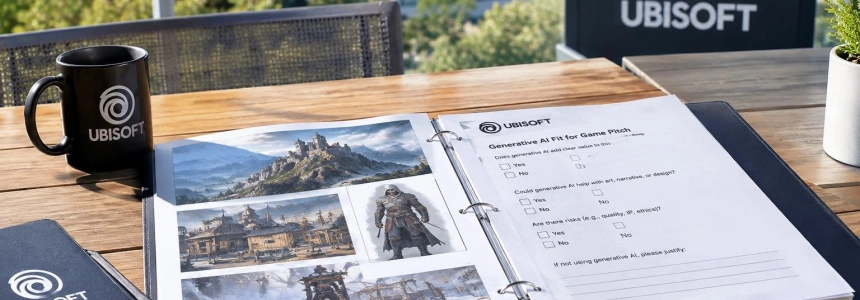
Ubisoft teams pitching new projects may have to explain how generative AI would help speed up development or detail why they do not plan to use it. According to several current employees quoted anonymously by Vertical Slice, proposals that omit both explanations will not be approved.
The information comes from accounts by current employees who spoke to Vertical Slice without revealing their identities for fear of retaliation. GamesIndustry.biz reported their statements and noted that, according to these sources, the people reviewing proposals expect to see how the technology would enable faster production. If a team decides not to use it, it would have to defend that decision in detail.
Speed as an argument for including AI
Management reportedly presented generative AI as a way to help small, agile teams prepare proposals and prototypes in less time. One person quoted told Vertical Slice that the plan was to iterate quickly and discard projects that did not work, with AI helping to maintain that pace.
The same source described the technology as essential to speeding up the process, according to the message received by teams. The idea, as the employee conveyed it, is that the tools would allow more ideas to be tested and help filter which ones deserve to move forward. The point of friction is that a proposal that does not include AI would have to justify why the tool is not appropriate.
“Ubisoft is in a top-down nightmare of AI psychosis. Yves [Guillemot] has hitched his wagon to the tech, demanding the rest of the company follow on.”
— Ubisoft employee quoted anonymously by Vertical Slice
Vertical Slice also reported that management presented the approach in an internal presentation for employees. According to one of its sources, Ubisoft does not explicitly require every project to incorporate generative AI, but the company’s push for the technology has changed the internal climate. Another employee summed up this shift by saying that staff feel cornered by AI.
The outlet attributes a parallel request to employees: that Ubisoft approve smaller projects and leaner teams, rather than relying so heavily on large triple-A productions. Those responsible for evaluating proposals are reportedly presenting AI as a way to support that model. The employees quoted by GamesIndustry.biz also say that the company considers the technology inevitable and believes most of its players do not mind it, even though a very vocal minority opposes it.
Ubisoft says use is not mandatory
Following the publication of Vertical Slice’s report, Ubisoft said it encourages its teams to explore cases where AI could add value, but clarified that no project is required to use generative AI. The company said each team should decide whether these technologies make sense for the game it wants to create and the experience it aims to offer players.
That qualification contrasts with accounts about proposal approvals: according to employees, not using the technology would not prevent a project from being submitted, but teams would have to explain why. Ubisoft had not responded to Vertical Slice’s request for comment when the report was initially published, according to GamesIndustry.biz. The latter outlet said it had also asked the company for a response.
The discussion comes after the launch of Motherbrain, a subsidiary dedicated to generative AI. The unit brings together the team that developed Teammates, Ubisoft’s first playable generative AI experience. CEO Yves Guillemot said Motherbrain will work on proprietary technologies for games, designed to help creators and open up possibilities for richer, more immersive experiences.
Ubisoft had already unveiled Teammates in November 2025. In that experience, companion characters responded to the player’s instructions and requests expressed in natural language. The company had also shown the NEO NPC demo at GDC 2024, built with Inworld’s Character Engine and NVIDIA’s Audio2Face, according to Wccftech. Ubisoft’s internal research into potential uses of AI in video games therefore predates the creation of the new subsidiary.
The debate coincides with staff reductions
The expansion of these initiatives is taking place during a period of cuts. According to Ubisoft’s latest fiscal report, cited by GamesIndustry.biz, its workforce fell from 20,700 people in September 2022 to 15,500 in September 2026—a reduction of 5,200 employees over four years. The outlet notes that not all of those departures were due to layoffs or studio closures.
Shortly before its most recent earnings announcement, Ubisoft laid off 166 employees at its Montreal and Quebec studios. In June, it closed its Winnipeg and Belgrade studios; jobs were also lost at the San Francisco office, and Ubisoft Barcelona made layoffs in July. GamesIndustry.biz reported that employees described internal morale as low and pointed to the cuts, the requirement to return to the office five days a week, and the lack of replacements for many people who leave.
One employee said some teams are being left with an unsustainable workload and that farewells to colleagues are happening every few weeks. Another described the atmosphere as “abysmal” and linked that mood to both the cuts and the return-to-office mandate. These assessments come from the anonymous employees quoted by Vertical Slice, not from an official Ubisoft statement.
A strategy the company presents as creative support
In May, after reporting a record operating loss of 1.3 billion euros, Ubisoft said it was using AI to improve the player experience and increase the creativity and efficiency of its teams. The company said at the time that it would accelerate investment in Teammates and was developing tools to manage the complexity of development processes, support quality control, and create smarter non-player characters and more reactive game worlds.
Wccftech places this push within a trend it also attributes to other publishers, including Epic Games, Krafton, Nexon, Electronic Arts, Square Enix, and Sony. In Ubisoft’s case, however, the new source of tension is the internal project-selection process: employees describe AI as an expectation weighing on proposals, while the company maintains that its use is up to each team.
For now, the difference between the two accounts lies in what that decision means for a specific proposal. Ubisoft says teams can determine whether AI is a good fit for the game; employees quoted by Vertical Slice say that if the answer is no, they will have to explain their reasons for the project to move forward.
Sources: Wccftech, GamesIndustry.biz, Vertical Slice, Digital Developer