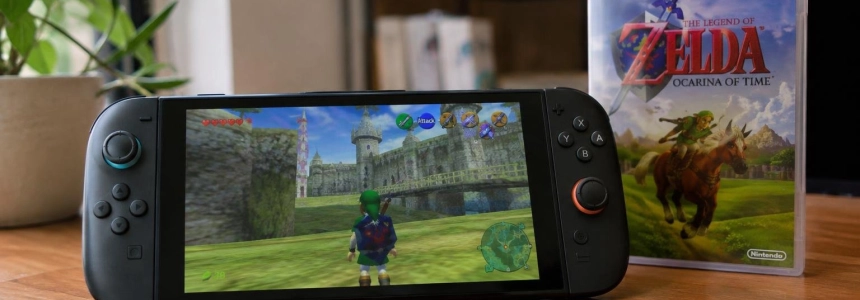
37 out of 40: that is the first score for the new version of The Legend of Zelda: Ocarina of Time, published by Japanese magazine Famitsu. Its four reviewers gave it scores of 9, 9, 9, and 10. The score arrives ahead of the release, scheduled for November 5.
- Platform: Nintendo Switch 2
- Release: November 5
- Digital price: $59.99
- Physical price: $69.99
A familiar adventure, with a revised camera and controls
The new version follows Link on a journey through Hyrule that unfolds across two eras. Nintendo has remade the graphics, added voice-acted scenes, and expanded character dialogue. It also features orchestral music and changes to the camera and movement.
The ocarina retains a central role: the melodies Link learns can open paths and change day and night. On Switch 2, players can play or hum near the built-in microphone to have Link perform the song; the game also responds to real instruments. The Nintendo Switch app offers Zelda Notes, a service for tracking the adventure, creating and sharing melodies, and answering a daily quiz with more than 2,000 questions.
Famitsu highlights the smooth camera, improved controls, more comfortable pacing, and revamped graphics. The score, however, does not mean the magazine considers every aspect to have aged well: it notes that the adventure is relatively simple compared with many modern games and that, at times, it may not be clear what to do next.
NPR's review praises the improvements and questions the pacing
Notebookcheck reports that NPR published a review before the embargo ended and then took it down. The piece had no score, and its contents circulated through subsequent references. According to those accounts, NPR called the game “superb and streamlined” and felt that the updated graphics convincingly modernize the original Nintendo 64 game.
“superb and streamlined”
— NPR, withdrawn review
The review also praised the smoother combat, faster switching between weapons and items, and a new jump button that gives Link greater control over his movements. At the same time, it found the pacing more choppy than in the original and some character designs odd; it singled out Nabooru's redesign in particular.
According to Notebookcheck's summary, the voice-acted scenes may interrupt exploration for players who prefer to progress at their own pace. It also notes objections to the over-the-shoulder camera, which replaces fixed angles that some longtime fans may miss, and to the targeting system, which could be simpler.
Fidelity divides expectations
Both reviews agree that the presentation and controls have undergone significant changes, but they view some design decisions differently. Famitsu praises the camera, while the review attributed to NPR raises concerns about the over-the-shoulder perspective and the loss of fixed camera angles. The sense of a simple adventure noted by Famitsu coexists with NPR's criticism of the less fluid pacing.
Notebookcheck also describes Nintendo's approach as cautious: some players had expected an expanded experience, not a faithful recreation. Comparing it with earlier versions adds context to the score: the original Nintendo 64 game received 40/40 from Famitsu and was the first game to achieve that score; Ocarina of Time 3D received 37/40. The Switch 2 remake matches the 3DS edition's score and falls three points short of the original.
New Young Link and Young Zelda amiibo figures will arrive in 2027 and unlock retro-style masks; other amiibo in the series will let players obtain useful items. More reviews are expected as additional scores are published.
Sources: Nintendo Everything, Notebookcheck, Nintendo-Online