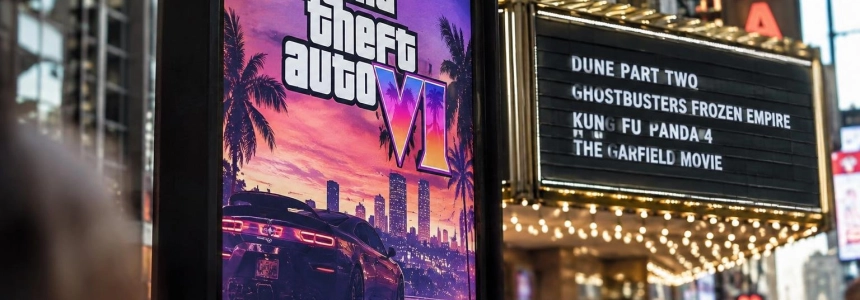
Take-Two expects net bookings of between $8.0 billion and $8.2 billion in its fiscal year through March 2027, up from $6.72 billion the previous year. The company attributes the projected jump to the boost from GTA 6, which Rockstar will release on November 19 without the online mode that has sustained GTA V for years.
The figure shows how much Take-Two is banking on a single release. It also helps explain why the game has become a planning factor for companies outside the video game industry: it is competing not only for sales, but also for dates, leisure time, and attention. In the PwC analysis cited by Multiplayer.it, Bart Spiegel compares it to a global event such as the Olympic Games.
A release that is already shaping other calendars
The GTA 6 release date acts as a danger zone for nearby launches. Xataka reports that Fable, a Microsoft production, was moved to February to avoid a clash; it also notes that several publishers delayed or brought forward announcements while waiting to learn the game's schedule. The pressure is not limited to direct competitors: the new Hunger Games film, directed by Francis Lawrence, will arrive in theaters one day later.
This ripple effect has a measurable precedent. When GTA V launched in 2013, it accounted for nearly 90% of game sales in the UK during its first week, according to Xataka. Anthony Palomba, a professor at the University of Virginia's Darden School of Business, recalls that GTA V generated more than $800 million in sales on its first day and accounted for close to half of video game revenue in the United States during its launch month.
The effect, then, is not simply that a blockbuster sells a lot. For rival publishers, releasing a game nearby can mean competing for a share of the conversation and spending concentrated on a brand that has been awaited for more than a decade. For Take-Two, by contrast, the absence of significant rivals in the same window reduces the risk that another release will split initial demand.
The impact extends beyond consoles
PwC has observed an increase of between 9% and 17% in requests for leave and vacation time around the launch, compared with normal levels. Spiegel argues that the broader economic effect could last much longer than launch day: if millions of people spend additional hours playing over the following months, they may spend fewer hours watching television, dining out, or doing other activities.
How that time is distributed could create winners and losers. Multiplayer.it cites the expectation that social networks and video platforms will see more clips, livestreams, and user-generated content, while streaming services compete for fewer hours of attention. Staying home could also benefit food delivery and cost restaurants and nightlife venues customers; these are anticipated effects, not outcomes already observed.
The potential scale is reflected in financial forecasts, although their figures are not equivalent. Altman Solon estimates between $3 billion and $5 billion in sales during the first week. Take-Two, meanwhile, projects net bookings for its entire fiscal year, a different metric that cannot be attributed exclusively to game sales. The forecasts indicate high expectations, not revenue already earned.
The precedent of GTA V is also a warning
Rockstar comes to this launch after a profound transformation. Xataka puts its workforce at 4,711 employees across a dozen offices, compared with 2,441 people who worked on Red Dead Redemption 2. Estimates cited by the outlet put GTA 6's budget at between $1 billion and $1.5 billion; Rockstar has denied the rumor that the total cost, including marketing, reached $2 billion.
The cycle between games also changed after GTA V. From 2013 to 2026, Rockstar released only one original game, Red Dead Redemption 2, in 2018, while GTA Online generated revenue for years. GTA V has sold more than 220 million copies, according to Xataka; Altman Solon puts its sales at over 230 million. The figures differ, but both sources describe a franchise that has built an enormous audience and enjoyed a long commercial life.
That success allowed for a lengthy, costly production, but it does not prove that the model can be replicated. Spiegel of PwC describes it as a benefit to the industry and, at the same time, an exceptional case: few organizations have the capital, technical capabilities, and sufficiently powerful intellectual property to take on a similar bet. The implication for other studios is not necessarily to make a bigger blockbuster, but to decide whether they can compete for attention with a release that dominates the calendar.
The online bet and the limits to growth
One key difference from 2013 is that GTA V was followed soon after by GTA Online, which turned the game into a sustained business. Altman Solon notes that the online version of GTA 6 is planned for 2027 and identifies a specific challenge: moving players from Los Santos to Leonida and achieving the adoption that the current experience has built up since 2013. The game's initial success alone does not guarantee that this transition will work.
The consultancy also warns that GTA 6 could mark the culmination of the model of big, narrative-driven games for console and PC, rather than provide a solution to the industry's growth problems. According to its analysis, the market has been flat since 2021, with little growth in either the number of players or spending per player. In its view, younger generations are more interested in social and cooperative gaming and user-generated content, as well as accessing games on phones and tablets.
This creates a tension for companies: the franchise shows how much people will pay for a differentiated experience, but it does not prove that raising prices or making ever more expensive games will attract new audiences. Altman Solon sees short-term potential in pricing, advertising, and in-game commerce, and long-term potential in new genres and platforms. These are the consultancy's proposals, not plans announced by Rockstar.
More attention for the industry, more pressure to monetize
Investor and corporate interest could extend to subscription services, infrastructure, advertising, mobile games, and artificial intelligence tools, according to Spiegel's comments cited by Multiplayer.it. AI, he adds, is an emerging possibility for improving development efficiency and reducing costs, not a guaranteed outcome. The distinction matters: the launch may increase commercial interest in the industry without automatically turning every investment into another major game.
There is also a growing incentive to seek revenue within worlds with large, active audiences. Spiegel expects advertisers to pay more attention to ad integration; for publishers, that offers a business opportunity, but raises the question of how to monetize without harming the experience. Neither source describes a Rockstar decision to introduce ads in GTA 6.
Rockstar's bet is unique in its scale, timing, and GTA V's ability to generate sales and online activity for years. For its rivals, the launch may showcase the cultural scale of video games, but it is also a reminder of how difficult it is to compete for attention with a franchise of this reach. The next test will be whether GTA 6 can sustain that attention when its online component, planned for 2027, arrives.
Sources: Xataka, Multiplayer.it, Darden Report, Altman Solon