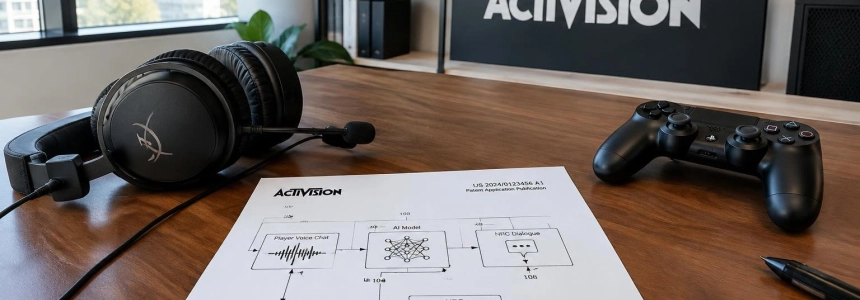
An NPC could celebrate a kill or respond to a death with the kind of reaction players often share over voice chat. That is the idea behind an Activision patent for generated audio: linking conversations with events in a match and using those pairs to train a neural network.
The application, titled “Methods and Systems for Applying Machine Learning to Generate Gameplay Audio”, was filed in July and published by the United States Patent and Trademark Office on November 12, 2026, according to reports about the document. Wccftech identifies the publication as US 2026/0355629 A1 and notes that it builds on an earlier application from December 2023.
From a kill to an NPC response
The system would start with events the game itself can detect: an elimination, the player’s death, the end of a round, or a celebration. It would then look for audio near that moment and link it to the event. The application gives as an example a window covering ten seconds before and after the play.
The time window matters because a reaction does not always start when the score appears. Someone might yell when they see an opponent approaching and laugh a few seconds after surviving; capturing only the audio after the kill would miss part of that sequence. The patent proposes using timestamps to associate the conversation with the corresponding moment in the game.
Those paired clips would serve as training examples. The neural network would learn patterns between the type of event and the reaction—including aspects such as emotions and expressions—so that, in a similar situation in another match, a character controlled by the game could respond with generated audio. The proposal may incorporate a large language model in addition to the neural network.
The stated goal is for characters to sound less limited to prerecorded lines. An enemy could celebrate an elimination or react angrily when defeated; allied or neutral characters are also mentioned. Another possibility would be to generate voice audio for player-controlled avatars whose players do not have a microphone or prefer not to speak.
The leap beyond in-game chat
The most delicate part is not just what the model would learn, but where the examples would come from. The application includes voice applications that operate independently of the game, with Discord and TeamSpeak among the examples mentioned; Wccftech also cites Ventrilo. In that scenario, audio from an external conversation would be aligned with match events using timestamps.
That would expand the potential material beyond built-in chat, but it also changes the expectations of those speaking. A conversation between friends in a separate application is not necessarily understood to be material for training characters. HardZone notes that players would need to give explicit consent for the idea to be put into practice. According to Wccftech and Dexerto, the patent description does not explain how that permission would be requested.
It is important to distinguish the technical possibility described from a capability that has already been deployed: there is no indication that Activision is collecting private Discord conversations through this system. Nor does the patent confirm that the company has integrated it into Call of Duty or any other franchise. Filing a proposal is not the same as announcing a product.
External conversations also introduce a problem of attribution. The fact that a phrase is heard near a kill does not by itself prove that it is a response to it: it may refer to something else the friends were discussing. The window before and after the event can preserve more context, but the document does not eliminate the ambiguity involved in deciding which reaction corresponds to which event.
Personalization and filters, with limits
The design includes profiles that could influence which responses are selected. Patentlyze describes variables such as language, location, and level of participation, as well as filters that would be updated when the profile changes. The patent also proposes adapting reactions to the player and making the generated response appropriate to the context.
There is a tension between personalization and keeping the system under control. A response in the player’s language may sound more natural, but using profiles means the system would organize information about preferences or activity. The documents covered in reports mention these data as possible inputs.
For content, the proposal includes filters intended to exclude abusive or offensive language before a reaction reaches the character. This is a safeguard proposed in the patent, not a guarantee that the filter will recognize every problematic expression or avoid mistakenly discarding valid material.
Dexerto clarifies that the idea is not to copy each player’s specific voice, but to learn how they react or speak in order to produce NPC dialogue. That distinction shifts the focus away from reproducing an individual voice, but does not by itself resolve the question of consent: the audio would still be the input used to train the verbal behavior described.
What it would require of a game and its operator
In design terms, the proposal shifts some of the work from writing and recording lines to building a system that links events, conversation clips, and responses. The game would have to identify relevant events; the training process would have to pair the audio correctly; and the generated response would need to be appropriate when something similar happens. These are components described in the application, but it provides no results from a production implementation.
Using an external application also presupposes that the system can access its audio while the game is running. Patentlyze describes two programs running in parallel on the device, with chat separate from the game. That architecture makes access authorization and transparency central: players would need to understand what is being captured, for what purpose, and whether their conversation is being used to train responses.
For a company, the potential appeal would be to give characters more variety without relying solely on a fixed set of lines. The practical and reputational cost is that a group of friends’ voice chat may include private jokes, offensive language, or comments unrelated to the match.
Activision already uses ToxMod, from Modulate, to moderate voice communications in Call of Duty, according to Wccftech; that use focuses on detecting disruptive communications, not generating dialogue for NPCs. This is an important functional distinction: moderating a conversation and reusing audio as training material are different uses, with different questions about purpose and consent.
A patent amid an ongoing debate
The proposal emerges in an industry where the use of generative AI in video games is also facing opposition. GamesIndustry.biz reports that six European video game workers’ unions recently published a manifesto on the technology’s impact, and that Japan’s actors’ union announced guidelines opposing the unauthorized use of voice performances for replication.
That context helps explain why a patent focused on spoken reactions can spark debate even without cloning voices. Players’ material would influence how characters controlled by the game speak; the question is therefore not limited to whether the result sounds convincing, but also to who agrees to provide those conversations and under what conditions.
For now, the patent presents a possibility, not a confirmed feature. Activision has not announced plans to bring it to Call of Duty or another series. It remains to be seen whether the company will develop the system and, if so, how it would ask permission to use external chats before turning a reaction between friends into NPC dialogue.
Sources: GamesIndustry.biz, Wccftech, HardZone, Dexerto, Patentlyze