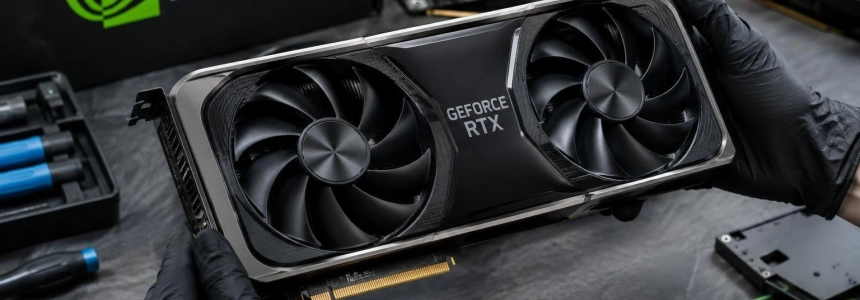
Nvidia reportedly notified its graphics card manufacturing partners of a 20% to 30% cut in gaming GPUs allocated for the fiscal fourth quarter, which runs from November 2026 to January 2027. The information comes from Board Channels and was reported by VideoCardz; for now, it is not known which GeForce RTX models would face the largest reductions or whether the measure would affect channels outside China.
The possible adjustment would affect a supply chain already facing low RTX 5000 series inventory. Hardware Upgrade reports that in recent weeks, several brands had asked distributors to prioritize models from earlier generations, such as the GeForce RTX 3060 and RTX 5050, as supplies of the latest cards gradually ran out.
Already limited supply in China
Board Channels described Nvidia GPU supply in China during the third quarter as “extremely tight,” according to Wccftech. The fiscal fourth quarter, by contrast, covers the period from November 2026 to January 2027. The cut communicated to AIC partners—add-in card manufacturers—would be in addition to previous allocations, which Hardware Upgrade already describes as limited.
The available information does not identify which specific products would be most affected. Nor does it clarify whether the adjustment would apply outside China: Hardware Upgrade notes that its scope has not been specified. Therefore, the 20% to 30% figure refers to the cut that Nvidia reportedly communicated to its partners, according to the cited reports, not to a confirmed reduction for every model or market.
Wccftech also links the news to Jensen Huang’s recent reinstatement as CEO, but acknowledges that no connection between the two events has been demonstrated. The outlet recalls that after he stepped down, RTX 5090 prices suddenly fell in various markets; it attributes this temporary change to the day after his resignation. However, presenting the possible supply constraint as a consequence of his return would be speculation.
“Unfortunately, GR20x is a product from 2028. That means they have postponed again.”
— Kopite7Kimi, hardware leaker
RTX 60 may not arrive until 2028
The supply adjustment coincides with uncertainty over when the next generation will appear. HardZone cites reports from MyDrivers suggesting that Nvidia may take longer than expected to produce GeForce RTX 60 cards in large quantities. The late 2027 date that had been circulating until now would mark the start of mass production, not the commercial launch.
There are intermediate stages between starting to manufacture cards and selling them in stores, HardZone notes; its estimate is that availability could shift to 2028, provided the forecasts hold. The publication stresses that Nvidia has not confirmed either the supply cut or the RTX 60 schedule.
Tom’s Hardware had already reported in September that leaker Kopite7Kimi placed the next generation in 2028. In a post on X, the leaker wrote that GR20x would be “a 2028 product” and that Nvidia had postponed it again. Tom’s Hardware contacted Nvidia; a company spokesperson replied that it does not comment on rumors or unannounced products.
According to the outlet, the RTX 60 would be based on the Rubin architecture. It also compares the possible process change with previous generations: Ada Lovelace, from the RTX 40 series, and Blackwell, from the RTX 50, share the TSMC 4N node. If the Rubin leak proves accurate, Nvidia would take six years to move its consumer GPUs to a more advanced process, TSMC 3N or 3NP, which Tom’s Hardware says is already used by its Rubin accelerators.
| Detail | Period or figure | What it describes |
|---|---|---|
| Supply cut | 20%-30% | Gaming GPUs during the fiscal fourth quarter, according to Board Channels |
| Fiscal fourth quarter | November 2026-January 2027 | Period to which the announced cut would apply |
| RTX 60 mass production | Late 2027 | Target cited by HardZone, not a launch date |
| Possible RTX 60 arrival | 2028 | Forecast reported by HardZone and Tom’s Hardware |
Fewer units do not mean the same price across the entire lineup
Lower availability could put upward pressure on prices, but the effect would depend on each store’s inventory and on demand. HardZone offers the example of an RTX 5060 Ti 16 GB with several versions: if the cheapest option sells out first, a buyer might have to wait for a restock or pay more for a variant with a larger heatsink. If the retailer still has plenty of stock, however, it might discount units to sell them.
The outlet cites an earlier episode of price increases in Huaqiangbei, a market in Shenzhen, as a reference. According to traders in that area quoted by MyDrivers, the RTX 5060 reached 4,200 yuan, while the RTX 5060 Ti 8 GB was priced between 4,300 and 4,400 yuan. These are isolated prices from a local Chinese market; they do not make it possible to predict how much those cards would cost in other countries.
Hardware Upgrade expects less product to potentially mean lower availability and more volatile retail prices. Wccftech also anticipates further increases in the coming weeks and says some budget GPUs have already reached $800, though it does not identify the models or market in that passage. None of these outcomes means that every model is certain to become more expensive: the result will depend on the supply reaching each channel.
Pressure from artificial intelligence orders
HardZone attributes the possible shift in resources to several Taiwanese manufacturers working with Nvidia reportedly dedicating more capacity to artificial intelligence orders. This information, reported by MyDrivers, could help explain why the company might cut gaming card supply again. It remains an explanation based on supply chain data, not a reason confirmed by Nvidia.
For those looking for an RTX 50, the immediate consequence of the rumor is not a guaranteed price, but the risk of finding fewer units of certain models. HardZone advises considering a purchase if the current card is already falling short and the desired model is available within budget; if the system still meets the user’s needs, it suggests waiting, provided waiting until 2028 is feasible. The schedule and the cut remain unconfirmed.
For now, the specific figure being discussed by partners is an estimated 20% to 30% reduction for the quarter ending in January. The outstanding question is whether it will also affect distribution outside China and which GeForce RTX models will receive fewer units.
Sources: Hardware Upgrade, Wccftech, HardZone, Tom's Hardware