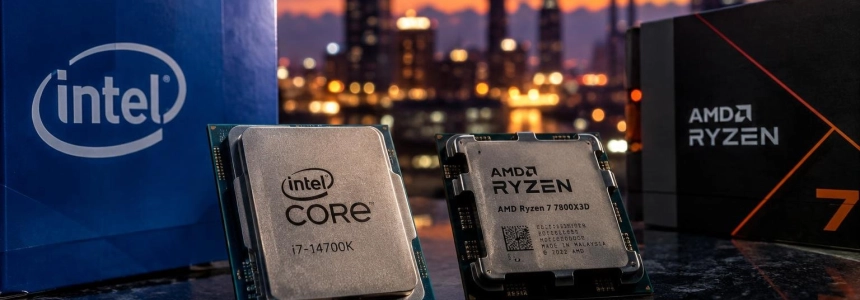
Intel raised its share of x86 desktop processor shipments to 70.1% in the third quarter of 2026, up from 65.1% in the previous quarter. AMD fell five points to 29.9%, in a shift that Mercury Research links to possible supply changes and weakness in the gaming PC market, not necessarily to a loss of appeal for its Ryzen processors.
A five-point swing in one quarter
Mercury Research data, reported by PC Gamer, show that Intel rose from 65.1% to 70.1% between the second and third quarters of 2026. AMD moved in the opposite direction: its share of shipments fell from 34.9% to 29.9%. The net change was five percentage points in Intel’s favor.
| Manufacturer | Second quarter of 2026 | Third quarter of 2026 | Change |
|---|---|---|---|
| Intel | 65.1% | 70.1% | +5.0 points |
| AMD | 34.9% | 29.9% | −5.0 points |
AMD’s figure is also below its 33.6% share a year earlier. Profesional Review puts this 29.9% at its lowest level since early 2025, when it was around 28%. MuyComputer offers another point of reference: AMD ended 2025 with a 36.4% share of the desktop market, after several quarters of gaining ground against Intel.
The contrast with that trajectory explains the surprise, but the metric has a specific scope. Mercury Research measures the share of processors supplied, not direct sales to consumers or stated preferences among people building or buying a computer. Shipments can change if one manufacturer has more units available for a segment, even if the perceived competitiveness of its products has not changed.
Supply may have tipped the balance
Mercury Research acknowledges that there is no definitive cause for AMD’s decline. One hypothesis is that Intel allocated more processors to desktops after demand for laptop CPUs weakened. The third quarter typically brings a seasonal increase in desktop demand, and the company may have been better able to meet it after experiencing supply problems in that segment early in 2026.
Profesional Review describes a similar mechanism: weaker laptop demand may have allowed Intel to ship more chips for desktop systems just as the seasonal uptick began. MuyComputer also suggests that Intel seized the opportunity while AMD may not have received the same boost. In both cases, this is a possible explanation, not a confirmed cause.
The same seasonality does not appear to have translated into equivalent growth for AMD. Wccftech suggests that the company’s exposure to gaming enthusiasts may have worked against it. Although its Ryzen X3D processors retain, according to the outlet, a considerable gaming performance advantage, a shortage of graphics cards may have weakened demand for gaming PCs and disproportionately affected AMD.
MuyComputer also links weakness in gaming PCs to rising component costs and difficulties obtaining GPUs. Profesional Review adds that current demand reportedly exceeds AMD’s shipping capacity, as the company itself is said to have acknowledged. None of these factors alone makes it possible to determine how much each contributed to the change in share.
More expensive memory and client-device demand
Memory costs may add to the pressure. Wccftech notes that Intel’s quarterly report attributes a negative effect on demand for its client products to higher component costs—particularly memory. Thus, Intel’s gain in desktop shipment share coincided with a 5% year-over-year decline in revenue for its Client Computing and Physical AI Group during the third quarter of 2026.
That figure makes it difficult to interpret 70.1% as a sign that Intel’s entire PC business is growing. Share and revenue describe different things: the former compares the proportion of units shipped in a category, while the latter reflects revenue for a business group. In this case, Intel gained relative weight in desktop processors even as the cited revenue for its client and physical AI group fell compared with the previous year.
Cost pressures are not affecting just one manufacturer. MuyComputer describes rising component costs as part of the weakness in the gaming market, while Wccftech highlights memory in particular. The available figures do not break down how much of AMD’s decline stems from DRAM prices, GPU availability, or the distribution of CPUs across segments.
AMD grows in servers while focusing on data centers
Outside the desktop market, AMD’s result was positive. Its share of server CPU shipments rose from 34.5% to 35.5% in the third quarter, a one-point gain. That result presents a different picture from the consumer market: AMD gained ground in servers during the same period in which it lost desktop share.
The growth fits with the greater importance of data centers to the company’s business. Wccftech reports that its most recent financial results attributed a record quarterly revenue of $8.5 billion to that business, up 97% from a year earlier. It also quotes AMD CEO Lisa Su, who said: “We are a data center first company”.
We are a data center first company
— Lisa Su, AMD CEO
The focus on data centers and artificial intelligence helps explain why a decline in desktop share does not, on its own, sum up AMD’s situation. MuyComputer notes that data centers and AI are driving its results and revenue forecasts; Profesional Review links the gain in servers to Su’s remarks. The desktop figure remains significant—five points down in three months—but it coexists with a stronger position in servers and an expanding data center business.
Share does not prove a change in preference
Intel had already lost ground in other segments before this shift. Wccftech recalls reporting in August that Intel’s overall share of x86 processors had fallen to levels not seen since 1995, while AMD gained ground in several categories. The desktop recovery therefore follows a period in which AMD’s gains had set the trend.
But the third-quarter figures are not enough to declare that Intel has durably reversed this competitive trend. The measurement concerns shipments, and the hypotheses around capacity, seasonality, and demand suggest that availability matters too. Nor does it show that consumers are turning away from Ryzen: Wccftech explicitly warns that the share rebound does not amount to a shift in buyer preferences.
For now, the most accurate reading is that Intel regained five points in x86 desktop CPU shipments, while AMD lost an equivalent share and gained one point in servers. The exact explanation for the change remains unclear; the next comparable data point will show whether the 70.1% figure was an adjustment linked to supply and the seasonal cycle or the start of a more persistent trend.
Sources: Wccftech, MuyComputer, Profesional Review, TechPowerUp