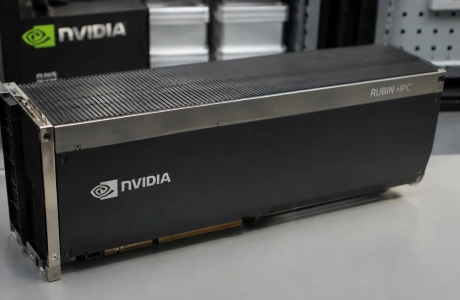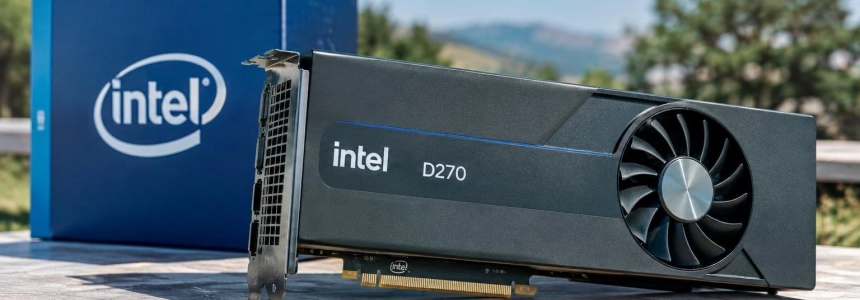
Intel says its D270 GPU, known during development as Crescent Island, delivers up to 5.9 times more performance than the RTX PRO 6000 Blackwell Server Edition in a double-precision financial benchmark. The company presented its first results at SC26 and maintains that the accelerator, designed for artificial intelligence inference, can also handle high-performance computing (HPC) workloads.
The central technical argument is native support for full-speed FP64 operations, a capability Intel presents as suitable for scientific simulations, engineering, and finance. The published comparison pits the D270 against NVIDIA's card, whose stated power consumption is 600 watts versus 350 for Intel's solution.
Four financial tests, with an uneven advantage
Intel's results cover four applications for financial calculations. The largest difference appears in European Monte Carlo; in American Black-Scholes, the claimed advantage is smaller. Taken together, the tests yield an average of approximately 4.5 times more performance for the D270, according to the company.
| Test | Claimed D270 advantage |
|---|---|
| European Monte Carlo | 5.9 times |
| European Black-Scholes | 5.6 times |
| Binomial model | 4.6 times |
| American Black-Scholes | 1.92 times |
The comparison was conducted by Intel using silicon still in the pre-production phase. StorageReview adds that the financial test configuration lists eight NVIDIA cards versus one D270, but does not specify whether the results are normalized per card. Therefore, the published figures alone are not enough to clarify how the two platforms compare in equivalent configurations.
The choice of FP64 sets the D270 apart from many accelerators focused on inference. This double-precision floating-point format allows the card to handle workloads that, according to Intel, need to maintain numerical accuracy over repeated calculations. The architecture also supports lower precision levels, from FP4 to FP8, to prioritize inference performance.
Xe3P, XMX, and a 160 GB configuration
The D270 is based on Xe3P and integrates 32 Xe cores and 256 XMX engines. Intel says each core can execute 64 FP64 fused multiply-add (FMA) operations. This combination makes it possible to switch between low-precision formats for AI and FP64 for tasks that require greater mathematical precision.
The reference card includes 160 GB of LPDDR5X, with a stated bandwidth of 1.5 TB/s. Partner-designed configurations can increase capacity to 480 GB. Intel presents this memory as a way to keep large datasets on the GPU and reduce transfers between the accelerator and the host system.
The standard model is designed to consume 350 W, use air cooling, and connect via PCIe 5.0. Intel also plans configurations with liquid cooling and two-GPU systems, although it has not provided commercial details for these variants. Memory capacity and the various cooling options are part of the offering for AI and HPC servers.
LPDDR5X is a different choice from the GDDR and HBM memory typically used in accelerators of this kind. Intel presents it as a balance between capacity, power consumption, and cost, but has not yet published a price for the D270 or its partner configurations.
A seismic demonstration with software ported to SYCL
At SC26, Intel also demonstrated a seismic imaging application developed with Veridien. This type of workload, associated with the oil and energy industries, repeatedly calculates the propagation of acoustic waves across large three-dimensional datasets and primarily uses FP32.
The demonstration keeps large wavefield matrices in the card's memory and uses stencil optimizations that reuse data in local caches. Intel said Veridien ported an application previously written for HIP and CUDA to SYCL in less than a month, without modifying the code running on the CPU.
According to Intel, about 90% of the kernels worked satisfactorily without hardware-specific optimizations. The most complex kernels reached up to 70% of theoretical peak performance in their first, unoptimized version. The company also said that both numerical accuracy and performance were validated.
Profesional Review and StorageReview describe another demonstration at the booth: an inference workflow split between D270 GPUs and SambaNova's SN50 processors, with Xeon 6 and Xeon 6+ coordinating the system. In this configuration, the D270s handle the initial processing of the request, and the SN50s generate the response.
Inference results for decision-making and language models
Intel's AI figures also compare the D270 with the RTX PRO 6000 Blackwell Server Edition. For Drex 2.0, described as a decision-making model, Intel claims up to 29% lower latency. In the throughput test with Qwen 3 30B-A3B, it says it achieved 1.12 times the throughput of NVIDIA's card; Profesional Review specifies that the measurement was made in FP8.
Intel links these results to agentic AI workloads: models that can chain together reasoning, information retrieval, tool use, and calls to other models. The use cases it mentions include retrieval-augmented generation (RAG) with long contexts, enterprise assistants, programming tools, document understanding, and multimodal and diffusion models.
The D270 is therefore not positioned as a GPU dedicated exclusively to HPC. Intel describes it primarily as an inference accelerator for data centers, and maintains that its memory and range of precision formats also let it handle scientific and financial workloads.
“open, heterogeneous, and balanced”
— Jeff McVeigh, Intel vice president and general manager of Data Center Strategic Programs, quoted by StorageReview
Open software, part of Intel's strategy
Intel wants adopting the D270 to avoid forcing users to rebuild existing applications from scratch or rely on a proprietary environment. Its approach combines SYCL for GPU programming with integration into AI frameworks and runtimes, as well as investments in Intel MPI, Fortran compilers, and high-performance C++ tools.
The Veridien demonstration serves as a concrete example of this approach: the port from HIP and CUDA to SYCL was completed in less than a month, according to Intel. The company also points to systems in which CPUs and accelerators divide HPC and AI tasks, with processors coordinating workflows while GPUs handle part of the computation.
SC26 is the venue Intel chose to showcase these capabilities and publish its first comparisons. However, the data remain manufacturer-reported results based on pre-production silicon; StorageReview also notes that it did not audit or reproduce the benchmarks and that NVIDIA's inference tests used an AWS virtual machine.
Price and launch date still pending
Intel has not set a commercial availability date or price for the D270. Both details remain pending as the company presents the card as a shared option for inference, HPC, and workloads that combine both areas.
Sources: Hardware Upgrade, Wccftech, Profesional Review, StorageReview.com