Gemini 4 Hydrogen is now rolling out to Google Search with a concrete promise: to understand long questions with multiple parts or hard-to-read errors, and respond with more relevant links and more visual results. Google calls it the biggest model upgrade the search engine has received and is also bringing it to Gemini and its developer tools.
The company announced the model on November 12. The Gemini 4 family already included the Carbon and Argon variants, geared toward problems that require extended reasoning; Hydrogen, by contrast, focuses on quickly executing multi-step workflows. Google describes it as an option that can work independently or collaborate with more powerful models.
“This is the biggest model upgrade to Search yet.”
— Robby Stein, vice president of product for Google Search
More natural queries and less predictable results
In Search, the change starts with how people ask questions. Google wants users to write the way they think, even when they make a request with several conditions, mix topics, or make spelling mistakes that are difficult to interpret. According to the company, Hydrogen follows instructions more accurately and can use the right tools to answer the different parts of a query.
The improvement also affects so-called query fan-out, a technique that breaks a question into smaller searches about related subtopics. Google says Hydrogen can better understand intent and launch simultaneous queries more effectively, connecting users with relevant pages that might be missed by a more direct search.
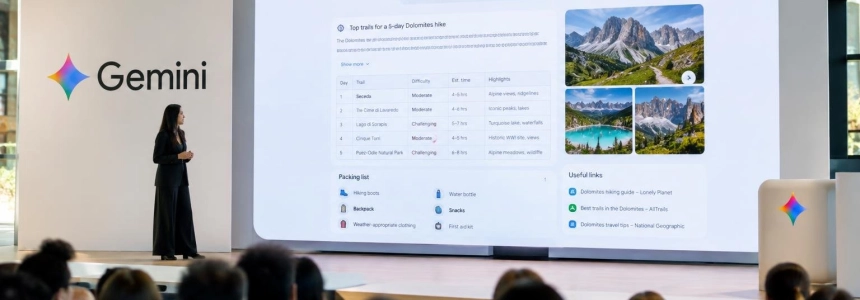
AI Mode answers will gain visual elements: Google mentions images, structured answers, comparison tables, and custom tools generated for the query. The company also promises more nuanced answers in all languages supported by AI Mode. Its announcement does not provide a more precise country- or language-specific schedule than the global rollout.
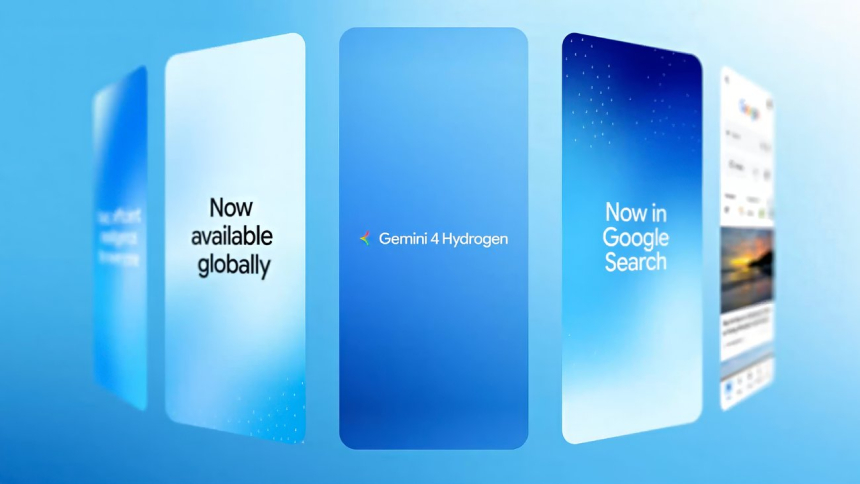
Hipertextual notes that access in the search engine may appear through the “+” button below the search box, where users can select the model. Google, for its part, says Hydrogen is already globally available in Search to all users; it may take some time to appear in certain accounts.
A fast model for agents and everyday tasks
Hydrogen occupies a different role from Carbon and Argon. Google positions it for tasks such as writing code, running tests, and verifying changes, as well as research, data analysis, and navigating large repositories. It can operate independently or take on tasks in a workflow where other models handle more complex decisions.
Google puts the speed improvement at 2.5 times compared with Gemini 3.8 Flash, its previous fast model. It also reports a score of 57% on Terminal-Bench 4.1, compared with 18.2% for Gemini 3.8 Flash, and says Hydrogen reduces fabricated claims by more than fivefold. These are figures disclosed by Google, not results from an independent evaluation included in these announcements.
On the Artificial Analysis Intelligence Index, Hydrogen scores 51 points at its default reasoning level, compared with 50 for Gemini 4 Argon; at the highest level, xhigh, it reaches 54. This comparison does not mean Hydrogen outperforms Argon on every task: it describes the result on that specific index. For multi-step tasks such as deep research, data analysis, and broad code navigation, Google says it ranks fifth on Agent Arena.
| Test or metric | Gemini 4 Hydrogen | Reference cited |
|---|---|---|
| Speed on certain tasks | 2.5 times faster | Gemini 3.8 Flash |
| Terminal-Bench 4.1 | 57% | Gemini 3.8 Flash: 18.2% |
| Artificial Analysis Intelligence Index, high level | 51 points | Gemini 4 Argon: 50 points |
| Artificial Analysis Intelligence Index, xhigh level | 54 points | No comparison cited at this level |
| Agent Arena, multi-step tasks | Ranked number 5 | Ranking cited by Google |
The model offers four reasoning levels: low, medium, high—the default—and xhigh, an extra-high option. Google says these let users adjust quality, latency, and cost according to the depth of reasoning required, and that the design aims to complete tasks with fewer output tokens.
Availability in Search, Gemini, and development platforms
Hydrogen is being rolled out in Search and the Gemini app, as well as Google AI Studio, the Gemini API, and Gemini for business. Google is also bringing it to Android Studio and Google Antigravity for paid AI Pro and Ultra subscribers. In Google Sheets, availability depends on eligible business subscriptions or, for consumers, AI Pro and Ultra plans.
In the Gemini app, free users may receive Hydrogen through automatic selection when the system determines it is a good fit for their request. Not everyone will be able to select it manually from the model picker. MuyComputer adds that eligible plans do allow users to select it, although it does not specify exactly which plans they are.
For API use, Google sets a price of $1.50 per million input tokens and $7.50 per million output tokens. According to the launch announcement, the rate applies across the entire one-million-token context window. The model card specifies that it supports text, images, audio, and video, and distinguishes between a unified context window of up to one million tokens and a default synchronous output of up to 64,000 tokens; long-running background decoding can reach one million.
Google presents Hydrogen as an adapted version of Gemini 4 Carbon. In Antigravity, its development tool, it includes Orchestrator, which can switch between models within a single session. On Terminal-Bench 4.0, Google says Orchestrator achieved success rates close to Carbon while using, on average, 24% less quota and completing tasks 19% faster.
Published results and acknowledged limitations
The Google DeepMind model card includes tests in coding, knowledge, computer use, multimodal understanding, and reasoning. In it, Hydrogen scores 71.6% on Agents’ Last Exam v1.1, 53.4% on Multimodal Knowledge Agent, and 58.8% on HLE-Diamond. It falls behind some of the compared models in other tests, such as Terminal-Bench 4.1, where it scores 57%, compared with 63.9% for Claude Sonnet 5.5.
| Evaluation | Gemini 4 Hydrogen | Comparison in the model card |
|---|---|---|
| Agents’ Last Exam v1.1 | 71.6% | Claude Sonnet 5.5: 60.4%; GPT-6.1 Terra: 69.8% |
| Multimodal Knowledge Agent | 53.4% | Claude Sonnet 5.5: 52.0%; GPT-6.1 Terra: 43.8% |
| HLE-Diamond | 58.8% | Claude Sonnet 5.5: 53.3%; GPT-6.1 Terra: 47.3% |
| Terminal-Bench 4.1, adjusted for cheating | 57.0% | Claude Sonnet 5.5: 63.9% |
The model card itself warns that the model may hallucinate, experience slowdowns or timeouts, and use more tokens to improve results, especially at higher reasoning levels. Its knowledge cutoff is March 2026, although Google notes that some areas may be less up to date.
On safety, Google says Hydrogen did not show a material increase in general capabilities compared with Gemini 4 Argon. In specific tests, it did not reach critical capability thresholds in the biological and cybersecurity domains, although it did reach the alert thresholds in both. The company says it maintains mitigations and will publish the full model safety and security report in the coming days.
The Search rollout has already been announced as global, while access in Gemini and Google tools varies by product and account type. In Search, the practical next step is to check whether Hydrogen appears in the selector under the “+” button; in the Gemini app, free users will depend on automatic selection.
Sources: Punto Informatico, MuyComputer, Hipertextual, Google, Google, Google DeepMind, TechCrunch