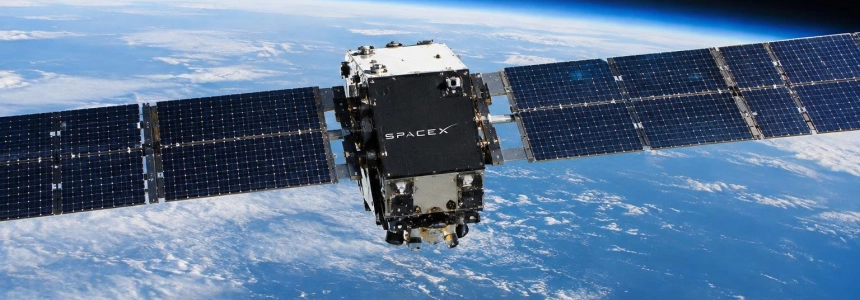
The United States Federal Communications Commission (FCC) authorized SpaceX to deploy up to one million Starmind satellites, equipped with artificial intelligence chips and intended for data centers in orbit. The approval sets two milestones: the first satellite must be deployed by 2033, and the constellation must reach one million by 2040.
The decision, announced on November 25, marks the FCC's first authorization for a complete constellation of AI satellites, according to The Verge. Google, Blue Origin, and other companies are also working on the idea of bringing computing capacity into space, but the regulatory green light granted to SpaceX is for a network of extraordinary scale.
FCC Chairman Brendan Carr presented the measure as a bet on U.S. computing infrastructure. “This action opens a bold new frontier for the computing infrastructure needed to power America's leadership and growth,” he said in a statement, according to Space.com.
This action opens a bold new frontier for the computing infrastructure needed to power America's leadership and growth.
— Brendan Carr, FCC chairman
One million satellites, with two deadlines
The authorization does not make deployment immediate: it imposes a schedule on SpaceX that stretches over more than a decade. The company must put at least one satellite into orbit by 2033 and complete the deployment of one million units by 2040.
| Milestone | Deadline or estimate |
|---|---|
| First Starmind satellite deployed | By 2033 |
| Constellation of one million satellites | 2040 |
| First launch planned by SpaceX | Third quarter of 2027 |
The third quarter of 2027 is the date SpaceX has set for launching the first spacecraft, according to Space.com. The company plans to use Starship, its fully reusable rocket, to transport the satellites. This launch estimate is earlier than the FCC's deadlines for meeting the two main milestones.
Starmind's numbers contrast with the current scale of space activity. Space.com estimates that, since the beginning of the space age in 1957, humanity has launched around 28,000 satellites, give or take a few hundred. The current version of Starlink, the largest constellation in operation so far, comprises around 11,000 spacecraft.
Solar energy would power computing
SpaceX describes Starmind as a way to capture solar energy in space to power AI capabilities on Earth. The company expects the satellites to send data via high-speed lasers connected to Starlink. It also plans to manufacture the chips intended for the constellation at a future Terafab facility.
The approach involves moving some of the computing infrastructure currently installed on the ground into space. Space.com notes that Elon Musk, SpaceX's founder and CEO, believes the future of AI computing is in orbit, where solar energy is available and there are no neighboring landowners who can complain about the location of facilities.
The project is part of a broader corporate bet on artificial intelligence. SpaceX has said it sees a potential total addressable market of $28.5 trillion in the long term, of which nearly $23 trillion would come from enterprise AI applications, according to Space.com.
The FCC leaves the question of graveyard orbits open
The approval comes with a caveat: the FCC postponed its decision on SpaceX's request to dispose of satellites located above an altitude of 600 kilometers in graveyard orbits, rather than having them disintegrate upon entering Earth's atmosphere. The agency said the company had not provided “sufficient information” about its disposal plans.
Therefore, authorization for the constellation and permission to use that disposal method are not moving forward at the same pace. The FCC has approved the deployment and its milestones, but has not resolved the request concerning satellites in those orbits.
The planned scale also raises a practical question: how much launch and maneuvering traffic will be required to maintain such large orbital networks? Space.com warns of the risk of collisions as the number of satellites increases. Current Starlink satellites can autonomously detect and avoid potential collisions, but the outlet notes that more evasive maneuvers will be needed as orbits become more crowded.
Starship and other constellations in the works
Starship has already carried next-generation Starlink satellites on its two most recent test flights, with 26 spacecraft on each. Those 52 satellites are part of another expansion: Musk has said the next generation of Starlink could reach around 100,000 satellites.
Space.com estimates that Starship can carry up to 60 Starlink V3 satellites per launch. At that capacity, building a constellation of 100,000 units would require around 1,700 launches, in addition to those needed to maintain it. The outlet estimates that each satellite has an expected operational life of about five years.
Starmind is not the only orbital data center initiative. Space.com lists Cowboy Space, Starcloud, Blue Origin, and Google among the companies that have expressed similar ambitions. Starcloud and Google have already launched experimental satellites related to AI computing.
Google took a concrete step last month by launching an AI server satellite for the Suncatcher project, according to The Verge. Blue Origin, meanwhile, plans to carry out the first dedicated heavy-lift launch for that project in 2029. SpaceX's authorization thus comes as other companies explore their own paths to computing in orbit.
Carr argued that computing campuses and data centers are necessary to maintain U.S. leadership, adding that SpaceX and its competitors are moving computing capacity beyond Earth. The FCC has set milestones of 2033 and 2040 for Starmind; meanwhile, its assessment of SpaceX's plan to dispose of satellites located above 600 kilometers remains pending.