Independent repair shops in the United States lose 83 million hours a year buying, downloading, and activating manufacturers’ software, according to the Closing Shop report. Its authors value that time at $12 billion: this is not a sum of software bills charged directly to drivers, but the estimated cost of labor hours added to the repair process.
The figure comes from Closing Shop, authored by Kyle Wiens of iFixit; Nathan Proctor of U.S. PIRG Education Fund; and Kevin O’Reilly of FULU. The Register reports its conclusion: vehicle digitization has turned access to diagnostics and certain repairs into an expense that repair shops must pay and manage before starting work.
A repair starts with a license
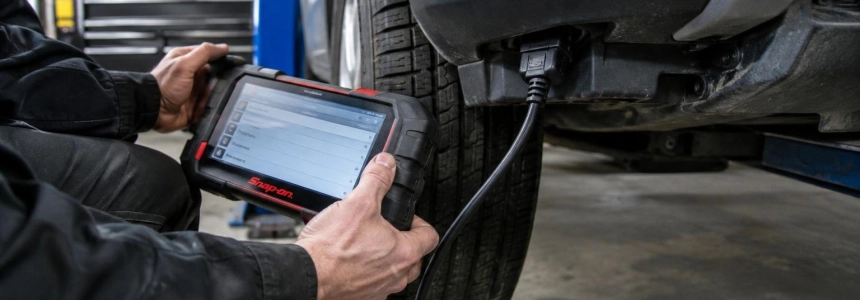
In a modern car, tasks such as locating a faulty sensor or retracting an electronic parking brake may require connecting a tablet or laptop to the vehicle. The shop needs compatible tools and, to access the manufacturer’s information, may have to buy subscriptions, adapters, and authentication permissions. The barrier appears before the repair: the mechanic spends time obtaining access to the system.
For jobs requiring manufacturer software, surveyed mechanics estimated a median of 75 minutes of waiting and administration, according to The Repair Association. The report calculates 1.25 hours per job of this kind; Closing Shop estimates that these tasks account for about one in five repairs at independent shops. At a shop rate of $140 per hour, iFixit calculates that this time amounts to $175 before the repair itself is counted.
The cost does not always appear as a separate line on the receipt. A shop may charge for some of that time, absorb it, or turn down the job. If it does not have the necessary license or tool, the customer may end up at an authorized dealership, where the manufacturer has already arranged access to its own systems. A dealership spreads the cost across more jobs; a multi-brand shop must cover several brands with a smaller customer base for each one.
The Closing Shop survey found that 88% of the mechanics surveyed had turned down some work in the previous year because they lacked the necessary software or tools. This is a sign of limited access, not a measurement of all repairs in the country. But it shows why the issue also affects people who do not pay for a subscription: losing the local shop can mean traveling farther, waiting, or turning to a more expensive alternative.
A different bill for every brand
The report calculated the cost of a license for one technician at five manufacturers. In August 2026, the total came to $15,878 per year, excluding adapters and other equipment. For a dealership focused on one brand, the license can be spread across many vehicles; an independent shop that accepts cars from different brands faces several fees.
| Manufacturer | Annual cost per technician |
|---|---|
| GM | $4,328 |
| Ford | $4,035 |
| Stellantis | $3,735 |
| Hyundai | $2,280 |
| Toyota | $1,500 |
| Total for the five brands | $15,878 |
These are Closing Shop figures for one software and documentation seat per brand; adapters, programming tokens, and licenses for multiple technicians can increase the expense. The report also notes that documentation and diagnostic services are usually separate products. For a small business, then, comparing the price of a subscription is not enough: what matters is how much it costs to cover the range of vehicles it wants to service.
The Stellantis example illustrates the breakdown: the source puts diagnostic software at $1,760 a year and technical documentation at $1,975, in addition to a $1,850 adapter. Programming a replacement module adds $39 per vehicle. Access is charged in layers, and a shop without them may be shut out of routine jobs.
From the repair shop to the insurance policy
Closing Shop links repair costs to the claims insurers pay. If a job involves more hours, calibrations, or software charges, the payout may rise and contribute to the cost of policies. The report cautions, however, that software alone does not explain rising insurance costs: used vehicle and parts prices, weather, and litigation also play a role.
The report’s comparison shows that the U.S. auto insurance price index more than doubled since 2012, while the overall Consumer Price Index rose 40%. The Register summarizes the trend by saying that insurance rose three times faster than the rest of the economy. That difference describes how prices have changed; it does not prove that repair licenses are the sole cause, nor does it allow the entire increase to be attributed to them.
Driver assistance systems bring their own digital costs. After replacing a windshield, bumper, or camera, sensors may need to be calibrated. Closing Shop puts the average calibration cost at about $500 per repaired vehicle, nearly double what it was five years ago. In 2025, these procedures appeared in 28.3% of claims involving repairs, up 30% from the previous year.
The report also notes that 23.1% of claims resulted in a total loss in 2025, the highest percentage in CCC Intelligent Solutions’ national series for 2013–2025. But CCC does not attribute that peak to calibrations or software: it links total losses to a combination of repair costs, vehicle age, and changes in claims. Correlation does not prove causation.
Connected data, unequal access
The dispute is not limited to software used in the repair shop. Connected cars transmit diagnostic and maintenance data that can reach dealerships. Manufacturers can use that information to alert drivers and direct them to their network, while the owner and their regular mechanic do not necessarily receive the data explaining the alert. Closing Shop describes this as a two-tier repair model: independent shops operate with less information and less powerful tools.
Access also has a privacy dimension. The report says that GM sold driving data to LexisNexis and Verisk, whose reports reached insurers; some drivers learned about those records after seeing their premiums rise or experiencing a denial or cancellation of coverage. In January 2026, the U.S. Federal Trade Commission finalized a settlement prohibiting GM from sending location and driving behavior data to consumer reporting agencies for five years, with exceptions for uses such as safety and repairs.
For manufacturers, providing diagnostic data to third parties means sharing a capability that currently helps direct customers to their dealerships. For repair shops, it could make it possible to alert the owner and prepare parts before the vehicle arrives. Chad Bechtel of Precision Tune Auto Care described that possibility in the report: «We already [have] the parts ordered, how far away are you?» The debate pits data control against commercial access, as well as involving driver privacy.
Security restrictions raise another trade-off. Secure gateways protect vehicle systems from remote attacks, but Closing Shop argues that some manufacturers also apply them to routine operations. A Hyundai Ioniq 5 N owner needed a $60 one-week subscription and an adapter costing about $2,000 to try to change the rear brake pads; the required security registration did not accept accounts from individual users. Hyundai later expanded access for some aftermarket adapters.
«We have allowed automakers to build a toll road between the mechanic and the repair».
— Nathan Proctor, head of the Right to Repair campaign at U.S. PIRG Education Fund
What the authors want and what could change
The authors propose that owners control their vehicle’s wireless data and be able to give their repair shop access; that routine repairs not be subject to unnecessary security barriers; and that a common protocol be established to authenticate independent tools. They also call for manuals and basic diagnostic software to be free, and for license fees to be capped at $100 per month or $1,000 per year per car.
For software and tool companies, a common protocol would make it possible to compete with equipment compatible with several brands instead of relying on proprietary access. For manufacturers, the proposals would reduce their exclusive control over diagnostics, data, and parts programming. Closing Shop presents these measures as legislative recommendations, not rules that have already been approved; their impact would depend on whether lawmakers adopt them and how security exceptions are defined.
Economic pressure can also have consequences outside major cities. The report says that more than a million Americans live over 100 miles from the nearest Nissan dealership. If the local shop stops repairing a brand because it cannot afford the licenses, the owner loses a nearby option. The software bill can become a matter of distance, as well as time and money.
The $12 billion figure summarizes labor hours the authors consider wasted on access to manufacturers’ systems; it is not a direct estimate of how much extra every driver pays. It does, however, spell out the mechanism that can pass these costs on: per-brand licenses, authentication tasks, rejected repairs, and charges included in claims. Closing Shop’s central proposal is that owners should be able to decide who accesses their data and where their car is repaired.
Sources: theregister, The Repair Association, The Repair Association, iFixit