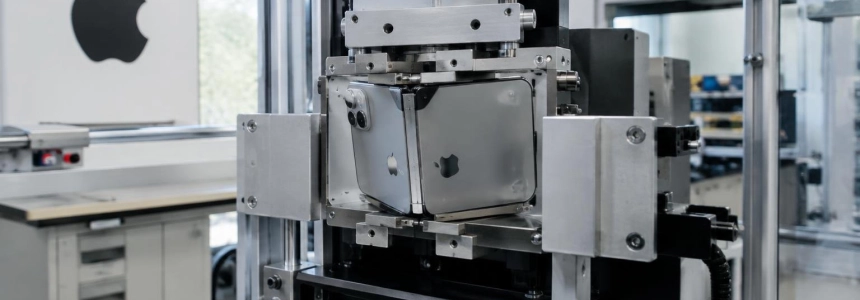
After more than 451,000 folds, the iPhone Duo no longer lies completely flat when opened by CNET's testing machine. The hinge has lost some of its firmness, but the phone is still working and the test continues: the change does not yet meet the conditions CNET considers a failure.
- Developer: Apple
CNET has spent three weeks putting the foldable phone through opening and closing cycles with a machine called Fold-a-Phone, while livestreaming the test. Wear began to become noticeable at around 390,000 folds; by about 440,300, the mechanism had stopped opening the screen in time before the next closing cycle.
Less firm when opening, but no cracks
According to CNET, the hinge has gradually lost stiffness, and the characteristic click when opening the device has weakened. The machine uses a thread to unfold the screen: it now retracts before the screen reaches the flat position, although previously the panel completed the movement through inertia.
The iPhone Duo stops 5 to 10 degrees short of fully opening during the automated cycle. It can still be opened all the way by hand, though it no longer feels or sounds the same as it did at first. CNET notes that the device holds its intermediate positions and shows no cracks or more visible crease.
The test is not considered over because of this change. CNET defines failure using conditions such as loss of power, the sensors failing to correctly detect the screen's position within the allotted time, or the panel going black. The phone is still operational, and the machine continues its cycles.
What 451,000 openings mean
CNET converts the counter to almost twelve and a half years of use, based on 100 openings per day. This is a mathematical equivalent based on that rate, not an estimate of how long each unit will last in real-world conditions.
The outlet warns that Apple has not published an expected fold count for the iPhone Duo. Estimates mentioned within CNET range from 500,000 to 1.5 million; the final figure will depend on how the hinge performs. For now, the team is continuing to fold the same device until it meets one of the failure criteria.
The test examines a single phone and reproduces repeated cycles with a machine. Therefore, its results cannot show how widespread this wear might be in other units or measure how the device would respond to other usage conditions.
What the tests say—and what they don't resolve
MacRumors also covers CNET's test: it highlights that, despite signs of wear, the screen shows no cracks and the phone holds its other positions. The outlet also notes that Apple has not shared an estimated lifespan for the hinge or the results of its own tests.
MacRumors mentions that the device's OLED screen comes from Samsung Display and compares the test with a 500,000-fold durability test passed by the Galaxy Z Fold7 screen. It also notes that Apple probably does not use a standard Samsung screen. That comparison alone does not establish the durability of the entire device: its lifespan depends on both the panel and the hinge.
The shared takeaway is clear: the mechanism shows wear after a very high number of cycles, while the device continues to work and the screen has not cracked. The difference lies in what can be concluded from the result: CNET is keeping the test open to observe how much worse the hinge gets, while MacRumors puts the figure in context with a Samsung screen test, without equating the two devices.
CNET's livestream continues on YouTube on weekdays; the machine will keep running until the iPhone Duo meets one of the failure conditions.
Sources: iSpazio, macitynet.it, MacRumors, Yahoo Tech, 9to5Mac