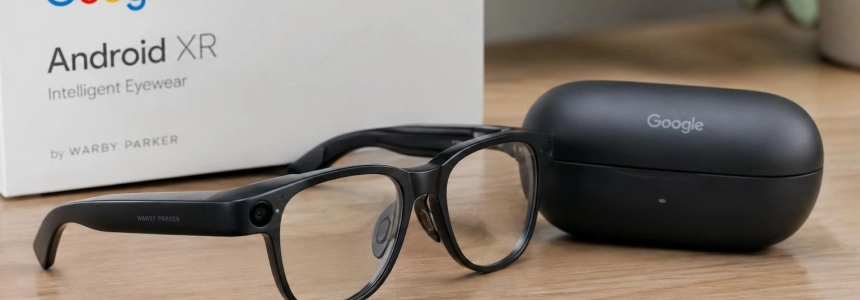
Google’s Intelligent Eyewear glasses are now available to reserve starting at $395: models from Warby Parker and Gentle Monster feature Gemini, a camera, and speakers, but no display in the lenses. Google announced the collections on November 12 and set December 10 as the start date for in-store and online sales.
The launch brings together Google, Samsung, and two eyewear brands with physical stores. Google provides Android XR and Gemini; Samsung is involved in developing the device, while Warby Parker and Gentle Monster handle the frames. WIRED describes the arrangement as a collaboration in which Samsung contributes hardware expertise and Google handles much of the software platform.
Two collections, starting at $395
Warby Parker sells three models—Alden, Reid, and Wren—in prescription or sunwear versions. According to Google, they are available in Pine, Saddle, and Jet Black, with different prescription, width, and lens options. The brand will offer try-ons at more than 360 stores, as well as the collection on its website.
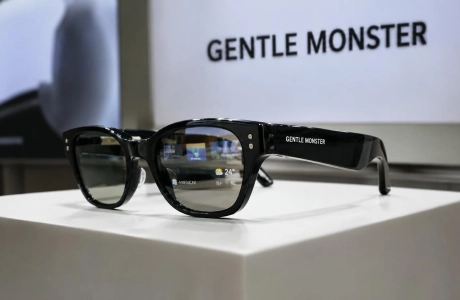
Gentle Monster offers six designs, in colors such as dark red, pink, gray, and yellow, with tinted, clear, blue, or brown lenses. Prescription options are available for most frames. The collection starts at $449 and will be available in the United States and South Korea, according to Google.
| Collection | Designs | Starting price | Availability listed |
|---|---|---|---|
| Warby Parker | Alden, Reid, and Wren | $395 | Warby Parker website and stores |
| Gentle Monster | Six designs | $449 | United States and South Korea |
The frames weigh around 41 grams, according to Google. 9to5Google gives a range of 40 to 44 grams, while WIRED also puts the weight at around 41 grams. Google estimates up to nine hours of battery life, varying with use and settings, and says the charging case can recharge the glasses up to seven times.
They have a 12-megapixel ultra-wide-angle camera on the front. A button lets users take photos and record video; WIRED says clips can be up to 90 seconds long and reach 3K resolution. There is also a touch surface on the temple for tapping, swiping, and controlling audio, as well as four microphones, two open-ear speakers, and a physical switch to turn them off and use them as conventional glasses.
Gemini activates by voice or from the temple
The most visible software update is “Hey Gemini,” Google’s first new always-listening wake phrase since “Hey Google” arrived around a decade ago, according to 9to5Google. Either phrase can be used with these glasses: WIRED also confirms that “Hey Google” remains available. For now, the change is limited to Intelligent Eyewear; Google has not clarified whether “Hey Gemini” will become the default option on other products.
When prompted, Gemini can hold a voice conversation and interpret what the user is looking at. Google gives examples such as asking for information about a mural, adding something in view to a shopping list, or checking the calendar to see whether there is time to attend an event advertised on a poster. WIRED explains that the camera should not activate if the request does not make clear that the user wants the scene analyzed: if a question is ambiguous, Gemini may ask for clarification.
“We felt that these are a Gemini-forward device. It's really you and Gemini going through your day together, so it was feeling a little dissonant for us. You're not talking to Google, you're talking to Gemini.”
— Juston Payne, Google’s senior director of XR product management, to WIRED
Google Maps can provide turn-by-turn audio directions. Google Translate offers real-time voice translation, with automatic language detection and support for more than 70 languages, according to Google’s announcement.
Guided Vision generates audio descriptions for people who are blind or have low vision, and can also help read small print or locate everyday objects. Google warns that the feature can make mistakes and is not intended as a clinical aid, a replacement for a cane, a navigation tool, or a system for safety-critical tasks. The partnership with Aira lets users transmit the camera image to a human interpreter for real-time visual assistance. Both features require a compatible Android phone at launch; Aira may require a subscription or membership.
The glasses also play music and audiobooks, receive notifications, and let users reply to messages and take calls hands-free. Google lists YouTube Music, Spotify, Apple Music, and Audible; at launch, Audible works only when paired with an Android phone. On iPhone, Gemini can make calls, send individual messages—including through iMessage—and display notifications, according to 9to5Google.

iPhone compatibility, with specific requirements
Although they run Android XR, the glasses also connect to iPhone and are Made for iPhone certified. Google’s companion app for iOS handles tasks such as HDR processing and saves photos and videos to Apple Photos. The certification enables Wi-Fi Aware for fast file transfers, according to 9to5Google.
Compatibility does not extend to every phone. Google lists Pixel 7 or later models running the September 2026 update of Android 17 or later; certain Galaxy models in the S, S FE, Z Fold, and Flip families running One UI 9.0 or higher; and the iPhone 13 Pro or later. WIRED notes that Google plans to provide more information in 2027 about expanding compatibility to other phones, but does not specify which models would be added.
Availability is also restricted by country and account: Google says the product can only be used with Google accounts from the United States and South Korea, and requires an eligible account for users over 18. The announcement allows reservations through Warby Parker and Gentle Monster stores and websites; Google adds that demonstrations will be available at selected locations from both brands and at Google Store.
Recording light and image processing
The camera turns on a blinking white light when taking photos or recording videos that are saved to the gallery. If someone covers or disables the indicator, the glasses stop recording. The system checks that the light is working; Google explains that it may blink white and blue while charging as part of this check. If a fault is detected, the camera is disabled.
Things work differently when Gemini uses the camera to answer a visual query. In that case, the light does not turn on: Google says those images are deleted after use, do not appear in Gemini history, and are not used to train models or target ads. Before sending images to Gemini, the phone app blurs other people’s faces; voice processing filters out other people’s voices, according to 9to5Google.
Google also lets users decide which apps can access the camera and microphone. The company says data stored on the glasses is encrypted, and is also encrypted during transmission if it leaves the device. For live translation, Google’s announcement mentions more than 70 languages; 9to5Google adds that the feature works within a 60-degree cone in front of the user.
The terms of use require users to agree not to record other people without permission, in sensitive locations, or while concealing the indicator light. Google may suspend use of the glasses if these rules are violated. Its Play policies prohibit apps from using the camera for live social streaming or real-time facial recognition, and from altering the external light. Google Shopping and Google Ads prohibit selling or advertising accessories designed to cover it.
The design addresses a distrust that did not arise out of nowhere. WIRED recalls that the original Google Glass project became associated with the nickname “Glasshole” and that the use of Meta’s smart glasses has prompted criticism and privacy concerns. Google acknowledges that it learned from the Glass experience; Juston Payne told WIRED: “We learned through Glass that you can make people uncomfortable if you're not clearly communicating.”
Versions with displays are still being tested
These glasses are an audio and camera device, not glasses with a display built into the lenses. Google has already shown a version with a display for navigation or captions, but Payne told WIRED that it is still being tested with people outside Google and remains on the roadmap, without giving a launch date.
WIRED also reports that Warby Parker is preparing more products: its co-CEO Dave Gilboa described a “pretty robust pipeline of additional products” when discussing possible audio glasses. For now, the specific date to buy the announced collections is December 10; reservations are already open.
Sources: 9to5Google, 9to5Google, 9to5Google, Google, WIRED