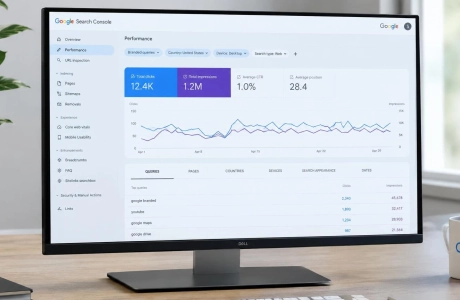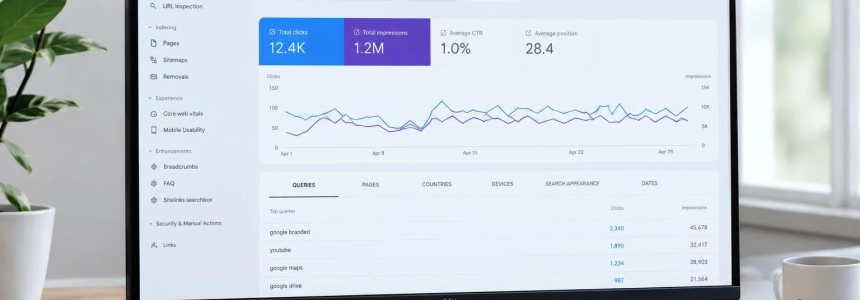
Google has added three features to Search Analytics API that were already available in the Search Console performance report: classification of brand queries, web multimodal search data, and filters for multiple countries and devices in a single request.
The Search Console team announced the change on November 16, 2026. According to Google, it responds to industry requests to make this data available for custom reports and automated workflows. The API can therefore be used to integrate search metrics into dashboards and custom tracking processes, rather than limiting access to the Search Console report.
“Today, we're bringing all three capabilities to the Search Analytics API, following ecosystem requests to make this data available for custom reporting and automated workflows.”
— Daniel Waisberg, Nati Yosephian, and Karin Gadasi, Search Console team
Three features coming to the API
The first new feature is brandedClassification, a field for grouping or filtering data according to whether queries are related to a brand. Google says it lets users compare the performance of brand searches with non-brand searches. Availability is limited to eligible properties: for other properties, the API response will not include rows for this data.
The second option, type=webMultimodal, returns web multimodal search metrics. Google lists three sources: Google Lens, Circle to Search on Android, and images uploaded to Google Search. For properties with bulk data export enabled, these metrics will also be available in BigQuery.
The third addition is filterLists, a field that accepts filters for multiple countries or devices within a single request. Google gives EMEA, LATAM, and DACH as examples of regional groupings. The company says combining these filters can eliminate the need to chain separate requests to obtain these data breakdowns.
| Feature | Field or value | What it lets you query |
|---|---|---|
| Brand classification | brandedClassification | Compare brand and non-brand queries; available only for eligible properties. |
| Web multimodal search | type=webMultimodal | Data from Google Lens, Circle to Search on Android, and image uploads to Google Search. |
| Multiple filters | filterLists | Filter by multiple countries or devices in a single request. |
Regional reporting and automated tracking
Google presents these additions as a way to automate reporting at scale, both for site owners and for companies with international operations and third-party tools. For example, the country filter lets users query regions such as EMEA, LATAM, or DACH without building several separate requests, while brand classification eliminates the need to maintain complex regular-expression lists to separate that traffic.
According to Google, combining filters also makes it possible to segment data by region and device. The company cites tracking a brand's growth in specific regional hubs or comparing which pages perform best in multimodal search across selected markets and devices as possible use cases.
For those already sending metrics to tracking dashboards, the multimodal feature makes it possible to incorporate this data alongside other Google Search results. The announcement does not detail supported values or all possible combinations: Google refers users to the Search Analytics API documentation for that information.

Features already available in Search Console
The update brings three capabilities from the Search Console performance report to the API. Google places their arrival within a series of changes it introduced the previous year: the brand query filter, web multimodal search reports, and filters for multiple countries and devices.
The practical difference now is access through custom workflows. Instead of viewing these breakdowns only in the interface, API users can incorporate them into their own reports or automations, subject to each feature's availability requirements. In particular, the response with no rows for ineligible properties applies to brand classification; Google does not say that the same restriction applies to the other two filters.
The announcement is signed by Daniel Waisberg, Nati Yosephian, and Karin Gadasi from the Search Console team. Google invites users to send questions or feedback on LinkedIn or in the Google Search Central community, and the API documentation lists the available values and combinations for configuring requests.