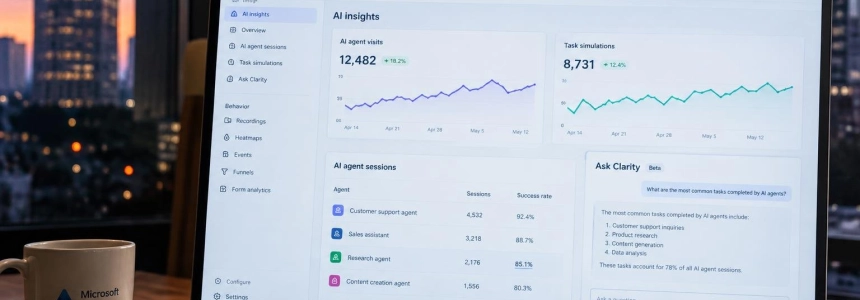
Microsoft Clarity now lets you observe what artificial intelligence agents do when they arrive at a website: from searches and form submissions to purchase attempts. The platform adds an activity dashboard, simulated task tests, and Ask Clarity, a feature for querying site data with questions in everyday language.
Microsoft announced the updates on November 4. It also said that the number of AI agents had nearly doubled in three weeks, approaching 2 million. The figure accompanies a new line of analysis: not just counting visits, but examining what happens during sessions involving an agent.
A dashboard for tracking agent visits
The new Agent Activity Dashboard shows how traffic attributed to agents changes over time, which agents visit a site, and what actions are recorded in their sessions. Examples listed by Microsoft include searches, form submissions, logins, downloads, appointment bookings, and steps in the purchase process.
The dashboard is generally available for Clarity projects that receive agent traffic, according to Microsoft's announcement. The tool builds on Clarity's Smart Events, which record actions relevant to a business, such as purchases, forms, bookings, searches, downloads, and logins.
The company is also adding simulation-based evaluations. Site owners can test whether an agent can complete important tasks before a real customer journey fails. The results show whether the task was completed, how long it took, how many interactions it required, and where the experience could be improved.
Microsoft is starting with commerce and travel scenarios and plans to extend simulations to other types of customer journeys. So this is not just about observing visits that have already been recorded: the tests make it possible to examine how a site responds to a specific task before that interaction becomes part of a real experience.
More than 5.2 million sessions analyzed
The launch follows an analysis published by Microsoft on October 29. The company studied more than 5.2 million sessions classified as sessions with agents, collected between August 13 and September 9, 2026, across 230,511 Clarity projects.
To classify these sessions, Microsoft used providers of agentic browsers detected in the OpenAI, Google, and Anthropic ecosystems. The company observed that the volume of sessions with agents had increased by 88% in three weeks across the projects analyzed.
The most frequent Smart Event action was Checkout: it appeared in 306,621 sessions with agents, equivalent to 25.21% of sessions in that category. Form submissions came second, with 241,391 sessions and 19.85%. Outbound clicks appeared in 173,655 sessions, or 14.28%, and appointment bookings in 102,401, or 8.42%.
The list also includes searches in 87,096 sessions (7.16%), logins in 83,096 (6.83%), the “Show more” action in 52,456 (4.31%), availability checks in 29,274 (2.41%), add-to-cart actions in 28,289 (2.33%), and downloads in 20,593 (1.69%). Microsoft also noted 10,521 sessions with the “Find location” action.
The figures describe actions recorded across separate sessions, not a common sequence. A session may include more than one action; therefore, the percentages do not form a conversion funnel and do not, on their own, prove that an agent completed a task autonomously.
How this differs from human sessions
Microsoft compared sessions with agents against human sessions across the same projects. Checkout ranked first among agent actions, at 25.21%, compared with 14.65% of human sessions. In the latter, outbound clicks were the most common action, at 26.99%; among sessions with agents, they accounted for 14.28%.
Other differences were smaller. Forms accounted for 19.85% of sessions with agents and 18.56% of human sessions. Searches made up 7.16% of the former and 4.79% of the latter. Microsoft concludes that both groups share many actions, but their distribution differs: sessions involving agents concentrate more activity on tasks such as checkout and bookings.
There is an important methodological caveat. A session classified as agentic may include human intervention. Clarity does not currently separate the part carried out by the agent from the human part across distinct sessions, so recorded events cannot necessarily be attributed to an autonomous AI action.
Ask Clarity and natural-language answers
Ask Clarity lets users ask natural-language questions about behavior on a website and receive answers and recommendations supported by evidence from real sessions, according to Microsoft's description. The aim is to reduce the work of finding patterns in behavioral data and turn the query into a direct question.
The feature joins other AI capabilities that Clarity already documented under the name Copilot. Microsoft's documentation describes a chat for querying project data and getting summaries, as well as insights from session recordings and heatmaps. It does not specify whether Ask Clarity replaces these features or exactly how it integrates with them.
The documentation also warns that generative models may misinterpret data or produce incorrect information, and allows users to submit feedback through positive or negative rating controls. That notice refers to the Copilot features documented by Microsoft; the announcement of the updates does not separately detail how Ask Clarity works internally or its availability.
Brand Agents expands to local businesses
The third announced update is the expansion of Brand Agents to local businesses. Microsoft says these agents help products appear in Microsoft Copilot, Bing, and MSN, and help local businesses attract potential customers and receive appointment bookings.
Brand Agents had already been introduced as AI shopping assistants for brand websites. In January, Microsoft Advertising explained that they could guide customers in each brand's voice, answer product questions, and help move them toward a purchase. The company also described performance statistics within Clarity for comparing assisted sessions with organic traffic.
The current announcement extends that approach beyond stores: it adds lead generation and bookings as objectives for local businesses. Microsoft did not specify in the announcement which businesses can now activate the expansion or the specific setup steps.
With the activity dashboard, simulations, and Ask Clarity, Microsoft is taking Clarity beyond visit measurement toward analyzing tasks carried out in sessions with agents. Simulations are starting with commerce and travel; the company plans to add other journeys over time.
Sources: Search Engine Roundtable, Understand your customers | Microsoft Clarity Blog, Understand your customers | Microsoft Clarity Blog, Microsoft Learn, Microsoft Advertising