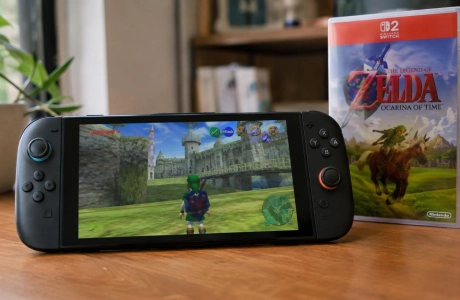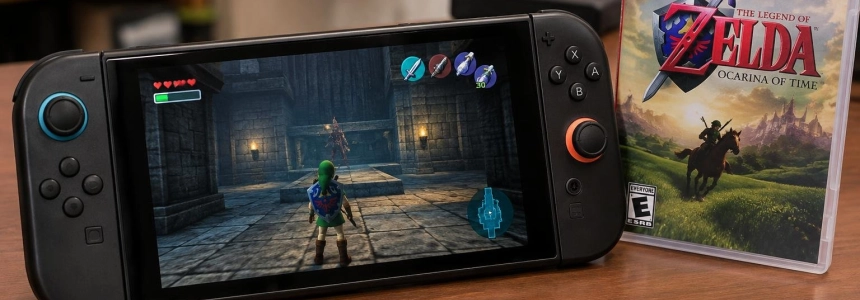
The remake of The Legend of Zelda: Ocarina of Time arrives on Nintendo Switch 2 with a rebuilt Hyrule, voiced scenes, and more direct controls. Eurogamer and The Guardian agree that the adventure retains its power; COGconnected, while praising the update, notes that combat can still feel slow.
- Developer: Nintendo
- Publisher: Nintendo
- Platform: Nintendo Switch 2
- Release: November 5
- Price: £59.99
The Same Adventure, from a Different Perspective
The story follows Link on his journey through Hyrule to face Ganondorf, with jumps between different stages of the hero's life. The route, the order of locations, and the dungeon solutions remain unchanged, according to The Guardian. Kokiri Forest, Hyrule Field, and the Temple of Time are still there too: the remake changes how they look and how you move through them, not the adventure's underlying structure.
Eurogamer notes that the fixed camera has given way to a controllable perspective, with one stick for moving Link and another for the camera. In its view, this change makes the environments feel more like open play spaces, though it sacrifices some of the original's stage-set quality. The outlet also appreciates the new look of places such as the Water Temple, now with an art nouveau palace feel, and the Forest Temple, transformed into a dark mansion overrun by trees.
The visual update is not equally convincing everywhere. Eurogamer warns that some areas can resemble other third-person action games and that the new look loses some of Zelda's identity. The Guardian, by contrast, describes the style as “hyperreal” and compares its characters to puppet-theater figures. Its review celebrates the environments but laments that Sheik has lost some of their androgyny.
Fewer Menus, More Flow in the Dungeons
Link can jump with a button instead of relying on the original's contextual jumps, and items are selected using shortcuts. The Guardian notes that combat feels a little faster and that the newly recorded orchestral soundtrack has more impact. It also mentions an option to play the ocarina by humming the melodies into the Switch 2 microphone.
For Eurogamer, the most effective change is not the most eye-catching: being able to equip and remove the Iron Boots without going through a chain of menus transforms the pace of the Water Temple. The review says it was able to experiment with water levels and available routes without disrupting the dungeon's flow. It also mentions less visible adjustments, such as a wallet with greater capacity from the start, though it does not confirm every change it suspects has been made.
Dexerto adds other new features: unlimited running, gyroscopic aiming controls, and the ability to check missions in Threads of Time. It also highlights Hall of Fallen Foes, a boss battle mode, and the option to activate melodies with your voice or a real instrument. In its view, these additions improve the adventure without drastically changing its structure.
Voice acting is one of the changes most likely to divide players who know the game. The Guardian notes that the dialogue has been expanded and that important scenes are voiced, but points out that Link still does not speak. Dexerto also notes that most characters, apart from Link and some supporting characters, are voiced. COGconnected praises the cast's performances and considers the music and visuals effective in sustaining the mythical tone of a story that, in its view, remains rather vague and “cheesy” at times.
Time Changes the Player, Too
The most enthusiastic reviews do not attribute the remake's impact to graphics alone. Eurogamer revisits the seven-year time jump that transforms Link from a child into an adult: returning to the game after nearly three decades, the critic finds an adventure about the passage of time that blends with their own memories. For The Guardian, returning to the Temple of Time as an adult makes the story especially moving, even when you already know what happens.
“The 2026 version looks awesome (mostly), the controls are seamless, and it feels faithful to the original.”
— James Paley, COGconnected critic
COGconnected shares the enthusiasm for the controls and visuals, but raises two specific concerns: some character models seem strange, and many battles retain long stretches of waiting before you can attack. The outlet believes speeding up these encounters would be difficult without straying too far from the original design. It also sees the story more as a myth open to the imagination than as a tale developed in detail.
Agreement on the Adventure, Differences over the Tweaks
Eurogamer, The Guardian, Dexerto, and COGconnected agree that the remake preserves the adventure's identity while making it easier to play and updating its environments. Improvements to item access and Hyrule's new presentation receive frequent praise; the Water Temple is a clear example of how a small adjustment can make a familiar dungeon easier to get through.
The differences lie in how much the modernization is appreciated. The Guardian celebrates the voiced scenes and new visual style, though it has reservations about Sheik's portrayal. Eurogamer notes that some locations lose their personality by adopting an aesthetic more familiar from modern games. COGconnected, meanwhile, is not convinced by all the character models and notes that combat's pacing has not changed enough. The adventure and its dungeons remain at the center; the debate is about how much Ocarina gains—or leaves behind—as it gets dressed for a new generation.
Sources: Eurogamer.net, the Guardian, Dexerto, COGconnected