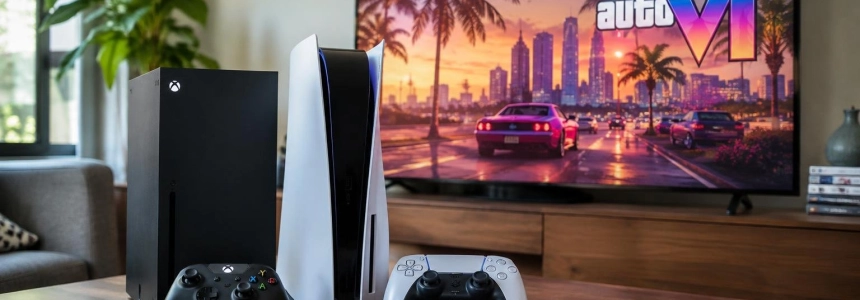
In Digital Foundry's comparisons, Xbox Series X maintains 30 fps more consistently than PS5 in GTA 6, although both consoles experience drops and share very similar visual quality. The difference appears more often in demanding sequences, especially when moving quickly in a vehicle.
The result contrasts with PlayStation's prominence in the game's marketing campaign, but it does not make Microsoft's console a radically different version. According to Digital Foundry, Series X's advantage is stability: the experience also drops below 30 fps on that console, just less often than on PS5.
The difference appears when speeding up
On PS5 and Series X, GTA 6 renders at an internal resolution of 1440p, upscaled to 4K. Both versions share graphics settings, including global illumination and ray-traced reflections. Digital Foundry also observed small resolution variations in Xbox's favor, although they are difficult to distinguish at a glance.
The 30 fps limit is not always maintained on either machine. Digital Foundry says PS5's most frequent drops occur during fast movement, such as driving at high speed; scenes with lots of activity can also strain the game. Notebookcheck's comparison describes drops into the mid-to-high 20 fps range in a driving sequence through a busy airport, and notes that explosions can bring performance close to 20 fps.
PS5 seems to be quite a bit worse in this regard
— Digital Foundry
The important takeaway is not that Xbox eliminates drops, but that both versions start with a 30 fps target and Series X maintains it more consistently in comparable moments. There is no 60 fps mode separating the consoles here: the tests described focus on how well they meet the current target.
| Version | Resolution and settings | Observed performance |
|---|---|---|
| Xbox Series X | 1440p internal, upscaled to 4K; global illumination and ray-traced reflections | Fewer drops than PS5; can still fall below 30 fps |
| PS5 | 1440p internal, upscaled to 4K; graphics settings similar to Series X | More frequent drops, especially when driving fast |
| PS5 Pro | Sharper image with PSSR and ray-traced shadows | The most stable option among those compared |
| Xbox Series S | Retains many of Series X's graphical advances | Frequent drops to 25 fps and occasional dips to 20 fps |
VRR and visual quality change the ranking
The comparison also depends on the display. Digital Foundry notes that Series X can take advantage of VRR at 120 Hz on a compatible TV, while GTA 6 on PS5 does not offer this compatibility. Notebookcheck adds that Xbox uses low framerate compensation (LFC) below 48 fps; according to the outlet, this helps make drops feel less uneven.
That does not mean the game stops dropping frames, or that VRR changes the performance target. The practical difference described in the analyses is how those drops appear on a compatible display. Players on PS5 do not get the same help smoothing the presentation, even though the baseline graphics quality is similar.
PS5 Pro comes out ahead in stability among the consoles analyzed. Digital Foundry highlights a sharper image thanks to PSSR and better ray-traced shadows, as well as steadier performance. Notebookcheck also considers it the most stable option and notes that it rarely falls below its target.
The trade-off is clear: Series X has an edge over the standard PS5 in consistency, while PS5 Pro offers the most advanced visuals and the most stable performance. None of these comparisons show that PS5 is incapable of running the game well; the difference described in the analyses is relative, not a divide between a playable version and an unplayable one.
Series S pays a higher price for the shared target
Microsoft's more affordable console retains many of Series X's graphical effects, something Digital Foundry considers notable. But its drops can reach 20 fps, and the outlet describes it as the version that is hardest to recommend because of its inconsistent performance.
Notebookcheck points to another difference: Series S uses a native resolution of 720p and scales it up to 1080p with FSR 4.1, although it notes lower-quality shadows and audio cutouts that, according to the outlet, updates had yet to fix. This is a more noticeable compromise than the one between Series X and PS5: it affects not only stability, but also sharpness and some graphical details.
For Rockstar, the results put the focus on optimizing drops, not matching resolution figures: PS5 and Series X have similar settings and visual output, but behave differently in specific scenes. 3DJuegos points to future updates as a possible improvement, especially for PS5 and Series S. It does not specify what changes the studio is preparing or when they might arrive.
A technical advantage that does not decide everything
PlayStation's promotional branding and the performance measurements tell different stories: leading the campaign does not guarantee a platform will be the most stable in every comparison. Windows Central considers the marketing claim that the game runs better on PS5 to be called into question; even so, the same outlet describes the differences in actual use as small.
The conclusion depends on what matters to you. Series X is more consistent than the standard PS5 in the cited tests; PS5 Pro offers greater stability and better shadows; Series S retains many effects, but suffers more pronounced drops. Those comparing frame rates will find measurable differences, although the sources do not describe a major visual gap between the standard PS5 and Xbox Series X versions.
For now, the 30 fps limit remains in place even on the most powerful consoles in the comparison. The remaining question is whether Rockstar's upcoming updates will reduce drops on PS5 and Series S, the two platforms 3DJuegos identifies as potential beneficiaries of those improvements.
Sources: 3DJuegos, Windows Central, Notebookcheck, GamesRadar+