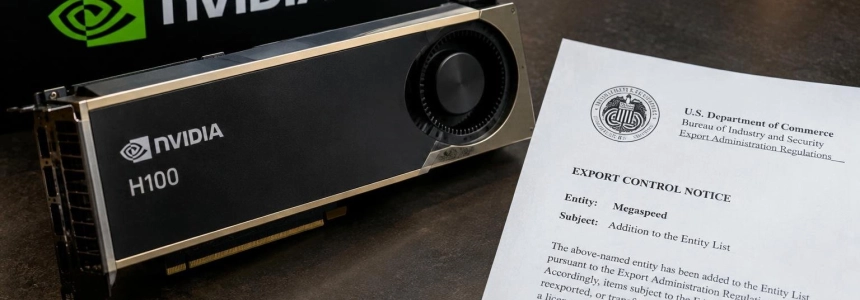
The U.S. Department of Commerce has added Megaspeed to its Entity List, barring U.S. companies from selling technology to the Singapore-based company and its subsidiaries without a federal license. The measure covers products such as artificial intelligence chips and comes hours after Nvidia reinstated Jensen Huang as CEO.
A list that reaches seven companies
The Bureau of Industry and Security (BIS), part of the Department of Commerce, added seven companies in Singapore, Malaysia, and Thailand to the list, including Megaspeed, according to The Register. The companies identified include Swiftdata, Megaspeed’s owner, and Speedmatrix, its Malaysian subsidiary. Also listed is Apex Enterprise Solutions, the Singapore subsidiary of Chinese cloud computing giant Alibaba.
The final rule was issued on Monday afternoon and is scheduled to be published in the Federal Register on Wednesday, The Register reported. The restriction applies to anyone seeking to supply the seven companies with goods subject to U.S. export controls: they must apply for a license, and applications will be reviewed under a “presumption of denial,” according to the BIS.
In practice, this blocks access to sensitive U.S. technologies without authorization, including advanced chips. Engadget notes that no U.S. company, including Nvidia, will be able to sell technology to Megaspeed or its affiliates without federal government permission.
The BIS says the listed companies pose a significant risk of diverting advanced computing hardware to recipients or uses not authorized by the U.S. government. The Register links the listing to an ongoing investigation into the alleged diversion of advanced GPUs to China.
“And I convinced them. I closed the deal.”
— Donald Trump, President of the United States, to CNBC
The investigation began before the scandal
The Commerce Department’s action did not arise in response to reports about Huang’s private life. In a joint statement released last week, the Justice and Commerce departments said the investigation into Megaspeed began in 2024, after suspicious activity was detected while monitoring potential violations of semiconductor export controls.
In May 2025, investigators requested records from Nvidia on direct and indirect sales to Megaspeed. A month later, Nvidia added the Singaporean company to its own internal “do not sell” list, according to the statement. The investigation included a visit to Megaspeed’s facilities and interviews with its then-CEO, Alice Huang, conducted by U.S. investigators accompanied by Singaporean law enforcement officers.
The Justice Department subsequently took the lead in the criminal investigation. CBS News reported that authorities in both countries are examining whether Megaspeed violated export restrictions and illegally transferred Nvidia chips to China. The company has denied any wrongdoing.
Megaspeed operates data centers in Southeast Asia and offers cloud and artificial intelligence infrastructure, according to CBS News and TechCrunch. During the period when Jensen Huang acknowledged having an extramarital relationship with Alice Huang, the company was one of Nvidia’s largest chip customers, according to TechCrunch.
Alice Huang, the Nvidia connection, and the allegations
Alice Huang, who is not related to Nvidia’s CEO, led Megaspeed for more than two years, according to TechCrunch. The Register reported that she had been interviewed by investigators and formally left the company in August 2025. Megaspeed has also said its former executive left last year.
The espionage allegations concern the possibility that Alice Huang worked for Chinese intelligence services. The Register attributes the suspicion to reports about U.S. intelligence officials; China has rejected the allegations, according to Engadget. Megaspeed maintains that its business is legitimate and lawful and says it complies with U.S. export control regulations. The company hired outside lawyers to conduct an internal investigation, The Register reported.
The case intersected with the leadership crisis at Nvidia after Jensen Huang admitted to being unfaithful. The Register noted that he never publicly identified the Megaspeed executive as the person with whom he had the relationship; CBS News also reported that Huang acknowledged an affair with a former company executive and a Nvidia subordinate.
The controversy has renewed questions in Washington about how Megaspeed was able to buy Nvidia chips despite restrictions intended to limit China’s access to advanced technology. CBS News cited criticism from experts and former government officials, who questioned the Commerce Department’s delay. Treasury Secretary Scott Bessent had told CNBC that other federal agencies had favored adding Megaspeed to the list for months, but that “Commerce holds the pen.”
Huang returns to the role after Trump’s intervention
Jensen Huang resigned on November 12, according to Engadget, after reports emerged about several extramarital relationships, including one with a former Megaspeed executive. On Monday, Nvidia’s board voted unanimously to reinstate him as CEO and chairman, after board chair Harvey Jones had said days earlier that the company had no intention of bringing him back.
The board met on Sunday night to vote on Huang’s return. Donald Trump joined the meeting by phone and later confirmed to CNBC that he had influenced the decision, according to Engadget and The Register. CBS News reported that Trump spoke with the directors and gave them assurances about national security. Nvidia’s board, for its part, said it had received assurances from senior U.S. government officials regarding the national security implications of Huang’s return.
The reinstatement followed a pressure campaign by Silicon Valley figures, including Elon Musk, and intervention by the White House, according to The Register. CBS News reported that Nvidia shares rose more than 30% after the decision. Huang had spent eleven days away from his role, according to The Register.
Congressional appearances in December
Huang’s return does not put an end to lawmakers’ questions. He is scheduled to appear before three congressional committees on December 1; Nvidia general counsel Tim Teter is due to appear the following day, The Register reported.
Nvidia also created a board-level committee to oversee compliance with national security and export control regulations. Staff responsible for trade compliance will report to three directors, The Register added.
Separately, the Commerce Department issued a rule last week intended to prevent Chinese companies from remotely accessing advanced chips installed in data centers in other countries. CBS News said the rule tightens export conditions for countries such as Malaysia and Singapore. The criminal investigation into Megaspeed, meanwhile, continues under the direction of the Justice Department.
Sources: Engadget, theregister, TechCrunch, CBS News