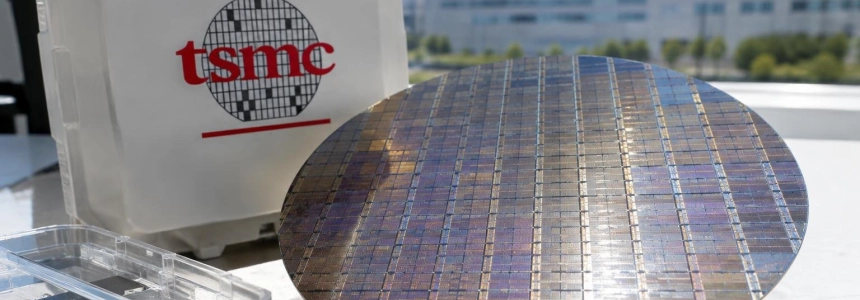
TSMC has asked that Chinese orders be halted for chips made using 16-nanometer processes or smaller unless customers obtain an export license from the United States. The measure responds to new Department of Commerce rules that expand controls beyond artificial intelligence chips to include designs for consumer products.
Reuters, in a report published by the Taipei Times, says the suspension affects orders that could previously be manufactured without an individual license. Tom’s Hardware reports, citing Nikkei Asia, that TSMC has put several shipments to Chinese and non-Chinese designers on hold while it checks how they comply with the new rules. DDay.it, meanwhile, reports that TSMC and Samsung informed Chinese customers that some deliveries were paused pending permits.
The threshold is now the manufacturing process
The U.S. rule, published as an interim final rule by the Bureau of Industry and Security (BIS), changes the criteria applied to certain Chinese designs. Previously, TSMC could examine a chip’s computing power and other technical characteristics to decide whether it fell outside the controls; under the new framework, advanced chips are presumed to be subject to control and require a license unless an exception applies.
According to people familiar with the matter cited by Reuters, TSMC has said that orders using processes of 16 nm or smaller must be stopped. Tom’s Hardware describes the classification as a presumption of control for semiconductors manufactured on 16 nm or 14 nm nodes. The question no longer depends solely on whether the design is intended for artificial intelligence: chips developed for other applications are also within scope.
The BIS rule also applies to wafer fabrication companies—foundries—and outsourced assembly and test companies, known as OSATs. Tom’s Hardware adds that the classification may apply even if a chip has fewer than 30 billion transistors and does not include HBM memory; those characteristics alone are no longer enough to assume that the product falls outside the controls.
The change took effect on November 19, according to Reuters, which described the new provision as effective the day before its November 20 report. The rule eliminates a compliance route that had allowed some Chinese designers to access advanced manufacturing without applying for an individual license in each case.
Consumer chips are also exposed
Until now, U.S. restrictions had focused on high-performance processors for artificial intelligence, such as Nvidia’s Blackwell accelerators and, according to Tom’s Hardware, the upcoming Vera Rubin products. The new rules expand controls to non-AI chips, including those integrated into smartphones, televisions, and automotive products.
DDay.it lists among the components potentially affected not only smartphone SoCs but also auxiliary chips for battery management and other coprocessors. The publication notes that TSMC manufactures processors for Xiaomi, Oppo, and Vivo phones, so the new licenses could affect deliveries to those manufacturers.
Licenses could be approved, according to industry sources cited by the Financial Times in the report carried by DDay.it. The problem, they add, is that processing times could be long enough to make production planning difficult. No approval dates or specific orders already affected by delays have been detailed.
| Process | Situation described | Conditions |
|---|---|---|
| 16 nm or below | Orders require a U.S. license; TSMC has ordered affected orders to be halted until they have one. | The license allows production to continue, according to the cited reports. |
| 28 nm or 40 nm | Possible alternatives for Chinese customers without a license. | The chip must not use HBM or require advanced packaging. |
The table reflects the alternatives described by Reuters and DDay.it: 28 and 40 nm processes remain an option for some designs, but not if they incorporate high-bandwidth memory (HBM) or require advanced packaging. Reuters explains that most cutting-edge AI chips are produced using 7 nm or smaller processes, while HBM enables the handling of large volumes of data and advanced packaging integrates chips and memory to increase computing capacity.
More controls on companies and routes
TSMC’s review is not limited to chip specifications. The people cited by Reuters say the company is also examining its customers’ locations, boards, and shareholders, as well as packaging providers and shipping routes. The checks cover orders placed through subsidiaries or intermediaries in Taiwan, the United States, Europe, Japan, and Southeast Asia.
DDay.it adds that TSMC is reportedly stepping up its search for shell companies and structures created to circumvent sanctions. According to the publication, the company is also reviewing operating locations and major shareholders, and has stopped accepting certification from independent packaging and testing companies as proof that a high-performance processor falls outside the restrictions. The outlet says some companies of this kind may have altered reports to facilitate the production of chips that should not have left Taiwanese foundries.
This stricter scrutiny matters for designers that relied on subsidiaries or intermediaries: the review can follow the order’s chain, not just the entity formally listed as the customer. Reuters does not specify which companies have been subject to these checks or which shipments have been blocked for that reason.
Pressure on China’s AI plans
The restrictions particularly affect Chinese companies seeking to develop AI accelerators and processors capable of competing with those from Nvidia or AMD. Reuters says some Chinese designers still had access to TSMC’s 7 nm manufacturing before the rules took effect, although it could not verify under what agreements those chips were produced.
The U.S. list of approved designers includes Nvidia, AMD, and Apple, as well as Taiwan’s MediaTek and Realtek, but no companies from mainland China, according to Reuters. The contrast leaves Chinese designers without an automatic route to advanced processes: they will have to obtain licenses, change the specifications of their orders, or seek other manufacturing sources.
DDay.it says Kunlunxin, Baidu’s chip division, and ByteDance are already looking for alternatives. The same publication links this search to recent supply problems: Nvidia has reportedly also halted shipments to China of data center products based on the Hopper generation, which had previously been authorized.
For now, the options described for those unable to obtain a license are to move down to 28 or 40 nm nodes, if the design meets the HBM and packaging conditions, or turn to Chinese foundries. The new rules also apply to manufacturing orders and intermediary verification, so the change is not limited to choosing another supplier.
The available reports do not specify how long the pauses will last or how many specific deliveries are affected. Reuters does point to an immediate consequence for customers: advanced orders are on hold until they obtain the required U.S. licenses.
Sources: Tom's Hardware, DDay.it, Taipei Times