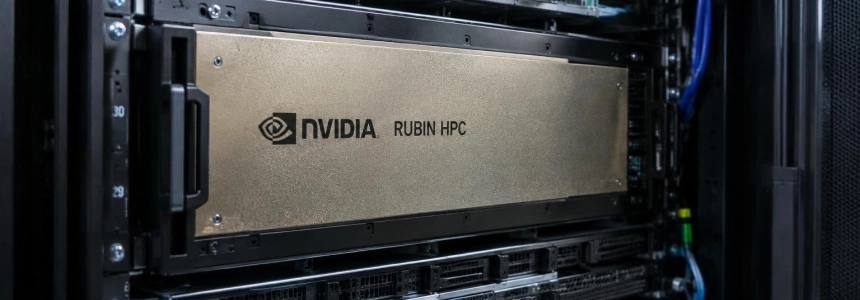
NVIDIA unveiled Rubin HPC, a GPU for scientific computing with more than 50,000 CUDA cores, compared with the GeForce RTX 5090’s 21,760. The company expects it to arrive in systems available in 2028; it is not a product for gaming or conventional desktop graphics.
A GPU in the Vera Rubin platform
The announcement was made at SC26, the supercomputing conference where NVIDIA introduced Rubin HPC as a new member of its Vera Rubin platform. The company is targeting science, engineering, and analytics workflows that need to process large datasets and run simulations.
In terms of core count, it is far ahead of the RTX 5090: Rubin HPC has more than twice and nearly three times its 21,760 CUDA cores. The comparison helps put the core count in perspective, but it does not make Rubin HPC a consumer card or, by itself, show how much faster it will run an application.
| GPU | CUDA cores | Described use |
|---|---|---|
| NVIDIA Rubin HPC | More than 50,000 | Scientific simulation and data processing, engineering, and analytics |
| GeForce RTX 5090 | 21,760 | Consumer graphics card cited as a reference for core count |
NVIDIA says the design combines computing capacity with data movement so that the cores do not spend time waiting for information. It also includes sparse data acceleration, intended for calculations that select a small number of values from much larger datasets. The company has not published performance figures that would quantify the effect of these design choices in specific applications.
Simulations, sparse data, and connections between GPUs
The company cites sparse matrix operations, stencil computations, sorting, and reductions. According to NVIDIA, these patterns appear in simulation and analysis work, including climate models, engineering, genomic analysis, and financial risk assessment.
Rubin HPC also features seventh-generation NVLink, NVIDIA’s GPU interconnect technology. The connection is intended for systems that distribute complex simulations across multiple processors. However, the company has not provided bandwidth figures for this implementation.
Another part of the offering is CUDA-X, NVIDIA’s collection of libraries with optimized implementations of algorithms for simulation, scientific research, and data analysis. The company proposes using them alongside Rubin HPC to accelerate calculations initiated by AI agents and other scientific applications.
“For agents tackling science and engineering, faster simulation means faster discovery”.
— Ian Buck, vice president of hyperscale and high-performance computing at NVIDIA
Buck linked the GPU to agents that propose materials, molecules, and design candidates, then use simulations to evaluate them and decide on their next steps. NVIDIA’s stated goal is to shorten this cycle of exploration, testing, and refinement; no measured results have been presented to indicate how much time Rubin HPC would save on a given task.
The timeline and what still needs to be measured
NVIDIA expects Rubin HPC to be available in 2028. The date refers to its arrival in deployed systems, not to a card users can buy now for a PC. Between the announcement and its availability, interested organizations will have to wait to evaluate the accelerator in their own environments.
StorageReview also reports a claim NVIDIA made during SC26: Rubin HPC would triple performance in simulation and analytics. The company did not identify the baseline used for this calculation. It also did not disclose memory capacity, FP64 performance, power consumption, or system configurations, so the figure does not allow comparison with a specific GPU.
The same coverage notes that Rubin HPC supports precisions ranging from FP64 to FP4. This adds to the technical description, but is not accompanied by performance results for each precision or details about the systems on which they would be achieved.
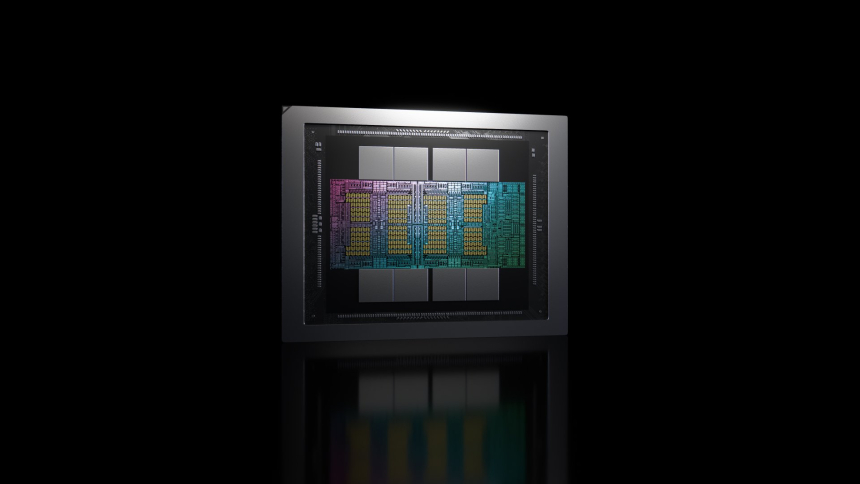
Tom’s Hardware suggests that the core count could point to a four-die configuration similar to Rubin Ultra, connected via NVLink-C2C. This possibility is the outlet’s inference, not a specification NVIDIA has confirmed for Rubin HPC.
For now, there are no independent tests establishing how much it will accelerate specific workloads. Its practical usefulness will also depend on the software, system configuration, and measurements obtained once the hardware is deployed. The next concrete timeline milestone is 2028, when NVIDIA expects Rubin HPC to be available.
Sources: TechRadar, NVIDIA Blog, Tom's Hardware, StorageReview