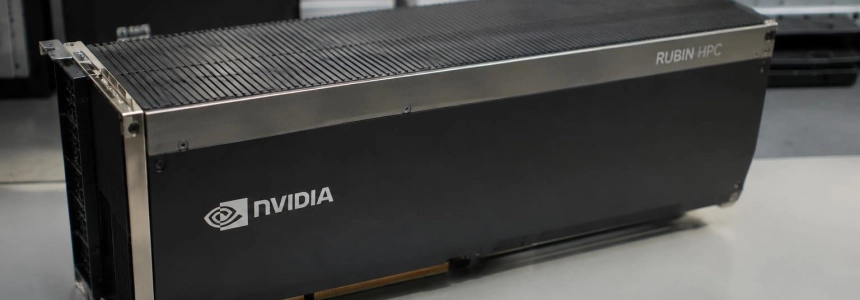
Rubin HPC exceeds 50,000 CUDA cores in a single GPU, according to Nvidia, and is designed for scientific simulations, engineering, and data analysis. The company introduced it at the SC26 supercomputing conference as part of its Vera Rubin platform; availability is planned for 2028.
The proposal is not simply about increasing the number of compute units. Nvidia also highlights a sparse data acceleration feature and a new generation of GPU interconnect, with the goal of keeping the cores busy as they work with large, distributed datasets.
An HPC GPU distinct from standard Rubin
The focus is on scientific computing, not primarily on training and running inference on artificial intelligence models. That is how Rubin HPC differs from the standard Rubin GPU, according to Hardware Upgrade: the new variant targets simulations, numerical operations, and applications that require high precision.
Nvidia lists climate models, engineering simulations, genomic analysis, and financial risk assessment among its use cases. Electronics Weekly adds that typical workloads in these fields often query scattered values within large datasets, calculate a result, and repeat the process at scale.
To address this pattern, the Sparse Data Acceleration feature aims to speed up access to irregular data and reduce the time processing units spend waiting for information. Nvidia mentions sparse matrix operations, stencil computations, sorting, and reductions. These patterns occur in various science, engineering, and analytics workloads.
Hardware Upgrade describes sparse matrices as structures with many null or computationally irrelevant elements, and stencils as operations in which the value of a cell depends on nearby positions in a grid. The company has not detailed how it implements Sparse Data Acceleration or confirmed whether it uses specific functional units or memory structures.
More cores, but performance figures are missing
The announced figure is more than 50,000 CUDA cores. Tom’s Hardware notes that Nvidia presents it as the largest number of CUDA cores in one of its GPUs. To put the scale in context, Hardware Upgrade compares the figure with the 20,480 cores in the Blackwell Ultra-based B300 and the 24,576 it attributes to the GB202, the highest-end gaming model.
| GPU or chip | CUDA cores | Cited figure |
|---|---|---|
| Rubin HPC | More than 50,000 | Nvidia, according to media reports |
| B300 Blackwell Ultra | 20,480 | Hardware Upgrade |
| GB202 | 24,576 | Maximum possible figure cited by Hardware Upgrade |
| RTX 5090 | 21,760 | Notebookcheck |
Notebookcheck calculates that Rubin HPC would have almost 2.5 times as many CUDA cores as an RTX 5090. That count alone is not enough to infer final performance: the Italian publication warns that Nvidia has not yet announced the new GPU’s FP32 or FP64 compute figures.
FP64 precision is relevant to many scientific simulations. As references from previous generations, Hardware Upgrade cites around 1.25 TFLOPS of native FP64 for the B300 and around 37 TFLOPS for the B200; for standard Rubin, it mentions around 33 TFLOPS of native FP64. It also reports 200 TFLOPS for standard Rubin in DGEMM with Tensor Core and emulation, a mode that is not equivalent to native FP64 performance.
Rubin HPC does not yet have complete specifications: Nvidia has not published its capacity or memory bandwidth, power consumption, or theoretical FP32 and FP64 performance. Its price and the specific systems in which it will be installed are also unknown, according to Notebookcheck. StorageReview reports that Nvidia said at SC26 that the GPU triples performance in simulation and analysis, but the company did not identify the comparison baseline.
NVLink 7 and an internal configuration still to be clarified
Rubin HPC will be the first product in the family with seventh-generation NVLink, according to Hardware Upgrade. Standard Rubin uses NVLink 6. GPU interconnect is important in large systems, where multiple accelerators work together and must exchange data during simulations.
For now, there are no bandwidth figures for NVLink 7 or information on how many links Rubin HPC will have. For comparison, Hardware Upgrade cites up to 1.8 TB/s of bidirectional GPU-to-GPU bandwidth for NVLink 5, used by Blackwell and Blackwell Ultra. Notebookcheck specifies that standard Rubin offers up to 3.6 TB/s with NVLink 6 and 288 GB of HBM4 memory; these figures should not be attributed to Rubin HPC.
The physical layout has also not been confirmed. Hardware Upgrade interprets the chip image presented at SC26 as indicating at least two chiplets, similar to the standard Rubin GPU, but cautions that the rendering does not establish how many dies it actually contains. Tom’s Hardware suggests that the core count could point to a configuration similar to Rubin Ultra, with four dies connected through NVLink-C2C; it presents this as a possibility, not a confirmed specification.
AI agents in the research cycle
Nvidia links the GPU to agentic workflows: AI agents that generate hypotheses, run simulations, and use the results to guide the next step. The company argues that accelerating this cycle would make it possible to examine more alternatives and direct laboratory work toward promising candidates sooner.
CUDA-X libraries are part of this software proposal. Nvidia describes them as a growing set of optimized implementations of complex algorithms, including those related to simulation and analysis. The idea is to combine these libraries with Rubin HPC so agents can run computations and use their results in new rounds of research.
“For agents tackling science and engineering, faster simulation means faster discovery,”
— Ian Buck, vice president of hyperscale and high-performance computing at NVIDIA
The announcement does not include benchmark results that would make it possible to measure Rubin HPC’s improvement over current accelerators. DigitalToday indicates that the simulation tests needed to evaluate performance will be published later. The expected availability date of 2028 appears in Hardware Upgrade, Notebookcheck, Tom’s Hardware, and StorageReview; Electronics Weekly, by contrast, gives 2018.
2028 is the date repeated by four publications, although Electronics Weekly gives 2018. Nvidia has not yet published a complete Rubin HPC specification sheet against which to verify its performance, memory, power consumption, and price.
Sources: electronicsweekly.com, Hardware Upgrade, Tom's Hardware, Notebookcheck, StorageReview, DigitalToday