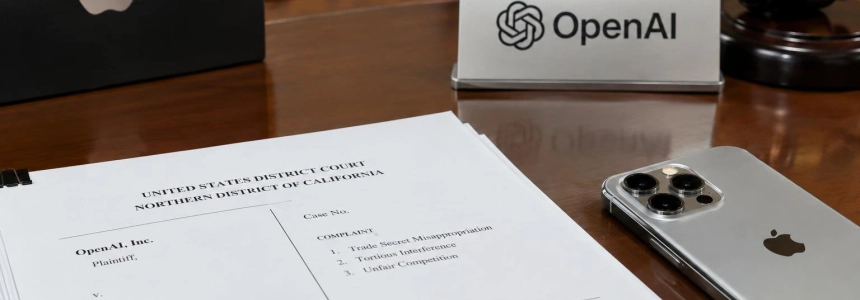
OpenAI accuses Apple of pressuring suppliers not to work on its future devices and of using its employment practices to make it harder for employees to leave for competitors. The company filed counterclaims on Friday in a federal court in California, in response to the trade secrets case Apple brought against it.
The accusations turn the lawsuit into a two-way dispute between two companies that previously worked together to bring ChatGPT to the iPhone. OpenAI claims Apple is trying to hinder its entry into the hardware market; Apple, for its part, had accused OpenAI of obtaining confidential information through former employees and using it to develop products.
Suppliers under pressure, according to OpenAI
In its court filing, OpenAI says Apple asks shared suppliers what projects they are working on for the company and which employees are involved, including those who previously worked for Apple. According to the filing, Apple then tries to prevent those people from being assigned to Apple projects. OpenAI argues that this dynamic makes suppliers afraid to allocate staff to its products.
The document describes specific consequences. One supplier allegedly moved OpenAI work to the night shift so it would not overlap with work for Apple; the measure reportedly increased OpenAI’s costs. Other suppliers allegedly rescheduled meetings with the company to avoid Apple detecting them.
OpenAI describes these practices as unlawful pressure and says Apple is trying to compete unfairly. The lawsuit also portrays Apple’s employment contracts as a barrier to worker mobility: it claims they treat almost everything an employee learns as a secret and restrict OpenAI from hiring Apple employees for one year.
The company also challenges the use of personal devices and accounts for work. According to the counterclaims, Apple encourages its employees to store corporate files on personal devices and cloud services, but then uses that practice against those who leave the company. OpenAI alleges that Apple continues accessing former employees’ personal devices and accounts, which would allow it to monitor those who join competitors.
“Apple has responded to OpenAI’s anticipated entry into the hardware market by unlawfully pressuring vendors not to work with OpenAI.”
— OpenAI, in its court filing
The allegation involving a former employee
OpenAI says a former employee returned to Apple after working at OpenAI for six months, during which time he had access to specific information about a new device and the roadmap for future hardware products. According to the company, upon returning to Apple, he shared details about product plans and suppliers. OpenAI argues in its filing that the timing of his departure raises suspicions that obtaining those documents may have been the original reason he joined the company.
The allegation intersects with the one Apple had made against OpenAI. Apple claims that former employees brought hardware secrets to the ChatGPT company and that OpenAI benefited from them. In its lawsuit, it also named Tang Tan, OpenAI’s head of hardware, and cited the hiring of people who had worked at Apple.
OpenAI has denied these allegations, along with the former employees involved. According to CNA, the company and the employees argued that Apple’s case relied on unauthorized monitoring of Chang Liu’s personal messages after he left the company. Tan and Liu’s lawyers did not immediately respond to a request for comment.
OpenAI also repeats an allegation about a former employee who returned to Apple and allegedly took more than 100 files about an unannounced device. Apple had alleged that OpenAI used former employees to obtain secrets and that a shared supplier copied an Apple metal-finishing method. In October, OpenAI agreed not to use the files that Apple says were stolen while the litigation continues.
A hardware project at the center of the conflict
The dispute comes as OpenAI prepares physical products designed with Jony Ive, Apple’s former head of design. TNW reports that the company plans to start with a doughnut-shaped speaker. The Decoder places this in the context of OpenAI’s acquisition of Ive’s studio, io, which it values at $6.4 billion.
Apple filed its lawsuit in July, after the acquisition of io, according to Engadget. The case accused OpenAI of misappropriating trade secrets; Apple also named former employees and argued that the information could help the company enter the consumer hardware market. OpenAI denies improperly obtaining Apple secrets.
The relationship between the two companies had previously been different: they worked together to integrate ChatGPT into the iPhone. The Decoder places the announcement of that partnership two years before the counterclaim. Now, OpenAI says its AI devices could compete directly with Apple products and challenge the company on its own turf.
The case also includes accusations by both sides concerning the use of confidential information and employee movement. Apple previously said it had found no evidence to support OpenAI’s allegations, according to TNW. Apple and OpenAI did not immediately respond to the requests for comment cited by CNA; TNW separately reported that Apple had also not immediately responded to Bloomberg.
The lawsuits continue
OpenAI says that 400 employees have moved from Apple to OpenAI and argues that Apple wants to intimidate other workers to discourage them from switching companies. That figure is part of OpenAI’s claims, not a judicial finding.
Apple’s case continues alongside OpenAI’s counterclaims. In October, OpenAI agreed not to use the files Apple alleges were stolen while the proceedings remain ongoing. For now, the accusations by both companies will have to be resolved in court, as OpenAI prepares to enter the consumer hardware market.
Sources: TNW | Apple, Engadget, The Decoder, CNA