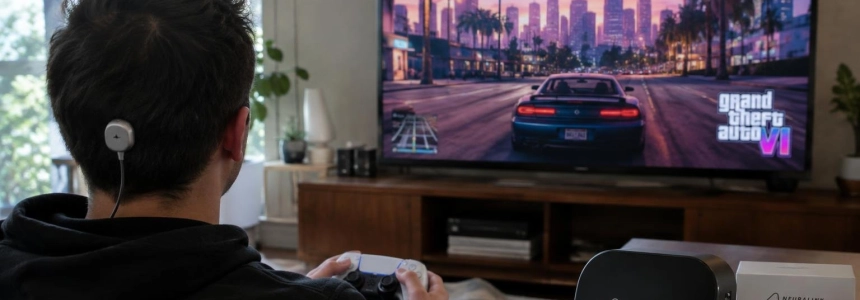
A participant in a Neuralink clinical trial plays GTA VI using brain signals: driving, piloting a plane and fighting while a PlayStation 5 controller reflects the commands they send. The company published the video on X on November 20, a day after the game's launch, and explained that its devices remain experimental and are not approved by the U.S. Food and Drug Administration (FDA) or other regulatory bodies.
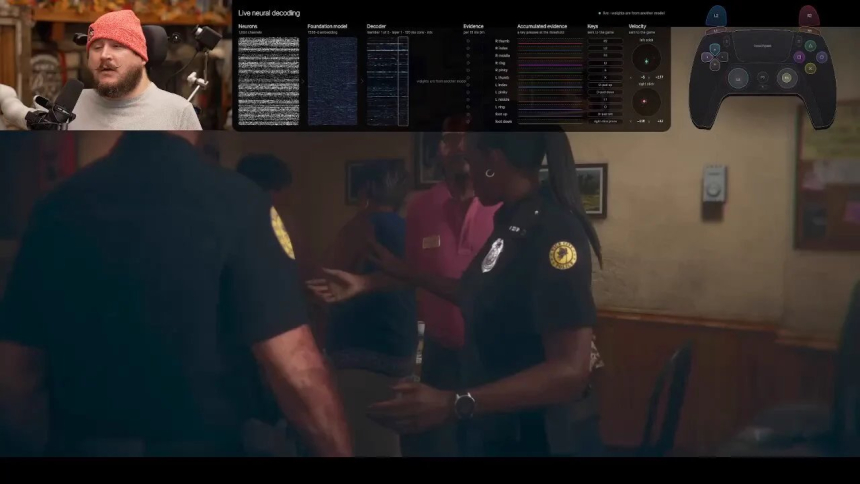
The two-minute recording combines footage of the player with a “live neural decoding” panel and an on-screen representation of the PS5 DualSense controller. The buttons light up when each input is activated. The participant is not identified by name.
The video shows the player performing several actions in GTA VI. To throw punches, they say they think about tapping their ring finger; to raise a plane's nose, they imagine sliding their right hand forward. They also drive and fly. The demonstration does not detail how all the actions are mapped or explain which movement corresponds to each button.
Imagined gestures turned into commands
“Right now I'm just like tapping my ring finger. Each ring finger. Bam. Look at that,” they comment while punching a character. The phrase describes the connection between a motor intention and a controller input: the player thinks about tapping their ring finger, and the system activates the configured action.
The participant also explains that the team added inputs from one foot to provide more buttons. They do not clarify whether the right or left foot is used, or which specific action it controls. To pilot, the command is to imagine sliding the hand forward, a movement they compare to a mouse gesture.
Tom's Hardware describes a mapping in which imagining ring-finger taps activates the square button on the PS5 controller, while sliding the right hand forward raises the plane's nose. According to InvenGlobal, the video shows the DualSense buttons lighting up when activated, but does not provide a complete mapping table linking each movement to each control.
TechRadar notes that the player appears to combine brain activity with some small physical movements, such as tapping a finger. The publication also describes control over actions such as fighting, driving, shooting and flying. The comparison with previously using simple taps on the iPad screen shows the broader range of actions the participant can perform in the game.
From a mouth stick to a PS5 controller
The player says that before the implant and surgery, they used a mouth stick and an iPad. They add that this method left their jaw sore. TechRadar summarizes that they could previously play games requiring simple taps on the screen; now, the system lets them control a broader range of actions in the game.
“You immediately get your portal to the world back,” the participant says in the video, referring to the ability to control a computer. The quote conveys the personal value they place on regaining this form of interaction. The player is not identified by name.
“Before the old chip and surgery, I was using a mouth stick and an iPad,”
— Unidentified Neuralink clinical trial participant
The video also includes the phrase “pretty wild” to describe the experience of controlling protagonist Jason in GTA VI, according to TechRadar.
The adapter connecting the implant to the console
Robert Dale Smith, whose X bio says he works on brain-computer interface applications at Neuralink, said he was working to enable device control, including on a PS5, with the goal of playing GTA VI from its launch. He credited some of the work to JoypadOS, his firmware for controller adapters.
According to InvenGlobal, JoypadOS handles USB and Bluetooth inputs and translates between controller protocols. This component makes it possible to link the output of the Neuralink system to a console controller.
Neuralink describes its brain-computer interface as a device that transforms neural signals into actions. On its website, the company explains, according to InvenGlobal, that trial participants use the implant to control computers and robotic arms. Among the people it mentions are participants with spinal cord injuries and amyotrophic lateral sclerosis (ALS).
A trial, not an approved product
Neuralink shared the clip on X with the text “Playing GTA VI with a Neuralink”. In a subsequent post, it warned that its devices are in the research phase and have not received authorization from the FDA or other regulators. It also said that the video captures the personal experiences of volunteers in clinical trials, which do not necessarily represent those of all participants or future outcomes.
The demonstration comes less than three years after Neuralink began its clinical trials, according to Tom's Hardware. The company emphasized that its devices are investigational and have not been approved by regulatory bodies; the access described is limited to volunteers in clinical trials.
Visible reactions on X were mixed. One user wrote that they were glad Elon Musk was funding technology to help people who need that kind of assistance, although they expressed disapproval of Musk as a person. Another replied that they would prefer the funding to go toward superintelligence. Neither comment adds information about the trial or how the implant works.
The player says Neuralink gave them back a way to interact with the digital world, and the session shows a use that goes beyond tapping a screen. But the device remains restricted to clinical research: it is not approved by the FDA or other regulators, according to the company itself.
Sources: Tom's Hardware, X (formerly Twitter), TechRadar, InvenGlobal