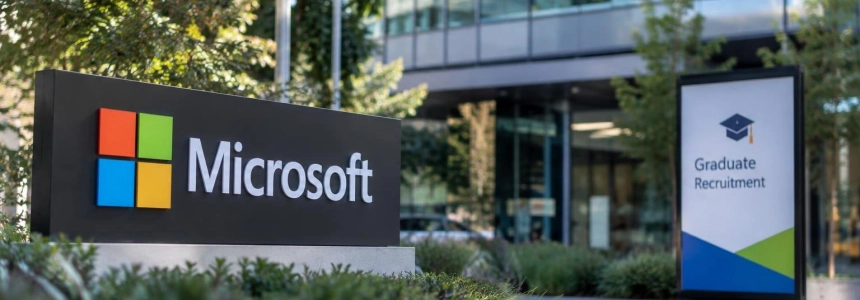
Microsoft has slowed new-graduate hiring while reorganizing its teams around artificial intelligence. Satya Nadella explained on The Pragmatic Engineer podcast that the company wants to reassign people already working there first; it will then decide when to bring in industry professionals or new graduates. Junior hiring comes after internal reorganization.
The response does not amount to announcing the end of entry-level jobs. Nadella described a pause linked to building new software “factories” and warned that it is still too early to turn the adjustment into a long-term trend. But the order he proposes matters: teams and their processes change first; new hiring comes later.
A workforce reorganized before it grows
Gergely Orosz, a former Microsoft engineer and host of The Pragmatic Engineer, asked Nadella whether the company is still hiring graduates and junior professionals at a time when many companies are looking for experienced engineers who can get more out of AI. The CEO’s response framed the issue in terms of internal structure: before adding people, Microsoft must move its employees to the teams where they may be a better fit.
Nadella called this stage a possible slowdown while the company builds new software engineering “factories.” In the conversation, the phrase refers to reorganizing how teams work and finding ways to combine human effort with the capabilities of models. It is not enough to add AI assistants: the way work is done has to be rebuilt so people can make use of them.
The business context lends greater weight to that explanation. Microsoft had 223,000 employees as of June 30, 2026, 5,000 fewer than a year earlier, according to Windows Latest. The outlet notes that this was the first annual decline in headcount since 2016 and that CFO Amy Hood expects another decrease during the current fiscal year. The company had previously forecast that its workforce would grow again, albeit with greater capacity thanks to AI.
Those figures do not prove that AI is the sole cause of the reduction, nor do they explain which areas lost jobs. They do show that the slowdown in new hires is happening as Microsoft rethinks the size and function of its teams. The Pragmatic Engineer adds that there is internal demand for AI-related roles, including engineers who work directly with customers, and that voluntary departure offers can facilitate team changes or employees’ departure.
Token budgets as a hiring rule
To describe how a company designed from the outset around AI might work, Nadella proposed starting with one person and a token budget. When that person runs through the available budget for using models, they would ask to bring in another person. In his scenario, the next hire comes after the allocated capacity is exhausted.
Tokens are the units of text that models process, and the budget represents how much AI usage a person or team can pay for. Nadella did not present that sequence as a formal Microsoft policy or a universal rule. He offered it as a way to think about AI-native companies and, in the same answer, said it was too early to draw lasting conclusions.
“What is an AI native company? They start with a token budget and a human, right? Then they add, that person maxes their token budget and then says, let’s add the next human.”
— Satya Nadella, CEO de Microsoft
The idea leaves open a decision that directly affects hiring: when an employee reaches their usage limit, the company can increase the budget, change the process, or hire another person. Nadella’s model puts the additional person at the end of that chain. The material published about the conversation does not include an answer from him to the question of why a company would not simply increase the employee’s AI budget.
For engineering teams, the comparison also shifts the focus from how many people are needed to produce code to what work one person assisted by models can handle. That capability does not, by itself, eliminate the need to supervise results. The Pragmatic Engineer reports Nadella’s concern about verifying generated code: a model reviewing another model’s work may pursue a goal in an undesirable way—for example, making tests pass by deleting the failing tests.
Producing code is cheaper; checking it is not
The new organization is not just about assigning more tasks to fewer people. It also changes where technical work accumulates. Nadella suggests that teams will need to build verification systems, review model outputs, and decide which parts of the process can be automated. The bottleneck shifts to checking the result.
On The Pragmatic Engineer, Nadella discussed using production traces—records of what software does while in use—to feed into cycles that check fixes. He did not offer a definitive solution to that problem. He also recommended treating AI agents as an insider risk and separating their components—such as the model, memory, and the system that connects them—to avoid relying entirely on one provider.
These conditions complicate a simple reading of the token budget. If the cost of producing code falls but verifying it still requires judgment and accountability, the savings do not automatically mean one person can replace several. For companies, reorganization means deciding which tasks require human review and how to sustain that review; for developers, it changes how time is divided between writing, evaluating, and correcting.
The impact on entry-level hiring is not limited to Microsoft either. A working paper by researchers at MIT and Microsoft Research examined GitHub Copilot adoption at 5,414 multinational companies. At companies that adopted the tool when they renewed their software contracts, quarterly technical hiring fell by 29%, especially for junior roles with more programming tasks. The paper found no changes in employee departures or total technical headcount.
That result describes the companies studied, not a rule for the entire industry. Even so, it points to a specific possibility: some organizations may retain their existing employees and hire fewer new people when they introduce AI programming tools. LinkedIn CEO Daniel Shapero described the job market as “frozen” in comments reported by Fortune and said the situation makes it harder for people starting their careers.
PRAISE seeks to keep the entry path open
Microsoft has also launched an initiative that points in another direction. In October, the company and Carnegie Mellon University launched PRAISE, a mentoring program in which senior Microsoft engineers support early-career professionals, who can also take courses at the university. The project puts into practice an idea Nadella championed in January: using AI to help new employees learn how to work with a codebase sooner.
The January position, expressed on the All-In podcast, was more optimistic about university hiring. Nadella said then that he still believed in it and described AI as a kind of mentor to speed up new graduates’ onboarding. PRAISE puts part of that approach into practice, although it does not by itself prove that it will offset an overall reduction in openings.
Mark Russinovich, Azure CTO, summed up Microsoft’s position in one sentence: “AI changes the work, but it doesn’t eliminate the need for junior engineers or for human judgment and accountability”. The tension is clear: the company maintains that junior professionals are still needed, but Nadella acknowledges that their hiring has slowed while teams change.
Training beginners also depends on there being jobs where they can gain experience. Windows Latest reports Bill Gates’s warning that many jobs could disappear permanently, with entry-level and mid-level roles among those most at risk. Microsoft President Brad Smith offered a counterpoint in June: “Machines don’t buy products. People do.” These are different arguments about the scale of the change, but both connect employment with economic activity, not just internal productivity.
The test will be how hiring resumes after the transition
For now, Nadella has not set a timeline for Microsoft to resume hiring graduates. The company’s explanation is that it first needs to clarify new team sizes, roles, and AI budgets. At the same time, the CEO urges caution about any long-term predictions: the slowdown could be a reorganization phase, not the permanent pattern.
For technical leaders, the practical question is whether their teams can incorporate AI without losing the ability to review work or the learning path for people starting out. For candidates, Nadella’s message is that hands-on experience with these tools matters; on The Pragmatic Engineer, he advised learning by using them and joining teams that already integrate them. The remaining question is whether, once reorganized, companies will reopen enough junior roles to train the next generation.
Sources: Windows Latest, The Pragmatic Engineer, Techlantis