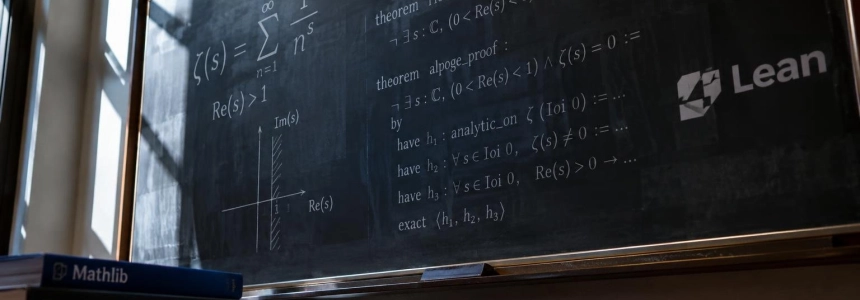
The Lean and Mathlib communities endorse the proof of the Riemann Hypothesis published by Levent Alpöge on November 20: its formal library has 17 million lines and has passed independent compilation and logical validity checks.
We have full confidence that Alpöge's proof of the Riemann Hypothesis is correct, and we congratulate him on this achievement.
— Lean and Mathlib communities
The joint statement, published on November 21 and endorsed by Lean FRO and Mathlib Initiative, goes beyond confirming that the file can be compiled: it certifies that the formalized statement corresponds to the hypothesis and that the proof passes various checks. Lean is the language in which Alpöge wrote the proof; Mathlib provides the mathematical library on which the code directly depends.
The endorsement addresses a specific question: whether the formal system has accepted a valid proof of the correct statement, rather than merely a program that compiles. To support their conclusion, the communities applied four criteria: checking the formulation, compiling the library, comparing the proved theorem with the expected statement, and reviewing the proof with formal verifiers.
What was checked in the 17 million lines
All 175,187 modules compiled without errors, using Lean 4.33.1 and Mathlib 4.33.1, according to a log by MIT mathematician Andrew Sutherland, updated on November 22 at 04:35 UTC. Dozens of people had reported successful compilations and reproduced the same proof export file.
The statement’s equivalence also passed separate checks. The community isolated the formulation of the hypothesis in a file that imports only Mathlib and compared that result with Alpöge’s theorem using Comparator and con-leche --compare. Both methods confirmed that it was the same statement defined by Mathlib.
The statement lists the official Lean kernel, con-leche, and con-ron as verifiers, along with independent tools contributed by third parties and written in different languages. Con-leche and con-ron have a formal proof—relative to set theory—that they cannot accept a false proof. The checks were performed on an inert export of the proof, separate from Lean’s source code.
Nanoda accepted the complete export in 27 minutes and 42 seconds, using 80 threads, according to Sutherland’s log. Con-leche accepted 1,468,418 declarations in verified mode, while con-ron confirmed that the proof’s five theorems were justified by the solution. Lean4lean checked the 175,187 compiled modules; five required raising the step limit after reaching the default limit.
The file was also rebuilt on a separate machine, in an isolated environment without a network connection and with the source tree in read-only mode. The export was identical to the published one: 61,570,595,788 bytes. The independent rebuild finished on November 21 at 18:07 UTC; the export comparison finished at 19:32 UTC.
Some stages of verification remain open
The status published by Sutherland distinguishes between accepted results and processes still underway. At 04:35 UTC on November 22, rerunning each module through the Lean kernel had finished, as had several independent checks; running the lake comparator and reproducing the export with the Lean kernel were still in progress.
The page also records that two tools packaged with Lean 4.36.0 declined to check the proof. They did not reject it: those older versions of con-leche and con-ron did not support a reflexive inductive type used in the argument. Versions compiled from the latest branches did accept it. Lean4lean, meanwhile, was not applicable in that package because it could not read a core library from version 4.33.
The audit of the five main theorems found that the only axioms were propext, Classical.choice, and Quot.sound. The log notes that no axioms were declared outside Lean’s core: there were 15 in the environment, all within Init. In the isolated rebuild, 175,186 of the 175,187 compiled files matched the manifest; one differed because its compilation is nondeterministic, although the final export matched byte for byte.
Lean verified five theorems, not just the usual formulation of the hypothesis. The first uses Mathlib’s definition of Riemann Hypothesis: all zeros of ζ other than the trivial zeros −2, −4, −6, and so on have real part 1/2. The case s = 1 is excluded because Mathlib assigns ζ a conventional value there, whereas ζ has a pole at that point.
The other results cover Dirichlet L-functions. One states that there are no zeros to the right of the critical line when the real part is greater than 1/2, except for the excluded case of the trivial character at s = 1. Another places zeros within the strip between 0 and 1 on the critical line; the fifth states the result for primitive characters, the usual form of the generalized Riemann Hypothesis for these functions.
The scope has an explicit limit: the verified generalization concerns Dirichlet L-functions, for all moduli and characters. It does not include Dedekind zeta functions, Hecke L-functions, or automorphic L-functions in general. Mathlib provides the mathematical definitions used in these statements.
Arithmetic consequences added to the verification
The verification work also connected the proof with Robin1984, an independent formalization of the Robin and Lagarias criteria. Combining the two projects in the same versions of Lean and Mathlib yielded two inequalities about the sum-of-divisors function, with no additional assumptions or mention of the zeta function in their statements.
For Robin’s inequality, the result applies to every natural number n greater than 5040: the sum of its divisors must be less than the product of n, the logarithm of the logarithm of n, and the exponential of the Euler–Mascheroni constant. Lagarias’s inequality applies to every positive n and compares that sum with the nth harmonic number plus the exponential of that number multiplied by its logarithm.
These consequences also received formal checks. Robin1984 compiled in 4,435 jobs; con-leche accepted 69,293 declarations from its formalization. In the combined project, con-leche accepted 1,472,825 declarations, con-ron confirmed the two theorems, and nanoda accepted the complete export in 33 minutes and 46 seconds, using 64 threads. Running the lake comparator on that combined export was still in progress.
Formal certainty does not yet explain the argument
Endorsement by the verifier is not the same as a readable mathematical explanation. The Lean and Mathlib communities say they hope that mathematicians’ subsequent work will help explain the proof’s new ideas. The files are difficult to interpret for anyone who is not a specialist, and Alpöge had committed to providing an explanation understandable to humans.
The announcement comes much earlier than the forecasts reported by The Decoder. Metaculus forecasters placed the expected date in May 2035; Terence Tao said the previous month that he expected the problem to be solved through a combination of humans and AI around 2050. The hypothesis, which predicts how prime numbers are distributed, was one of mathematics’ best-known open problems.
WWWhat's new credits Claude with helping in the discovery, but notes that the model used has not been specified. That publication also reports that Alpöge described the discovery as a journey in which he found pieces of the argument with Claude, and that he felt uncomfortable publishing the proof without a readable explanation. The formal code and technical checks now provide strong support for its correctness; human understanding of its ideas remains the next task.
To reproduce some of the checks, Sutherland notes that the export requires approximately 100 GB of RAM and 70 GB of disk space with Lean 4.36.0; con-leche compiled from source requires around 50 GB of RAM and took less than four minutes on 64 threads. These figures describe the resources needed for the checks, not a requirement for understanding the proof.
Sources: The Decoder, WWWhat's new, Lean community blog, Andrew Sutherland, MIT