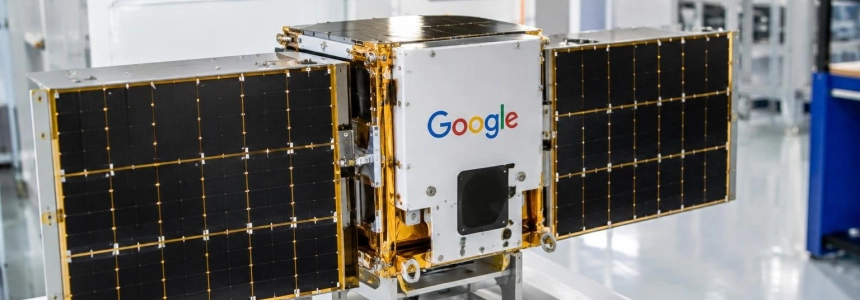
Google will partner with Blue Origin to launch two satellites for its artificial intelligence data center project in space. The flight, scheduled for the first quarter of 2029, will use a New Glenn rocket and place the spacecraft in sun-synchronous orbit. Each satellite will have capacity comparable to that of a data center rack.
The agreement is part of Project Suncatcher, Google's effort to expand its computing infrastructure for artificial intelligence beyond Earth. The company envisions a network of satellites equipped with its tensor processing units, or TPUs, to run machine learning workloads in space and take advantage of constant access to sunlight.
The decision also marks a change from the project's first flight. The M1 prototype reached orbit on October 1 aboard a SpaceX Falcon 9; for the mission involving the two satellites, Google will turn to Blue Origin and its heavy-lift New Glenn launch vehicle.
From the first prototype to a pair of satellites
Google presented the project as long-term research, not as infrastructure already deployed. Its prototype, built by Planet Labs, flew on SpaceX's Transporter-18 mission. The satellite was released into low Earth orbit about an hour after liftoff, according to the mission timeline cited by Punto Informático.
The vehicle carries four TPUs and generates up to 1 kW, according to TechCrunch. However, it can activate only one TPU at a time, and power consumption limits its operation to about 20 minutes per session.
After several weeks of commissioning, the team completed system checks and powered on the host computer and TPU trays. On October 30, Google announced that it had received the first response generated by a data center-class TPU in orbit: it asked the open Gemma 4 model to write a haiku about space.
Blue marble below
Data streams in silent grace
Starlight feeds my core. ✨— Gemma 4, response from the Project Suncatcher prototype satellite
The team also tested space-themed limericks and prompts for querying the satellite's telemetry and technical status. Google described that first response as a “Hello World” milestone for the project. TechCrunch added that the spacecraft was operating normally, according to a company spokesperson.
Radiation testing before scaling up
The next phase will study how TPUs behave under heat and radiation in orbit. Google wants to verify that the chips can reliably run workloads in the space environment.
TechCrunch explains that radiation can cause memory bit flips and corrupt data without necessarily triggering the usual monitoring mechanisms. Google's ground tests indicated a limited impact on inference tasks and greater difficulty with model training, but the prototype will make it possible to observe these effects under real-world conditions.
In its announcement, Google said the upcoming tests will continue with thermal stress assessments and radiation exposure. The results will help determine whether TPUs can sustain workloads in space and advance to the next stage of Suncatcher: satellites connected to one another.
The company expects two interconnected satellites to process models using their respective TPUs and exchange data through optical laser links. This connection would allow work to be distributed among spacecraft, rather than treating each satellite as an isolated unit. TechCrunch noted that Google wants to demonstrate optical links between satellites in the two-unit phase.
The 2029 date depends on New Glenn
Google and Blue Origin announced that a New Glenn will fly in the first quarter of 2029. Blue Origin, the aerospace company founded by Jeff Bezos, will transport the spacecraft to sun-synchronous orbit. Passing over each point on Earth's surface at the same local solar time, this orbit aligns with Google's plan to maintain constant access to sunlight.
The date is still subject to an operational hurdle. Punto Informático reported that Blue Origin still had to repair a launch pad damaged by a rocket explosion, so the schedule was not guaranteed. It also noted that the company must supply rockets for Artemis missions.
According to Europa Press, Google and Blue Origin's announcements present the collaboration as Suncatcher's first heavy-payload launch. This does not change the prototype's flight: that first satellite was already placed in orbit by SpaceX in October. The mission announced with Blue Origin is the subsequent stage, involving two satellites.
The project remains experimental
The timeline mentions an interim goal to test two connected satellites in 2027, while the New Glenn launch is scheduled for 2029. For now, the program is moving from the M1 prototype toward validating chips and links between spacecraft.
Suncatcher's design stands out for its aim to distribute work among satellites using high-speed connections. TechCrunch contrasts this approach with proposals from other companies that expect to run inference on individual satellites; it also mentions SpaceX, whose space data centers would include laser links, although its satellites would orbit too far apart to share processing effectively.
The program's economic viability remains an open question. TechCrunch described Suncatcher as a long-term bet, aimed at making the infrastructure economical in the 2030s. It also cited a peer-reviewed analysis published that month by Suncatcher researchers, which estimated that SpaceX would have to conduct 1,800 Starship flights to achieve cost reductions similar to those achieved with its earlier vehicles.
For Google, the next concrete result will come from testing the prototype and preparing for the Blue Origin mission. The 2029 launch remains the goal, but the repair of Blue Origin's launch pad still affects whether the schedule can be met.
Sources: Punto Informatico, europapress.es, Google, TechCrunch